Mirror Wall
Judging the Judiciary
By Kassapa
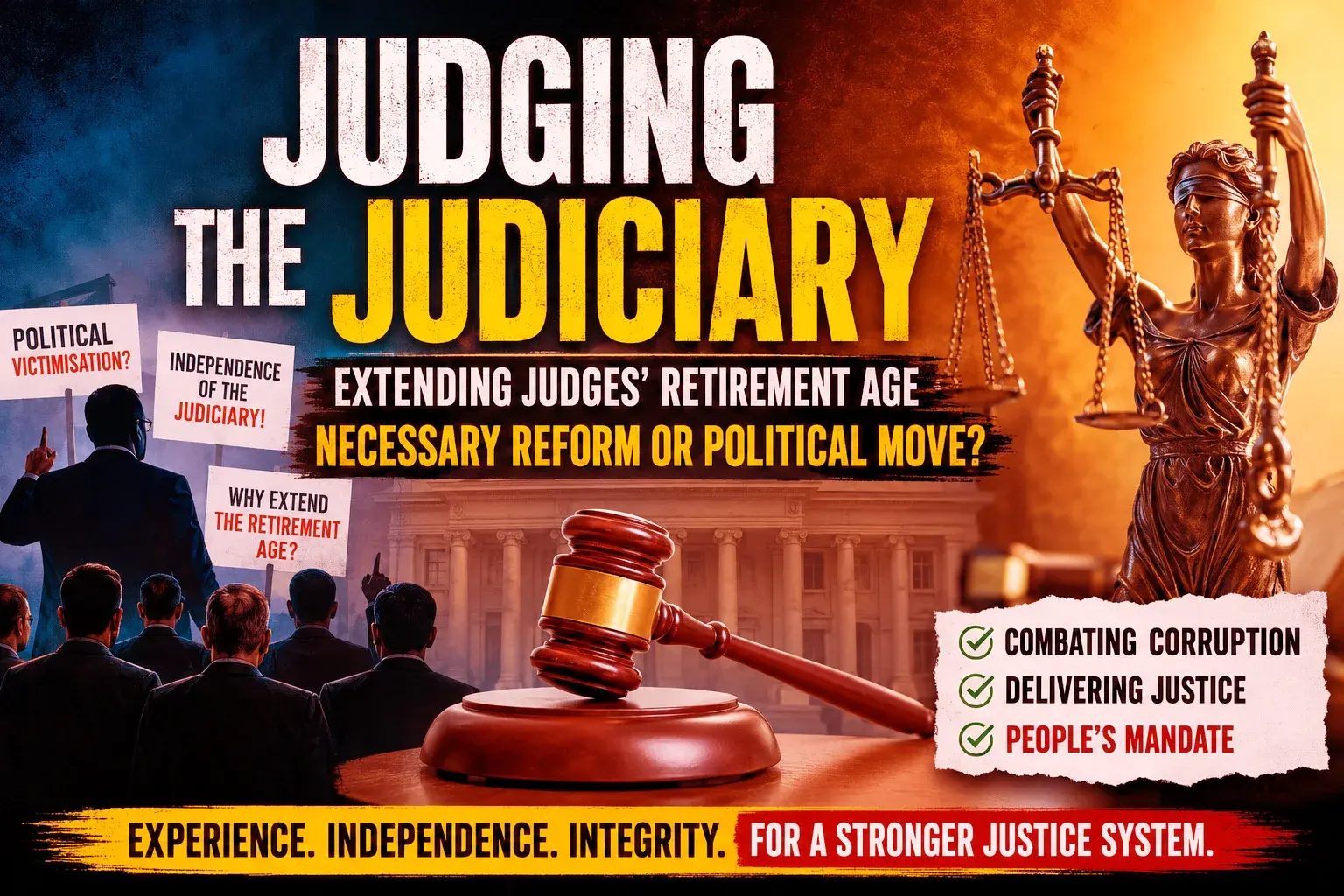
The latest kerfuffle the government finds itself in, is the allegation that it wants to extend the retirement age of judges of the superior courts. The opposition claims this is being contemplated to keep “certain” judges in office for longer, so the government can carry on its campaign of “political victimisation”. The government insists this is not the case, it is merely keeping its promise to eliminate corruption and abuse of power for which it has secured a mandate from the people.
Extending the retirement age for judges of the higher courts, purely on principle, is perhaps long overdue. Many countries have done so and have the retirement age at 70 years or higher. Judges of great experience are much in need in Sri Lanka and they cannot be produced overnight.
Facts get blurred in this discussion, for example, when organisations such as the Bar Association of Sri Lanka, hitherto with a reputation of championing democracy, oppose the move. Worse still, the Judicial Services Association issues a statement claiming it has ‘unanimously’ decided to oppose the move when the number of judges who attended the meeting which passed a resolution to that effect was less than a third of its membership.
To begin with, there is no formal proposal from the government as yet. However, there are whispers in the corridors of power that extending the retirement age should be done. Why then, should the opposition be alarmed?
It is no secret that the wheels of justice have been steadily gathering speed under the present Judicial Services Commission (JSC) headed, ex-officio, by the incumbent Chief Justice. Many reforms have been initiated. Many cases that have been hibernating are being expedited and indeed some culprits (such as Mahindananda Aluthgamage, Nalin Fernando and S.M. Ranjith) are already behind bars. Naturally, others are worried. They want to stem the tide before they themselves become victims. Hence the protests.
It is also strange, if not amusing, when the likes of Namal Rajapaksa is championing the cause of the judiciary. Even those with short memories would recall how the Rajapaksas, in their heyday, impeached then Chief Justice Shirani Bandaranayake.
To begin with, Bandaranayke was not a ‘typical’ appointment to the Supreme Court, where the coveted seats are usually reserved for judges graduating from the Court of Appeal or promoted from the position of Attorney General. She was handpicked from academia by G. L. Peiris. However, when the lady stood her ground and refused a verdict in favour of Basil Rajapaksa, the Rajapaksas broke every convention and impeached her in what is still the darkest day in our judiciary. With such history behind them, many will take the opposition’s laments with a pinch of salt.
On the contrary, on the government side, there is a feeling that although it has won government, it is yet to gain full control of the state, especially in relation to matters in the Attorney General’s Department. Two recent examples can be cited as ready evidence.
In the case where former President Ranil Wickremesinghe is accused of misappropriating funds for a private visit to Britain, Additional Solicitor General Dileepa Peiris assured at a previous hearing that indictments would be filed shortly. In the most recent hearing though, court was informed that this was still awaiting the opinion of the Attorney General.
Similarly, in the case where the former chief prelate of Anuradhapura is charged with sexual assault of a minor, the Attorney General did not think it fit to make representations in court, when bail was sought for the prelate. It is not that the government should be able to directly intervene in such instances; however, it appears that the powers that controlled state agencies during previous regimes still have a significant say and clout in the decision-making processes.
That said, the government has also not got its act together, which is more the rule rather than the exception for this government. It promised an Independent Prosecutor’s Office in the National Peoples’ Power (NPP) manifesto. If it delivered on this promise, it wouldn’t have to rely on the whims and fancies of the Attorney General’s Department for prosecutions.
Similarly, the NPP also promised an overhaul of the 1978 Constitution. We have heard nothing about that for the past one and a half years. Surely, if that was a priority, there would have been some public discussion about it by now? If the Constitution was being replaced, the government could have easily incorporated all the changes it wanted to make to the judiciary and its retirement ages into the new Constitution.
Even regarding the proposed revision of retirement ages of judges of the Supreme Court and the Court of Appeal, we have seen nothing formally yet. Cabinet spokesman Nalinda Jayatissa gave his usually vague answer when asked about it saying, “all aspects are being studied’.
Despite this, is the opposition fighting a losing battle? That is probably the case. The retirement age of superior court judges maybe an issue of the highest priority for the opposition for obvious reasons but it is not so for the majority of the general public. In fact, the opposite is true. Whatever this government’s lapses- and there are many- the one issue on which they have scored vis-à-vis the average voter is its commitment to bring criminals and the corrupt to book. When a group of politicians, half of whom have charges pending in court, begin agitating for the ‘independence of the judiciary’ the opposition don’t become heroes, they become the laughingstock.
The government also has another ace up its sleeve and reports suggest that they are willing to play that card. Thus far, the protests have come from the lower rungs of the judiciary who fear that their promotional prospects would be scuttled by the extension of the retirement age for just the superior courts. This can easily be countered with a simple move, by raising the retirement age for all judges, regardless of where they sit on the judicial pecking order.
The government would do well to go public with what it proposes to do so with the judiciary’s retirement ages before this discussion gets too ugly and personal- and the opposition would do even better, thinking more carefully about who they offend with the derogatory statements they are making now.
Share this story