Current Affairs
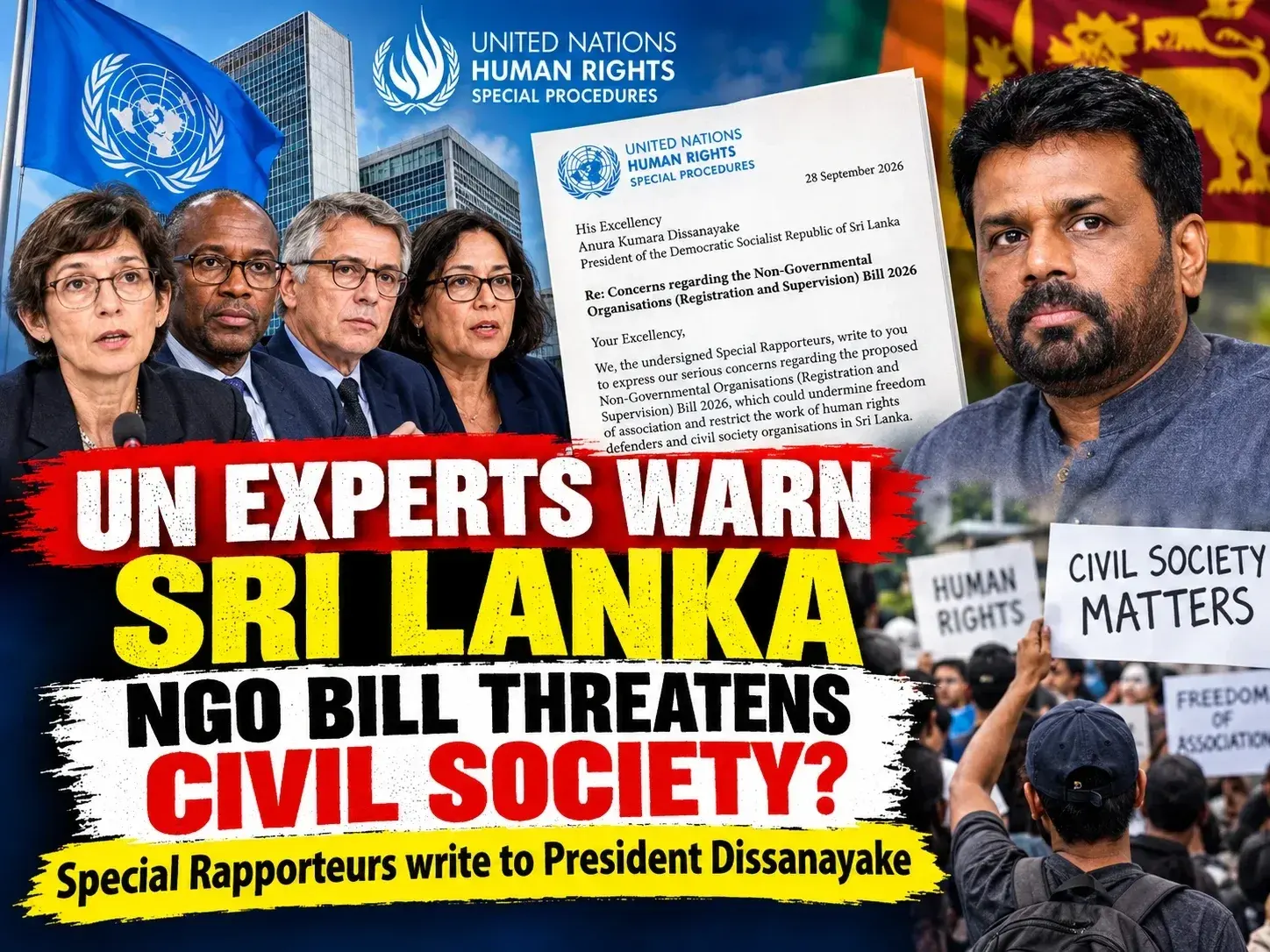
UNHRC Special Rapporteurs write to Sri Lankan President their concerns about the NGOs’ bill
Share this story
By P K Balachandran
Geneva, October 2(UNHRC) - Four Special Rapporteurs of the UN Huan Rights Council (UNHRC) have written to the Sri Lankan President Anura Kumara Dissanayake on their concerns about Sri Lanka’s NGOs’ bill.( Ref.: OL LKA 5/2026).
The Special Rapporteurs are: Ben Saul, Special Rapporteur on the promotion and protection of human rights and fundamental freedoms while countering terrorism; Leopoldo Maldonado Gutiérrez, Special Rapporteur on the promotion and protection of the right to freedom of opinion and expression; Gina Romero, Special Rapporteur on the rights to freedom of peaceful assembly and of association; and Andrea Bolaños Vargas, Special Rapporteur on the situation of human rights defenders.
The letter dated 28 September 2026, is here reproduced in full:
We have the honour to address you in our capacities as Special Rapporteur on the promotion and protection of human rights and fundamental freedoms while countering terrorism; Special Rapporteur on the promotion and protection of the right to freedom of opinion and expression; Special Rapporteur on the rights to freedom of peaceful assembly and of association and Special Rapporteur on the situation of human rights defenders, pursuant to Human Rights Council resolutions 58/14, 61/14, 59/4 and 61/22.
In this connection, we would like to bring to the attention of your Excellency’s Government information we have received concerning the Non-governmental Organizations (Registration and Supervision) Bill 2026 (the “Bill”). We are concerned that some of its provisions are not consistent with the right to freedom of association under international human rights law, as well as international standards concerning terrorist financing.
The Bill
The Bill was first published in 2024, reportedly with no consultation with civil society or the Human Rights Commission of Sri Lanka. The Bill has undergone successive drafts, with the latest version in June 2026 and including new provisions on the monitoring of non-governmental organizations (NGOs) for compliance with counter-terrorism financing and anti-money laundering standards.
The Bill is reportedly part of Sri Lanka’s efforts to ensure compliance with international counter-terrorist financing standards, in advance of the country’s mutual evaluation by the Asia/Pacific Group on Money Laundering (a Financial Action Task Force (FATF)-Style Regional Body) planned for October 2026.
It is intended to replace the Voluntary Social Services Organisations Act 1980. The current Bill is undergoing restricted stakeholder consultations in Sri Lanka.
The Preamble of the Bill states that its objective is to efficiently regulate activities of all Voluntary Social Service organizations including NGOs.
Section 2(1) includes a comprehensive list of actors subjected to the Bill’s provisions, subject to certain exclusions under section 2(3).
Under the Bill, all NGOs will be required to register with the Competent Authority (section 8) and it would constitute an offence to fail to register (section 19), prohibiting the existence of unregistered groups. Directors and office bearers of a body corporate also bear criminal liability (section 20).
A registration certificate would be valid for three years (section 10) and accordingly would need to be renewed for an NGO to continue.
No time period is specified for a registration or renewal decision, but NGOs may not commence activities until registration is granted.
The Bill additionally allows the Competent Authority to require registration of a voluntary social service activity or project where it is non-religious in nature or outside the body’s constitutional objects.
Once registered, obligations under section 15(2)(a)-(m) apply (see below), thus bringing otherwise exempt bodies within the regulatory regime and exposing civic, charitable, or advocacy activity to control even where the parent body itself remains exempt.
The Bill imposes numerous obligations on NGOs, including to “align with the policies of the government”; “not engage in any activity that adversely affect sovereignty or territorial integrity of Sri Lanka or violates the provisions of the Constitution”; “not induce or cause to induce any public disorder which affect safety and interests of the general public”; not to “engage in any advocacy to support political ideologies using funds and resources of the non-governmental organization during a period of pre-election or, unless it is an object of such non-governmental organization”; to “utilize fund of the non-governmental organization only for the purposes it was registered”; and to “notify the Competent Authority prior to initiation of any crowdfunding activity” (section 15).
There are also obligations to act in conformity with instructions from the Central Bank of Sri Lanka (section 15(2)(h)) and to disclose certain funds and account details (
RELATED NEWS
View all
Current Affairs
Denial of the right to vote is not new in India
Oct 01, 2026
Current Affairs
The 1948 UNSC resolution on Kashmir was in India’s favour
Sep 25, 2026

Current Affairs
Sri Lankan Presidential pardons- the good and the bad
Sep 11, 2026
Current Affairs
The pros and cons of joining BRICS- the dilemma of Pakistan and Bangladesh
Sep 09, 2026