WEELKY POLITICAL WATCH, Columns
Arrests eclipse battle over 22nd Amendment
Mahinda expected to lead SLPP’s Anuradhapura rally
by Counterpoint Political Desk
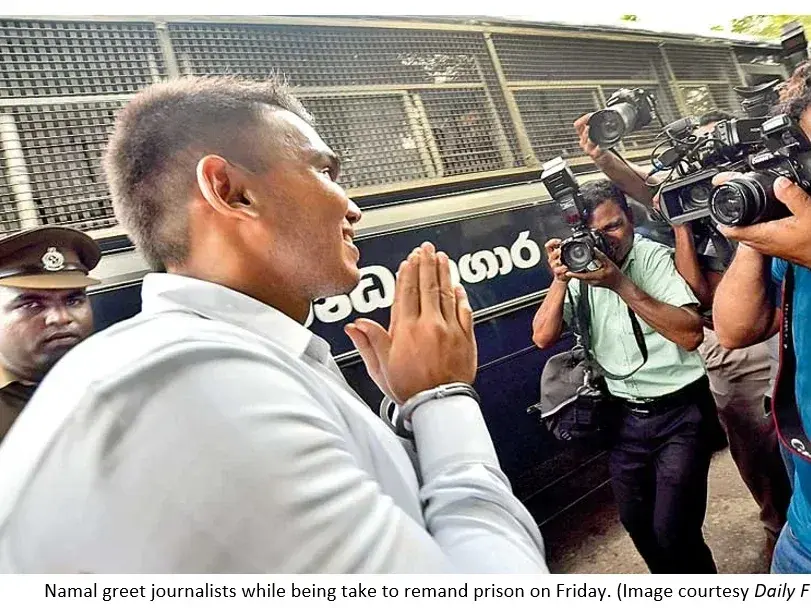
SLPP National Organizer and MP Namal Rajapaksa has been remanded until 18 Sept., over an alleged bribe of Rs. 100 million linked to the purchase of an aircraft while in power. The Commission to Investigate Allegations of Bribery or Corruption (CIABOC) arrested him on Friday after recording a statement from him. Rajapaksa told the media a few days ago that the government would have him arrested before the SLPP’s Anuradhaprua rally scheduled for 12 September.
The CIABOC also arrested former Minister Johnston Fernando in connection with an investigation into a questionable procurement while he was the Minister in the Rajapaksa government. Produced before the Colombo Chief Magistrate’s Court, he was granted bail.
President Mahinda Rajapaksa is expected to lead the SLPP rally scheduled to be held in Anuradhapura on 12 Sept. The SLPP will try to gain political mileage from Namal’s arrest by portraying him as a victim. It would have the public believe that the government has engineered Namal’s arrest. It has complained that it was not allowed to a book a spacious venue in Anuradhapuara.
The SLPP’s Anuradhapura rally is intended both to mobilise public opinion against the government’s proposed 22nd Amendment and to draw attention to the economic hardships faced by the people, including farmers in the Rajarata region.
SLPP General Secretary Sagara Kariyawasam said his party had faced considerable difficulty in securing a venue for the rally. When the party applied to hire the Salgadu Grounds for the event, paying the required fee, the authorities rejected the request, saying that the grounds would not be made available for any event, Kariyawasama claimed. Following repeated requests from the SLPP, the Anuradhapura Municipal Council grounds had been eventually made available.
Controversy over 22nd Amendment
Friday’s arrests eclipsed the controversy surrounding the proposed 22nd Amendment. The Supreme Court, which concluded hearing petitions challenging the constitutional amendment bill, on Friday (04), is expected to convey its determination to Speaker Dr. Jagath Wickramaratne soon.
As many as 67 petitions were lodged with the Supreme Court, challenging the 22nd Amendment. The Bar Association of Sri Lanka (BASL) and several other legal organisations, the Mahanayake Theras, the Church of Ceylon, as well as several international organisations including the United Nations, the Commonwealth Lawyers Association and the International Association of Judges have urged the government not to proceed with the 22nd amendment, which they insist will undermine judicial independence and erode public confidence in the judiciary. But the government is determined to have it passed. President Anura Kumara Dissanayake has declared that he will not take a step backwards and that he is prepared to take any risk to pursue the course he has embarked upon.
From the outset, a majority of the petitioners requested that the petitions be heard by a Full Bench of the Supreme Court. Chief Justice Preethi Padman Surasena, however, appointed a five-judge bench instead. Lawyers pointed out that the bench did not include the most senior judges of the Supreme Court.
Lawyers arguing that the preliminary objections should be rejected maintained that, under the Constitution, the Chief Justice had full authority to appoint a bench and that his decision should therefore be accepted by everyone. The petitions were consequently heard by the five-judge bench.
International concern over the court
On the second day of the hearing, a distinguished visitor arrived to observe the proceedings. He was Stephen Thiru, President of the Commonwealth Lawyers Association. Representing the legal profession across the Commonwealth. He is an internationally recognised legal expert.
After observing the proceedings, Thiru expressed his views at a media briefing. He said the judges had conducted the proceedings well throughout the day and had given all parties a fair opportunity to present their cases. However, he said he was deeply concerned that lawyers who sought an opportunity to reply at the end had not been given that opportunity. In any jurisdiction, he said, it was normal for lawyers to be allowed to make oral submissions, particularly in an important constitutional case. Here, however, the lawyers had been directed to make their submissions in writing, he said.
Thiru also noted that many people had believed that a Full Bench should have been appointed to hear the petitions. He said he had learned that the request had been rejected and that the senior-most judges of the Supreme Court had not been included in the bench. He also referred to concerns among members of the legal profession about whether the Chief Justice should have presided. Perhaps, other judges should have been allowed to hear the petitions so that there would be no doubts about transparency and fairness, he suggested. That would give the public a sense that the petitions were heard with complete impartiality.
Thiru said he was not commenting on the case or the arguments advanced by either side. His concern, he said, was the broader principle of judicial independence. “Judicial independence is an extremely important and precious principle,” he said. “It must therefore be protected at any cost.”
Protecting judicial independence
Both sides must recognise the importance of protecting judicial independence, Thiru said, noting that leaving aside all the legal arguments surrounding the case, any doubts that a step has been taken which could undermine judicial independence must be eliminated.
If such doubts persist, he said, lawyers had a responsibility to ensure that judicial independence was protected at all times. That may sometimes require action even where the law did not specifically demand it, simply to ensure that the independence of the judiciary remained beyond question, he said. His experience of Commonwealth countries, he said, had taught him an important lesson: many Commonwealth countries have powerful judicial systems. Yet if their independence is in any way further compromised, it is worth paying any price to protect it because at the end of the day, if the citadel of the judiciary is not protected, citizens have nowhere else to turn for protection.
Chief Justice Sansoni on an impartial judiciary
At this point, an observation made decades ago by one of Sri Lanka’s most distinguished Chief Justices, M. C. Sansoni, is worth recalling.
His words on a fair trial possess a timeless relevance: “Giving the parties to a case adequate opportunity to present their case and having the case heard before an impartial bench are essential elements of a fair system of justice. They cannot be curtailed at any time.”
The striking similarity between Chief Justice Sansoni’s observation and the concerns expressed by Commonwealth Lawyers Association President Stephen Thiru is difficult to miss.
Whispered discussions in Pelawatte
Amidst the legal battle, members of the government’s inner circle gathered at the Pelawatte office to discuss the President’s proposed programme of meetings with people across the country.
The campaign, reportedly titled, “Two Years, Good for the Country,” is to be launched to mark the government’s completion of two years in office. But the real reason for the exercise, it is said, is the Opposition’s growing presence at grassroots level.
The strengthening of the SJB’s and, particularly, the SLPP’s party machinery in villages has become a headache for the government, according to those familiar with the discussions in Pelawatte.
The government has also taken note of the defeats suffered by its candidates in cooperative elections, despite not publicly responding to them. The party has therefore decided that the President himself should meet the people and explain the government’s position.
A gift for Nalinda
There is also a specific political reason for deciding to launch a special government programme in the Kalutara District. It is intended to provide an opportunity for the emergence of a second tier of leadership within the NPP government.
One of the main objectives of the Kalutara rally is reportedly to assign greater responsibility to Nalinda Jayatissa, the Government’s Media Spokesman and Minister of Health and Mass Media.
There are also reports that the government leaders are planning to change his ministerial portfolio and entrust him with a subject carrying greater responsibility.
If the NPP government is preparing for its next political leap, senior leaders appear to have concluded that younger leaders capable of carrying that responsibility must be brought to the forefront. Nalinda is expected to receive an opportunity under this plan.
SJB takes the fight to Fort
The main Opposition, led by the Samagi Jana Balawegaya, on Thursday staged a well-attended public protest near the Colombo Fort railway station against the government’s proposed 22nd Amendment.
SJB leader Sajith Premadasa, General Secretary Ranjith Madduma Bandara and several other senior party figures participated in the protest.
Premadasa said the SJB was prepared to wage a continuous struggle against the government’s attempt to curtail the democratic rights of the people through the proposed amendment and that the effort would ultimately be defeated by popular power.
Dr. Harsha de Silva made an interesting reference. He recalled that when an impeachment motion was brought against then Chief Dr. Justice Shirani Bandaranayake in 2013, JVP leader Anura Kumara Dissanayake had jointed forces with the SJV in a common struggle at the same Fort railway station.
Today, he said, his party had once again been compelled to fight at the same location against similar actions by the government led by Dissanayake. He described this as an unfortunate situation.
The Bar Association stands firm
When the Supreme Court concluded the hearing of the petitions concerning the 22nd Amendment and announced that its determination would be communicated to the President and the Speaker, the petitioners were directed to make their final submissions in writing.
The BASL and several other parties, however, decided not to submit written submissions. The BASL subsequently informed the Supreme Court of its position through a motion. Its decision was reportedly prompted by the denial of an opportunity to make oral submissions in open court at the conclusion of the hearing and the rejection of the request for the petitions to be heard by a Full Bench. Recent reporting confirms that the BASL has maintained this position.
The people of Sri Lanka still place considerable faith in the country’s judiciary. It is therefore the responsibility of everyone concerned to act in a manner that protects that confidence.
Share this story