By Vishvanath
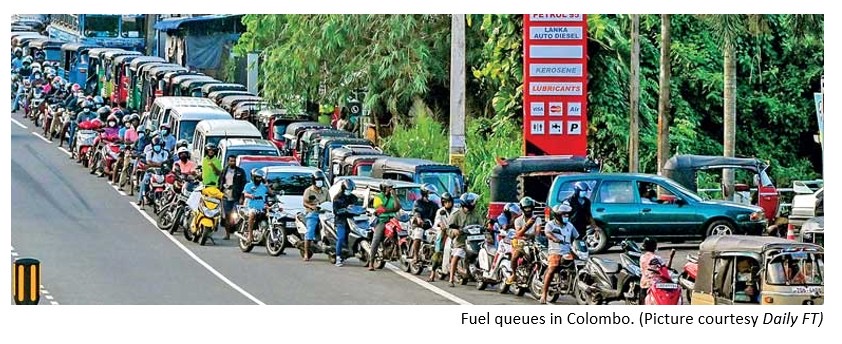
The JVP-led NPP government finds itself in an unenviable position, struggling as it does to overcome a crippling energy shortage, with an economic crisis on the horizon. Not even the introduction of the QR-based fuel quota system has helped it get rid of long queues of vehicles near filling stations the way it expected and it had to be coupled with the so-called odd-even rationing. This is not a situation anyone may have bargained for a few weeks ago. In fact, no country could predict a global energy crisis. It is well-nigh impossible to read US President Donald Trump’s mind. The US-Israeli airstrikes on Iran and equally devastating retaliatory attacks have rendered the entire Middle East region vulnerable and taken a heavy toll on oil exports from the region. The closure of the Hormuz Strait for international navigation has worsened the situation, with the world being deprived of about 20% of its oil supply among other things. Iran has so far attacked about 18 ships sailing through that choke point despite its warnings and orders.
Politics is like Snakes and Ladders; it is full of pitfalls, unpredictable twists and turns and ups and downs. Hence, there is no guarantee of the stability of any government however big its parliamentary majority may be. Existential problems could come from unexpected quarters, unsettling even seemingly monolithic governments, as we have seen in this country. Who would ever have thought a pandemic would leave the SLPP government with a two-thirds majority in Parliament struggling on the economic front, and the economy would go into a tailspin, making President Gotabaya Rajapaksa, a former military officer, flee the country and resign?
It never rains but it pours, as they say. The JVP-led NPP government now has a worsening energy issue to contend with while carrying out the formidable task of post-disaster rebuilding and resettlement. It will also have to face paralyzingblows to the economy from the Middle East crisis. It is facing a double whammy. The current fuel shortages are beyond the government’s control, but people become impervious to reason when they struggle to meet their basic needs. People languishing in long queues near filling stations need fuel are blind to global realities. They expect the government to ensure an uninterrupted fuel supply and prevent price escalations somehow or other. That is the way the cookie crumbles. After all, the JVP leaders flayed President Gotabaya Rajapaksa and his government for shortages of some essentials, especially fuel, during the Covid-19 pandemic, which necessitated lockdowns and international travel restrictions disrupting global production and supply networks.
One may recall that the world faced a global grain shortage in the early 1970s. The crisis unfolded between roughly 1972 and 1974, when a combination of poor harvests, rising demand and policy missteps led to a sharp tightening of global grain supplies. For the first time since the Second World War, global food production actually declined in absolute terms, triggering widespread concern about famine and food security. The grain shortages adversely impacted many countries around the world, making them adopt stringent measures to ward off mass starvation and riots. In Sri Lanka, the then SLFP-led United Front government resorted to austerity measures, and strove for food self-sufficiency. It introduced severe controls and regulations to achieve that goal. The UF government, which had some prominent socialists in its ranks, in a bipolar world, took those measures to an extreme even after the global situation improved somewhat. Its political opponents made the most of the people’s hardships to turn public opinion against that administration, which suffered a disastrous defeat in the 1977 general election. There were of course other factors that led to its downfall, but food shortages and long queues were prominent among them.
The rationing of essentials, however justifiable it may be under certain circumstances, such as global crises, has adverse political consequences for governments in power the world over, albeit to varying degrees. The Sri Lankan governments that play a provider role, granting subsidies, etc., find themselves in far worse situation. In the early 1950s, the Asian region experienced grain shortages although there was no global food crisis as such at the time. That situation and worsening economic conditions after the Korean War boom compelled the then UNP government to resort to drastic measures such as reducing the rice subsidy, causing the price of rice to nearly triple and triggering widespread anger, which found expression in a mass uprising, or hartal, which was led by the LSPP and its allies. Protests resulted in bloodshed and the resignation of Prime Minister Dudley Senanayake in 1953.
Ironically, now a JVP-led government is facing the political consequences of fuel shortages caused by a global crisis. One of the main reasons for the 2022 mass uprising was a chronic fuel shortage, which resulted in long queues near filling stations and cooking gas sales outlets. While waiting on the roadside for days on end, irate people began protesting and their agitations snowballed into what came to be known as Aragalaya. The JVP capitalized the situation to turn public opinion against all the main parties that had been in power, calling the post-Independence history a 76-year curse. Now, the JVP-ledgovernment is unable to do what it asked the previous administrations to do during crises. It is not good for any government’s political health to have people waiting near filling stations, for tempers can flare any time.
About 69 million people, who voted the incumbent government into office, in 2024, expected a grand political reset to prevent the former rulers, their cronies and their parties from making a comeback for a long time so that the country would be able to recover from the ill-effects of their reigns and usher in a new political culture. The people had similar expectations in 2015, only to be disillusioned and voted for the SLPP consisting of the same previous leader into office four years later. They pinned their hopes on the leaders who pretended to have mended their ways, but the public was in disillusionment again. Now, the JVP-led government is facing allegations of corruption and abuse of power. A vote of no confidence against Energy Minister Kumara Jayakody was handed over to the Speaker of Parliament yesterday over irregularities in coal procurement. The manner in which the government is handling the fuel crisis is obviously not to the liking of the people. Has the grand political reset the people hoped for has become another distant dream?