What does debris field mean?
Put simply, the debris field is where parts of any vessel that had somehow been destroyed. In this case, the debris fields were where teams found pieces of the Titan on the ocean floor. There were five major different pieces of debris that led officials to realize those parts were from Titan, according to expert Paul Hanken. "The initial thing we found was the nose cone, which was outside the pressure hull. We then found a large debris field, within that large debris field we found the front end bell of the pressure hull. That was the first indication that there was a catastrophic event," he said. A second, smaller debris field was also found, which included the other end of the pressure hull, “which basically comprised the totality of that pressure vessel,” Hanken said. The Coast Guard will continue searching the sea floor near the Titanic shipwreck for more clues about what happened to the Titan submersible deep in the North Atlantic waters. Officials say there isn’t a timeframe for when they will call off the massive international search. Efforts to recover the submersible and the remains of the five men who died in a catastrophic implosion aboard the vessel remain ongoing. Much of the search is being done by remotely operated underwater vehicles known as ROVs that can scan the sea floor. “This is an incredibly unforgiving environment down there on the seafloor,” Rear Adm. Mauger said. Former OceanGate passenger speaks on missing Titanic submersible search
Rescuers on Wednesday rushed more ships and vessels to the area where a submersible disappeared on its way to the Titanic wreckage site, hoping underwater sounds they detected for a second straight day might help narrow their search in an increasingly urgent mission.
Where was the debris field?
“This morning, an ROV from the vessel Horizon Arctic discovered the tailbone of the Titan submersible approximately 1,600 feet from the bow of the Titanic on the sea floor," Mauger said Thursday afternoon. Afterward, the ROV found additional debris and it was found to be consistent with the "the catastrophic loss of the pressure chamber," he said. The families of the five crew members on board were notified afterward. While the Coast Guard said the debris field was discovered near the Titanic but it’s too early to tell exactly when the catastrophic implosion occurred. The Titan submersible was reported missing Sunday – eight hours after it initially lost contact with its surface ship – and its 96-hour oxygen supply would have run out Thursday morning. It’s not clear whether the implosion occurred Sunday or in the days following, during an international search effort to find the missing submersible. The implosion likely occurred near the shipwreck, where the submersible was headed. The Titanic wreckage is located at a depth of 12,500 feet in the North Atlantic waters.What is an implosion?
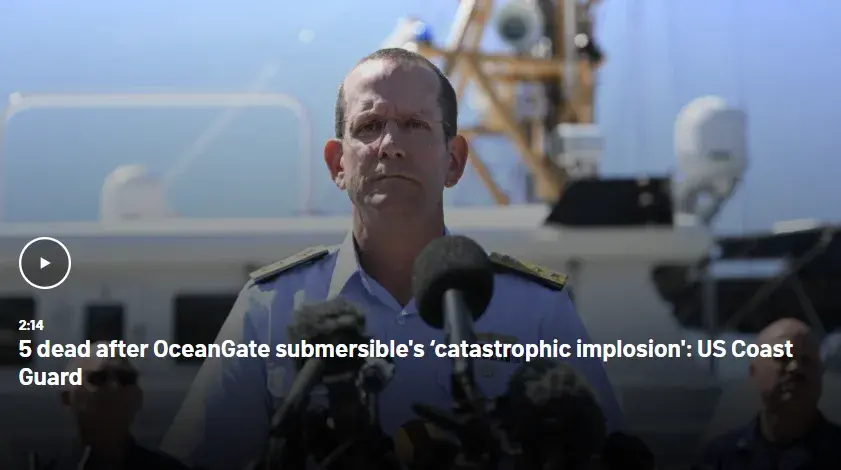
The U.S. Coast Guard says a missing submersible imploded near the wreckage of the Titanic, and all five people on board are believed to be dead. Coast Guard officials said during a news conference Thursday that debris found during the search for the vessel “is consistent with a catastrophic implosion of the vessel,” said Rear Adm. John Mauger of the First Coast Guard District. According to their basic definitions, an implosion occurs when something collapses inward because the external pressure is greater than the internal pressure, in other words it is a violent inward burst. It is the opposite of an explosion which happens when pressure builds inside of an object and pushes outward. When an object implodes, it collapses or squeezes in on itself, generally because it is being crushed by an outside force. In the case of the Titan, that outside force may have come from the pressure outside the vessel. “The debris is consistent with the catastrophic loss of the pressure chamber,” Rear Adm. Mauger said. How is an implosion different from an explosion? In explosions, the force is radiating outward from the object. Implosions have the force collapse the object upon itself, concentrating and minimizing the volume occupied. Implosions can shoot parts of the imploding object outward, as the smaller parts rebound away or are ejected as other parts collapse. OceanGate did not provide details when the company announced the “loss of life” in a statement or how officials knew the crew members perished. The Titan’s 96-hour oxygen supply likely ended early Thursday. It's not clear exactly when the Titan imploded, but Coast Guard officials said that Sonar buoys dispatched "did not hear any signs of catastrophic failure." "This was a catastrophic implosion of the vessel which would have generated a significant broadband sound down there that the sonar buoys would have picked up," said Mauger. Sonar buoys had detected noises in the water Tuesday and yesterday that were being assessed for patterns, but he said today "there doesn't appear to be any connection between the noises and the location [of the debris] on the sea floor." The Titan was reported overdue Sunday afternoon about 435 miles (700 kilometers) south of St. John’s, Newfoundland, as it was on its way to where the iconic ocean liner sank more than a century ago. OceanGate Expeditions, which is leading the trip, has been chronicling the Titanic’s decay and the underwater ecosystem around it via yearly voyages since 2021. The wreckage of the Titanic, which the submersible was set to explore is located at a depth of around 12,000 feet. “The wreck sits in the dark bathypelagic, or midnight, zone, at a spot 12,400 feet below the ocean’s surface. The pressure around the famous sunken ship is about 375 atmospheres. That means every square inch of an object’s surface experiences the equivalent of 5,500 pounds of force. Such an amount is greater than the bite pressure exerted by some of the strongest jaws in the animal kingdom: Crocodile bites have been measured at up to 3,700 psi. And one computer modeling study has estimated that a relatively large great white shark could sink its teeth into prey with a force of almost 4,000 psi,” Scientific American reports. In order for submersibles to survive what would be the equivalent of being crushed by a great white shark’s jaw, the vessel would have to be built out of strong materials and have a shape to withstand the pressure on all side, according to Scientific American, which also notes that in order to combat that pressure, most submersible are spherical, whereas the Titan was cylindrical.5 dead after OceanGate submersible's ‘catastrophic implosion': US Coast Guard
The U.S. Coast Guard confirmed Thursday that pieces belonging to the missing OceanGate submersible were discovered in a debris field near the wreckage of the Titanic.