Point of View, Counterpoint Political Desk
Protesting monks’ challenge: Govt. picks up the gauntlet
By Counterpoint Political Desk
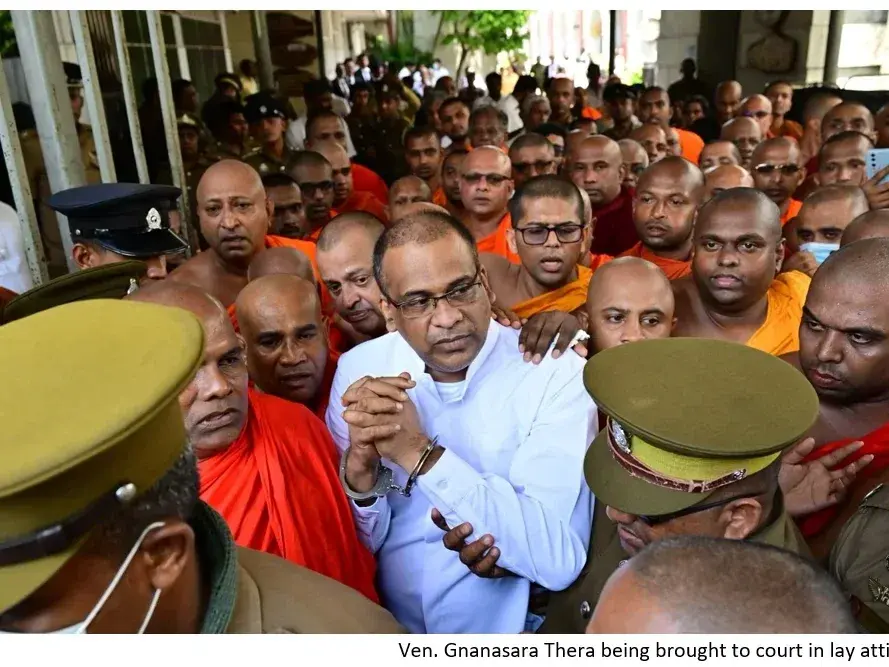
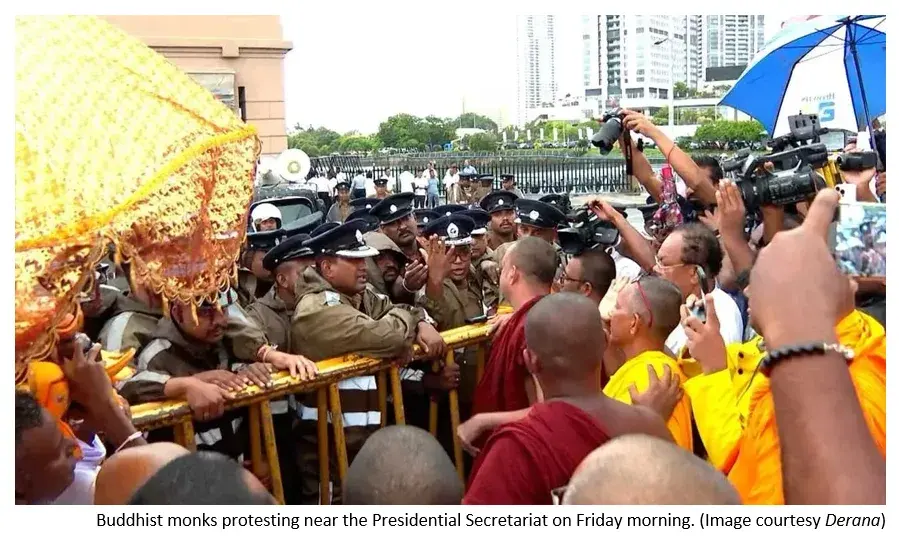
A protest, launched by Buddhist monks, seeking the release of Ven. Gnanasara Thera from prison, is currently underway at the Viharamahadevi Park, Colombo. Protesting monks first gathered near the Presidential Secretariat, on Thursday, having walked all the way from Kandy. They stayed there overnight.
On Friday morning, the police obtained a court order, prohibiting the gathering in a high-security zone, and the protesters, including a large number of laypersons, shifted to the current venue, vowing to continue their protest until President Anura Kumara Dissanayake resolved the technical issues that led to the invalidation of the previous presidential pardon for Gnanasara Thera monk and granted him a fresh pardon.
President Dissanayake remained noncommittal on the request for presidential pardon for Gnanasara Thera when a group of senior Buddhist monks met him on Oct. 08, at the Presidential Secretariat. One monk reportedly told the President that the Supreme Court had overturned the pardon granted by former President Maithripala Sirisena on procedural grounds and that he now had an opportunity to grant a fresh pardon to the monk in accordance with the law. The President reportedly replied that the appeal process was still ongoing and said: “My wishes should not become the law.”
However, on Friday (16), Minister K. D. Lal Kantha declared that President Dissanayake would not grant Gnanasara Thera a pardon because such action would run counter to the government’s mandate. So, the government’s message is loud and clear: Buddhist monks can go on protesting, but the President will not consider their demand for Gnanasara Thera’s release from prison. Thus, the government has picked up the gauntlet and is ready for a game of chicken with the protesters.
Beginning of an anti-government protest campaign?
The ongoing conflict is not likely to remain apolitical indefinitely. Even the 2022 Aragalaya, which began as an apolitical, leaderless people’s protest movement eventually became politicized, with the JVP, which had infiltrated it, hijacking it following an SLPP goon attack on the Galle Face protesters. Some political parties, including the SJB and the SLPP have already pledged their solidarity with the protesting monks, and the possibility of the monks’ Viharamahadevi protest evolving into a political battle against the government cannot be ruled out.
The problem with protests is that they snowball. It may be recalled that a protest that stemmed from an internal dispute in the Ranasinghe Premadasa government in 1992 developed into a mammoth political movement, marking the end of the 17-year UNP regime in in 1994.
What paved the way for the ouster of President Gotabaya Rajapaksa in 2022 was an agitation staged by the Samagi Vanitha Balawegaya (SVB), the women’s wing of the SJB, outside his private residence in Mirihana, Nugegoda, on March 5, 2022. There were protests elsewhere against fuel and gas shortages, but the SVB demonstration, led by the then MP Hirunika Premachandra, emboldened the irate public to surround Rajapaksa about three weeks later, triggering a wave of protests countrywide, including the main one at Galle Face, where protesters set up what came to be dubbed ‘Go Gota Gama’. The rest is history.
Lesson from China
Mao Zedong, who led the famous Long March before seizing power in China, said recognising and correcting our mistakes brings future benefit. The saying suits a political arena so often rife with hatred. The NPP government is strong, but strength does not license it to act as it pleases. In a democracy, those in power must tread carefully and tolerate dissent and protest. But can governments be toppled with protest marches? History offers some landmark examples. In 1934, Mao led the Long March across 9,000 kilometres over 370 days, with hundreds of thousands reportedly taking part. Communist rule followed.
Around the same time, Mahatma Gandhi's Salt March became a milestone in Asia's protest history. Beginning in 1930, thousands walked 389 kilometres from Sabarmati Ashram to the coastal village of Dandi in protest against the draconian British salt tax. There they made salt themselves, defying the colonial government in a decisive turning point for Indian independence.
Kandy-Colombo protest marches
Since Sri Lanka gained Independence in 1948, several major political protest marches have been held along the Kandy–Colombo route in one direction or the other. The best-documented examples include the 1957 UNP march against the Bandaranaike–Chelvanayakam Pact, and the 2001 UNP march against the Chandrika Kumaratunga government, the Joint Opposition's 2016 Pada Yathra.
The trigger for the recent protest march of Buddhist monks was the prison officials producing Galagoda Aththe Gnanasara Thera in court, dressed in lay attire. The government initially underestimated the protest. But the involvement of the Mahanayake Theras forced President Dissanayake, regarded as the government's most politically astute figure, into retreat.
Is this the work of the "Rajapaksa sect"?
On social media, pro-government groups attacked the monks taking part in the protest march, alleging that they were part of a "Rajapaksa sect" plot. Before his recent hospital admission, Mahinda Rajapaksa reportedly told associates that the Rajapaksa camp had not yet properly entered the fray.
With Namal Rajapaksa still in remand prison, and Mahinda and Shiranthi Rajapaksa are in hospital, it is worth asking whether the march can fairly be reduced to a Rajapaksa project. It was organised by
members of the Maha Sangha, led by the Chief Incumbent of Mihintale, the Venerable Ulapane Sumangala Thera, and Professor Venerable Agalakada Sirisumana Thera, among others. Many of these monks backed the NPP at the last election, and the government should ask itself why they now oppose it.
The story of Sir John and the chair he kicked
Disputes between monks and governments have a long history. The earliest after Independence was under Prime Minister Sir John Kotelawala, who reportedly said at a public meeting that undisciplined monks would have their robes removed and tar applied to their shaven heads. The remarks triggered nationwide protests, and eventually a large crowd of monks gathered outside Temple Trees.
When his secretary, Bradman Weerakoon, informed Sir John that the monks were at the gate, demanding a meeting, he said: "Then, man, why leave them standing there? Tell them to come inside. Place chairs in the grounds and serve them refreshments.” "Sir, there are a great many, and they are angry," Weerakoon replied. Kotelawala said he would handle it himself. Once refreshments had been served, he went out to the monks. A separate chair had been placed for him in front of their row. He asked Weerakoon about it.
"That is for you, Sir."
Kotelawala flew into a rage. "Who the devil put a chair here for me? Don't you know that a layman does not sit in front of Buddhist monks?" he shouted, kicking it into a nearby flower bed.
He then joined his palms in reverence. "When I said that tar would be applied, I was not referring to virtuous and disciplined monks such as you. I was referring to undisciplined monks. So, do not be upset. We are good Buddhists, but, Venerable Sirs, I am not prepared to change my opinion about undisciplined monks."
By the time he finished, the monks' anger had subsided, and the dispute was settled peacefully. Tact is a prerequisite for handling sensitive issues.
The monks' protest against Bandaranaike-Chelvanayakam Pact
The second major monks' protest targeted the Bandaranaike government, which came to power in 1956 backed by a collective of politico-social forces comprising the Sangha, ayurvedic physicians, teachers, farmers and workers. The cause of the monks’ ire was a pact between S. W. R. D. Bandaranaike and S. J. V. Chelvanayakam, which proposed regional councils.
The Maha Sangha, led by the Ven. Baddegama Wimalawansa Thera, opposed the pact and blocked the road to the Prime Minister's residence at Rosmead Place. Notably, the government's own Health Minister, Vimala Wijewardene, joined them. The protest unfolded as the Federal Party was agitating against the Sinhala letter "Sri" on vehicle number plates, and the monks demanded that the government formally cancel the pact.
Bandaranaike told them the Federal Party's actions had already voided it, and promised to put that in writing. He later signed such a letter and handed it to them. The monks won, though the issue went on to become a civil war lasting three decades.
As the saying goes, those watching a procession see what its participants may not. If the government believes the Kandy march, which began with a clear objective and little political involvement, has somehow served its interests, it should pause and judge how wise that assessment really is.
A separate place in prison for the robe
The government appears somewhat unsettled. Last week, a group of senior prison officials, including Senaka Pallathenna, Commissioner of Prisons (Operations and Media), made a sudden visit to Kandy to meet the Mahanayake Theras of the Asgiri and Malwatte Chapters.
The Asgiri Mahanayaka, the Most Venerable Warakagoda Sri Gnanarathana Thera, asked directly what procedure existed for Gnanasara Thera's release. The Commissioner gave the familiar bureaucratic answer: no decision had yet been taken.
The Malwatte Mahanayake, the Most Venerable Thibbatuwawe Sri Sumangala Thera, made a weightier appeal. A monk remanded or imprisoned should be held in a facility separate from ordinary prisoners. Noting that the matter had been discussed before without result, he stressed that monks should have a place where they can freely perform their religious observances and be treated with due respect.
On Thursday, the President's Secretary told the monks who had gathered near the Presidential Secretariat that he needed one month to resolve the matter. They offered one week instead, saying that they would stay near the Secretariat until then. The government meanwhile obtained a court order to remove them from the high-security zone.
An Arab saying holds that patience is the key to solving problems, and both sides are in need of it. If every problem is met only with legal measures, some will read it as repression, and confrontation may follow.
Share this story
RELATED NEWS
View all