Current Affairs
Analysis of electoral upsets in Tamil Nadu and West Bengal
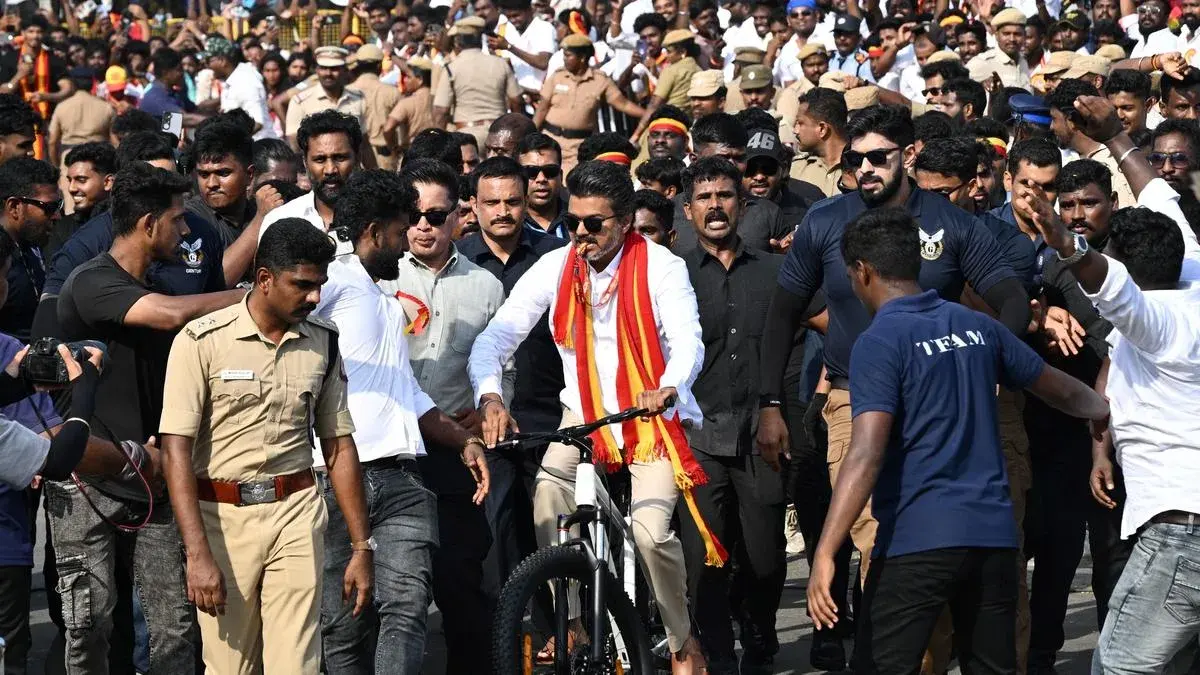
By P.K.Balachandran
Colombo, May 6 – Electoral upsets with major consequences for both State and national level politics marked the Tamil Nadu and West Bengal elections in India.
In the results which came out on Monday, a Gen Z-led Tsunami resulted in the victory of Tamilaga Vetri Kazhagam (TVK) helmed by the matinee idol, Vijay in Tamil Nadu. The victory marked the end of continues rule of the State by the Dravidian parties, namely, the Dravida Munnetra Kazhagam (DMK) and the All India Anna Dravida Munnetra Kazhagam (AIADMK), since 1967.
In West Bengal, the Bharatiya Janata Party (BJP) ended the 15-year dominance of the Trinamool Congress (TMC) and signalled the entry of Hindu nationalistic politics into a State that had been either Centre Left or Communist, since 1947.
Vijay’s TVK
All pollsters, except Axis India, had given the TVK only a double-digit number of seats, at best. And political pundits dismissed him as a mere “spoiler” attributing whatever he might do to his celluloid image as a dashing hero and not his political ideology or political effort.
The media failed to correctly assess the groundswell of support among Gen Z for Vijay, for whom he was Thalapathi (Tamil for Commander).
“Most of those who root for him are not old enough to vote,” was a common comment among the intelligentsia. But many also quoted parents as saying that they would vote for Vijay only to please their sons and daughters.
Asked by TV channels why they wanted Vijay, youngsters said, “We want change. There should be change!” Few had any clear idea about the kind of change they wanted or expected from Vijay.
”We had the two Dravida parties (DMK and AIADMK) taking turns to rule Tamil Nadu since 1967. Its time, somebody totally new, got a chance,” was the general refrain.
For all the support, Vijay did not hold a single press conference to elucidate his idea of change. In the few public speeches he made, he played up the alleged harassment of women and the selling of drugs by politically connected hoodlums and the pervasive corruption associated with DMK’s cadres. The DMK, which had the Central government’s statistics to counter these charges, failed to do so effectively.
It did not matter to the people that Vijay was a political novice and that his party was a fledgling, having been launched only in 2024. Its main purpose was not to spearhead a political or ideological movement but to fight the 2026 Assembly elections – a goal which was seen by many as cinematic rather than realistic.
However, Vijay had a vast network of fan clubs which had done some sporadic social work or he himself would give awards to bright students at public functions. But he did precious little to politicise his fans or school them in his political thoughts or ideology. In fact, he had no ideology other than social equality and secularism, which is common to all parties in Tamil Nadu except the BJP.
In contrast to the absence of substance in Vijay’s claims, the DMK had a solid list of achievements to its credit. Chief Minister M.K. Stalin had made Tamil Nadu a top-performing State in India, with enviable social and developmental indices. But Stalin’s claims fell on deaf ears partly because his concept of “development” had not yielded many jobs for qualified youngsters.
In contrast to the centralised development model of the DMK and AIADMK, Vijay’s manifesto promised to set up a government website through which the common man could suggest to legislators schemes useful to the people. The manifesto promised that these suggestions would be followed up and the progress communicated. To keep up with technological advancements, he proposed to set up an AI university.
Vijay’s success is remarkable also because he came with no political background or experience. Unlike his film star predecessors in politics, he had not held any political office or contested any election.
Many pooh poohed the TVK for the absence of a leadership structure. The “leadership” of the TVK was but a motely crowd of greenhorns and defectors from other parties. It was therefore easy for political pundits to write off Vijay and concentrate on the prospects of the political heavy weights like the DMK, AIADMK, the Congress and the BJP.
Ideologically, Vijay was woolly. His thoughts were a hodge podge of the Dravidian concept of social justice, anti-caste rhetoric, equalitarianism and secularism. Vijay’s secularism was in no doubt. Though a practising Christian (his name being Joseph Vijay Chandrashekhar), he who would visit Hindu temples too
The TVK had also surprised observers by opting to enter the electoral fray solo, contesting all the 234 seats up for grabs. This, too, was attributed to political inexperience or the bravado of a novice.
Shock for Heavyweights
But shock was in store for the heavyweights who expected to sail through. The State Chief Minister and DMK Supremo, M.K. Stalin, was defeated by the TVK in Kolathur, and the well-spoken and intellectual Palanivel Thiyagarajan was trounced by a TVK candidate in his home turf in Madurai, where he was considered unbeatable.
Future Stance
Observers expect him to be status quoist, following the tried and tested Dravidian policies trumpeted by the DMK and AIADMK. He is expected to be close to the Congress, as many Tamil Nadu Congressmen, who were yearning for a share of power in the State, had pressed for an alliance with Vijay rather than the DMK.
Not surprisingly, Rahul Gandhi congratulated him on his victory heartily.
Observers say that Vijay would keep a safe distance from the Bharatiys Janata Party (BJP) which he considers an “ideological opponent”.
BJP to the Fore in West Bengal
In the run up to the West Bengal elections, the BJP was seen as a strong contender against the Mamata Banerjee-led Trinamool Congress (TMC) but not strong enough to beat the TMC. This was mainly because Banerjee was trying to come to power for the fourth time in a row when her government had failed on the law and order front.
However, only the diehard supporters of the BJP thought that it would defeat her. This was because she had resisted the BJP’s north Indian bias and its aggressive Hindu nationalism – which did not gel with Bengalis who had a distinct culture and were largely secular.
Pollsters and analysts also highlighted Mamata’s aggressive campaigning against the Special Intensive Revision (SIR) of the electoral rolls which she felt was meant to cut off Muslims who were her supporters.
One of the SIR’s objectives was to weed out illegal immigrants from neighbouring Muslim-majority Bangladesh. But Banerjee said that weeding out illegal voters was only a cover to reduce the number of Muslim voters.
At the end, TMC won 80 seats from among the 294 seats in the West Bengal State Assembly, while the BJP swept the polla by capturing 206 seats. The Congress and the Communists could manage only 2 and 1 respectively.
Though Banerjee is accusing the BJP of rigging the polls with the help of the Election Commission of India (ECI), she has to admit that her 15 year rule had too many warts. And unknown to her, the people were thirsting for change.
Even her traditional supporters, the Muslims, shied away from her because she had not stopped the revision of the electoral rolls and had not developed the Muslim areas. Her actions did not translate into action in many cases.
With the BJP in the seat both in Kolkata and New Delhi, the issue of illegal immigration from Bangladesh will be taken up with seriousness causing friction with Muslim Bangladesh. It could also create Hindu-Muslim conflict in West Bengal itself.
Political observers would be keenly watching whether and how far the BJP will take its ideology of Hindu majortarianism and Central control over Tamil Nadu and West Bengal.
That Vijay is a novice could be exploited. But he would be backed by the opposition parties which are wedded to States’ rights vis-a- vis the Centre and have ideologies which clash with those of the BJP.
And as far as West Bengal is concerned, it remains to be seen as to how the BJP’ government in the State is able to deviate from Bengal’s political and socio-cultural traditions to suit the BJP leadership at the Centre.
END
RELATED NEWS
View all

Current Affairs
Sri Lankan Presidential pardons- the good and the bad
Sep 11, 2026
Current Affairs
The pros and cons of joining BRICS- the dilemma of Pakistan and Bangladesh
Sep 09, 2026
Current Affairs
Disaster in Nepal gets embroiled in geopolitics.
Sep 08, 2026
Current Affairs
Why Mecca Pact, and what does it imply for its members, Israel and India?
Aug 18, 2026