Current Affairs
BJP launches charm offensives in New Delhi and Washington Counters criticism about promoting a Hindu supremacist agenda
By P. K. Balachandran
Colombo, May 4 – The Bharatiya Janata Party (BJP)’s once-dominant image has frayed over the past year amidst domestic discontent and international headwinds. With parliamentary Sabha elections due in mid-2029 and several State-level polls in-between, the party and its ideological parent, the Rashtriya Swayamsevak Sangh (RSS), are mounting a damage-control campaign at home and abroad.
The BJP has launched charm offensives in New Delhi and Washington to counter criticism about aggressively promoting a Hindu supremacist agenda.
India’s National Security Advisor (NSA) Ajit Doval, Prime Minister Narendra Modi’s key aide, and RSS-linked think tanks are at the forefront of the campaign to remove the warts.
Signs of Strain
The downturn accelerated after the brief but costly May 2025 IndiaPakistan conflict. India’s strikes under “Operation Sindoor” had failed to deliver geopolitical gains. “”Strategic partner” the United States, decisively tilted towards Pakistan, inviting Pakistani army chief Field Marshal Asim Munir for lunch at the White House twice and making
Pakistan a facilitator in talks with Iran. A 50% tariff was imposed on Indian goods, and curbs were put on oil imports from Russia before tariffs were reduced to 18%. New Delhi was pressured into a onesided trade deal. The opposition Congress party dubbed “Narender Modi” as “Surrender Modi”.
In March this year, the 2025–26 US Commission on International Religious Freedom (USCIRF) report painted a grim picture, recommending that India be designated a “Country of Particular Concern.” It criticised new laws targeting minority places of worship, draconian anti-conversion measures, and tolerance of Hindu vigilante violence. The report also called for sanctions against the RSS and India’s external intelligence agency, the Research and Analysis Wing (RAW).
New Delhi’s manifest tilt towards Israel and the US in the on-going Iran war has dismayed both liberals and Muslims in India.
Domestic Campaign
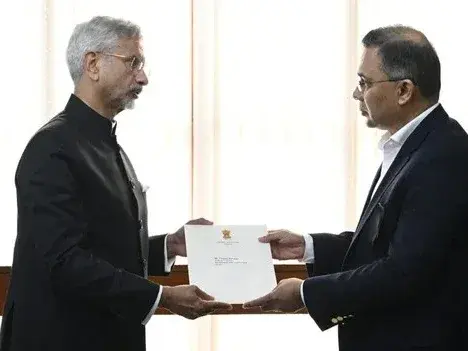
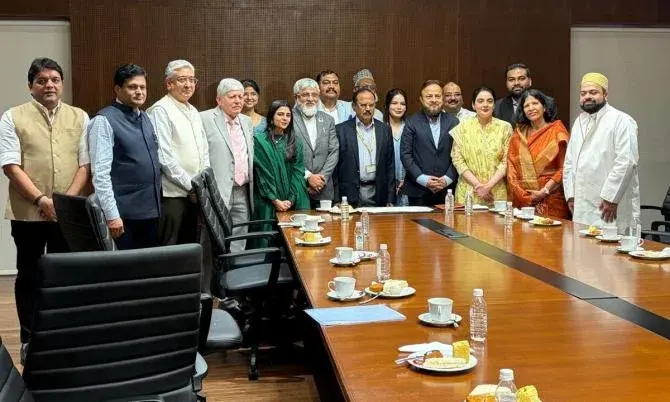
Domestically, the BJP’s push towards a Hindu-majoritarianism met stiff resistance in States such as Tamil Nadu and West Bengal. To counter this, on April 18, Doval hosted 16 prominent Muslims at the Prime Minister’s Office in New Delhi. The delegation, which included businessman-educator Zafar Sareshwala of Gujarat, described the meeting as unexpected but constructive.
The delegation raised concerns about “institutional discrimination” and name-calling, but did not seek a religion-based quota since the constitution of India did not allow it.
Speaking to Rediff.Com, Sareshwala quoted Doval as saying: “Hindus and Muslims are on the same ship—we sail or sink together.” He claimed improved Muslim recruitment in the armed forces through an anonymised selection process and offered private-sector support for Muslims’ skill development.
However, critics note that these assurances provided little comfort to the broader Muslim community, which remains disproportionately represented at the bottom of socio-economic indicators. Even 78 years after independence Muslim account for only 3.2% in the civil services despite being 15% of the population. Muslims are mainly in the unorganised sector as labourers or artisans.
Doval suggested that the Muslim elite start development programmes which could eventually get corporate financing with his help. Muslims should qualify themselves first as the discrimination the Muslims complain of could well be due to lack of qualifications or competence, Doval argued. Doval made no commitment to curb Hindu vigilante groups.
Global Image Management
Abroad, the India Foundation—linked to Doval’s son Shaurya Doval, and RSS veteran Ram Madhav—facilitated an event at the Hudson
Institute in Washington on April 23. Walter Russell Mead, Distinguished Fellow in Strategy and Statesmanship at Hudson Institute, conducted the sessions.
RSS General Secretary Dattatreya Hosabale, BJP foreign affairs head Vijay Chauthaiwale, and Ram Madhav attempted to correct the negative perceptions about the RSS. Hosabale rejected comparisons to the Ku Klux Klan, described Hindu identity as civilisational rather than religious, and called for dialogue to address minority fears.
The RSS representatives denied the RSS’s documented record — three Indian government bans, decades of anti-Muslim and antiChristian violence. And the chair, Walter Russel Mead, did not question the veracity of the RSS's claims.
While Hosabale was assertive, Ram Madhav took a softer line wondering why the US was harsh on India when it had complied with every demand made.
“India agreed to stop buying oil from Iran. We agreed to stop buying oil from Russia despite so much criticism from our opposition. India agreed to a 50% tariff without saying too much,” he said.
US Civil Societies’ Condemnation
The timing of the Hudson Institute meeting—weeks after the USCIRF recommendations—drew criticism from groups like the Indian American Muslim Council. Observers have questioned potential undisclosed funding ties between Indian-aligned entities and Western think tanks, an account in counterview.net says.
A coalition of advocacy groups—including the Indian American
Muslim Council, Hindus for Human Rights, The Sikh Coalition, Sikh
American Legal Defence and Education Fund, Dalit Solidarity Forum,
Save America From Hindutva, The Religious Nationalisms Project, No Hindutva Maryland, and Equitas Forum USA—issued a joint statement condemning Hudson’s decision. They highlighted that the USCIRF’s March 4, annual report explicitly recommended targeted sanctions against the RSS for its role in the religious persecution of minorities in India.
The coalition stressed that the RSS is the ideological nucleus of a network accused of enabling violence against Muslims and
Christians, and historically linked to Nathuram Godse, the assassin of Mahatma Gandhi. They further pointed to recent cases of transnational repression tied to the same ecosystem. In February 2026, Indian national Nikhil Gupta pleaded guilty in a US federal case involving a murder-for-hire plot against a US citizen, allegedly directed by an Indian government official. Canadian authorities have also accused Indian-linked operatives of killings, arson, and extortion on their soil.
“Hudson Institute is providing a prestigious platform to a foreign organisation that the U.S. government body has called to be sanctioned. This raises profound questions about judgment, accountability, and the normalisation of extremism in Washington policy circles,” the coalition said.
The groups emphasised that think tanks like Hudson play a critical role in shaping U.S. foreign policy discourse. By legitimising organisations accused of systemic rights violations and linked to transnational repression, they warned, such institutions risk undermining U.S. policy objectives and public trust.
The coalition has called on Hudson Institute to reconsider its decision and urged policymakers, media, and civil society leaders to critically examine the implications of engaging with organisations tied to religious persecution and international repression.
This controversy underscores growing scrutiny of India’s political organisations in North America and the tension between US-India strategic engagement and human rights concerns.
Hiring Lobbyists
US Journalist Pieter Friedrich suspects that the Hudson Institute may have received contributions from India. He says that it has a documented history of receiving foreign-government-adjacent funding without disclosure. However, whether the India Foundation or its BJP-aligned principals have made financial contributions to
Hudson since September 2023 is not publicly known, Friedrich says.
Friedrich recalls that Mead had made trips to India and had written laudatory articles on Modi and his policies in The Wall Street Journal.
With mounting challenges from opposition parties in India and liberal voices in the West, the BJP-RSS ecosystem is likely to intensify its outreach. Whether these efforts can restore the regime’s earlier shine before key electoral tests remains an open question.
END
RELATED NEWS
View all

Current Affairs
Sri Lankan Presidential pardons- the good and the bad
Sep 11, 2026
Current Affairs
The pros and cons of joining BRICS- the dilemma of Pakistan and Bangladesh
Sep 09, 2026
Current Affairs
Disaster in Nepal gets embroiled in geopolitics.
Sep 08, 2026
Current Affairs
Why Mecca Pact, and what does it imply for its members, Israel and India?
Aug 18, 2026