Current Affairs
Killers of journalists go untraced in 90% of cases, the UN says
By P.K.Balachandran
Colombo, November 3 - According to the UN, killers of journalists go unpunished in 90% of the cases, says the UN. Its “International Day to End Impunity for Crimes against Journalists”, observed every year on November 2, is meant to stop such impunity and indifference on the part of the State.
The day commemorates the murder of two French radio journalists, Ghislaine Dupont and Claude Verlon, in Mali on November 2, 2013, when they were reporting for their station RFI.
Since 1993, more than 1,700 journalists have been killed while reporting, the UN says. UNESCO’s most recent data puts the global “impunity rate” in these cases at 85%.
“Killings represent only the most extreme form of pressure against journalists. The International Day also draws attention to kidnapping, torture, harassment, and a growing wave of digital-sphere threats that media workers increasingly face, particularly women journalists,” the UN points out.
When attacks on journalists go unpunished, public-interest reporting is suppressed, including investigations into corruption, human rights abuses and crime.
In recent years, declining press freedom worldwide has exposed journalists to growing threats, including escalating attacks, judicial harassment through lawsuits, arbitrary detention, intimidation and killings, making independent journalism increasingly dangerous.
While killings are the most extreme form of media censorship, journalists are also subjected to a variety of threats - ranging from kidnapping, torture and other physical attacks to harassment, particularly in the digital sphere.
Threats of violence and attacks against journalists create a climate of fear among media professionals, impeding the free circulation of information, opinions and ideas among citizens. Women journalists are particularly impacted by threats and attacks, notably by those made online.
According to UNESCO’s discussion paper, “The Chilling: Global Trends in Online Violence against Women Journalists,” 73 % of the women journalists surveyed said they had been threatened, intimidated and insulted online in connection with their work.
The Arab States had the highest number of murders of journalists, according to the 2026 UNESCO Director-General’s Report on the “Safety of Journalists and the Danger of Impunity.” The Palestinian-American woman correspondent, Ms. Abu Akleh, was fatally shot in the head on May 11, 2022, by an Israeli soldier while wearing a “Press” vest as she covered an Israeli army operation in the West Bank town of Jenin. An investigation by Palestinian human rights organisation Al-Haq and research agency Forensic Architecture found that she was directly targeted, despite repeated denials by Israeli authorities.
Her killing prompted the Committee to Protect Journalists (CPJ) to investigate Israel’s killings of journalists over 22 years. In its 2023 report “Deadly Pattern” it said that from 2001 to 2022, the Israel Defence Forces (IDF) killed at least 20 journalists, with no accountability for any of the deaths.
Javier Valdez Cardenas, a veteran Mexican investigative journalist and editor who reported on organised crime and corruption – despite threats and attacks against him and his colleagues- was shot at 12 times on May 15, 2017, near the editorial offices of Riodoce, the weekly he co-founded, in the Mexican city of Culiacán. A Sinaloa drug cartel member ordered Valdez’s murder over his reporting on a cartel turf war, prosecutors said.
Over 150 journalists have been killed in Mexico since 1992.
Sri Lanka
At least 44 journalists and media workers were killed while reporting on the civil war between 2000 and 2010. To date, not a single perpetrator has been held to account for any of them, says www.redress.org
Sri Lanka has systematically shielded the killers of journalists over a quarter of a century, says a new report focusing on the failures of the police investigation into the October 2000 assassination of BBC Jaffna reporter, Nimalarajan Mylvaganam on October 19, 2000. The cadres of the pro-government Eelam People’s Democratic Party (EPDP) were suspected but no one was punished
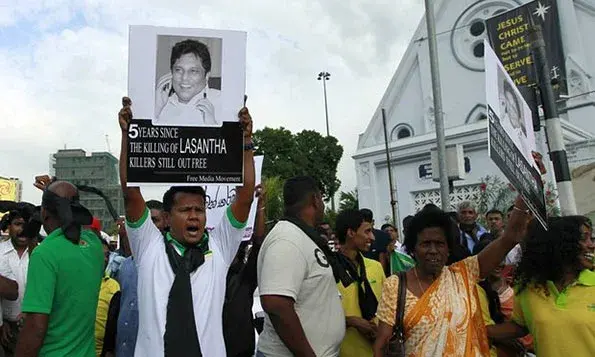
Investigative journalist and editor of the “Sunday Leader”, Lasantha Wickramatunge, was killed by gunmen in Colombo in broad daylight on January 8, 2009. People at the highest level in the Mahinda Rajapaksa government were suspected to have ordered the killing, but the suspicions were not pursued.
Cartoonist and political commentator Prageeth Eknaligoda was abducted by men in a van on January 24, 2010. Members of his family believe that he was abducted by pro-government supporters because he was investigating the alleged use of chemical weapons. Investigations drew a blank even as the international community repeatedly sought action. Whether Eknaligoda is alive or dead remains a mystery.
Pakistan
A report by Freedom Network Pakistan shows that in the 53 cases of journalists killed between 2012 and 2022, convictions have only been made in two instances. “This is a catastrophic rate of impunity of around 96%,” the Freedom Network said.
According to CPJ, despite the government’s promises, unsolved journalist murders remain persistent in Pakistan. Since 1992, not a single journalist murder case in Pakistan has been met with full justice.
Zakir Husein Dahar, also known as Shan Dahar, was a senior journalist with Abb Takk Television and was shot on January 1, 2014, in Larkana district of Sindh province. At the time of his death, he was investigating the illegal resale of donated medicines. The sole suspect prosecuted in the case was acquitted in 2018. Two other suspects, Brohi and his brother Aamir, were declared absconders. Brohi was arrested this year.
Bangladesh
In the evening of 18 December 2025, panic rippled through the newsrooms of The Daily Star and Prothom Alo, two of Bangladesh’s most popular media outlets. Mobs armed with sticks and petrol torches forced their way past the gated buildings in Dhaka. They set fire to vehicles and pushed towards the main press buildings. Inside, journalists and support staff scrambled in the smoke and heat, trying to secure files and save equipment as the blaze grew.
For the first time in decades, the country's two largest newspapers were forced to stop printing. Outside, the crowd cheered. Inside, reporters huddled on the rooftop, fearing for their lives. Observers accused the interim government led by Dr.Muhammad Yunus of allowing it to happen.
From Official Threats to Mod Justice
Under Sheikh Hasina’s 15 years of autocratic rule, media freedom was shrunk through strict laws, surveillance, and direct government control. Her government used the 2018 Digital Security Act to arrest journalists and censor critical outlets, while broadcast licenses were tightly controlled and intelligence agencies monitored dissent.
Under the interim government led by Nobel Peace Prize laureate Muhammad Yunus, the threat was less from official censorship and more about mob intimidation. Journalists reported that if a newspaper published something unpopular, crowds quickly appeared with sticks, fire, or threats.
351 journalists were harassed in their offices or on the street; 109 journalists beaten while reporting; 167 journalists were stripped of press cards; More than 300 journalists were banned from leaving the country; 140 journalists faced criminal cases, including murder.
Criminal cases against journalists had shot up by 558% during the interim government days. Murder charges were particularly worrying. Many reporters were simply covering the summer 2024 protests where people were killed, largely by Hasina’s security forces. But reporters who happened to be on the scene were blamed for those deaths.
Presently, under the Tarique Rahman government, Bangladeshi journalists face 10-year jail terms for ‘unverified’ reporting under draft cybercrime law. In September 2026, the CPJ asked the government to immediately withdraw or substantially revise proposed amendments to the Cyber Protection Act that would criminalise reporting officials deem unverified, and grant authorities the power to block journalists’ work and deregister news outlets.
The draft amendments include a new criminal offense for circulating “rumour” and “misinformation” online that carries a punishment of up to 10 years in prison or a heavy fine, according to multiple news reports. In the bill’s current form, online material could be in violation of the law if authorities decide it is “unsubstantiated or unverified” and it creates public confusion, panic, or unrest. Cases would be tried before a specialised court, the Cyber Tribunal, that hears cases under Bangladesh’s digital and cyber laws.
News outlets could also be convicted of violating the law, and courts would be empowered to suspend or cancel the company’s license to operate.
Bangladesh has a track record of using cybercrime legislation against journalists in politically motivated cases. Under the previous Awami League government, at least 255 journalists were sued under the Digital Security Act that governed online speech and digital offenses between 2018 and 2023. Writer Mushtaq Ahmed, who was charged under the act, died in custody after nine months in pretrial detention.
END
Share this story
RELATED NEWS
View all
Current Affairs
India’s new privacy law would chain the media, leading publishers including Ambani and Adani tell the Supreme Court
Oct 28, 2026
Current Affairs
Netanyahu’s Likud trails Eisenkot’s Yashar in Israeli pre-poll surveys
Oct 23, 2026

Current Affairs
Bloody killings mar the backdrop of Bollywood films
Oct 20, 2026
Current Affairs
UNHRC Special Rapporteurs write to Sri Lankan President their concerns about the NGOs’ bill
Oct 02, 2026