Current Affairs
Denial of the right to vote is not new in India
By P.K.Balachandran
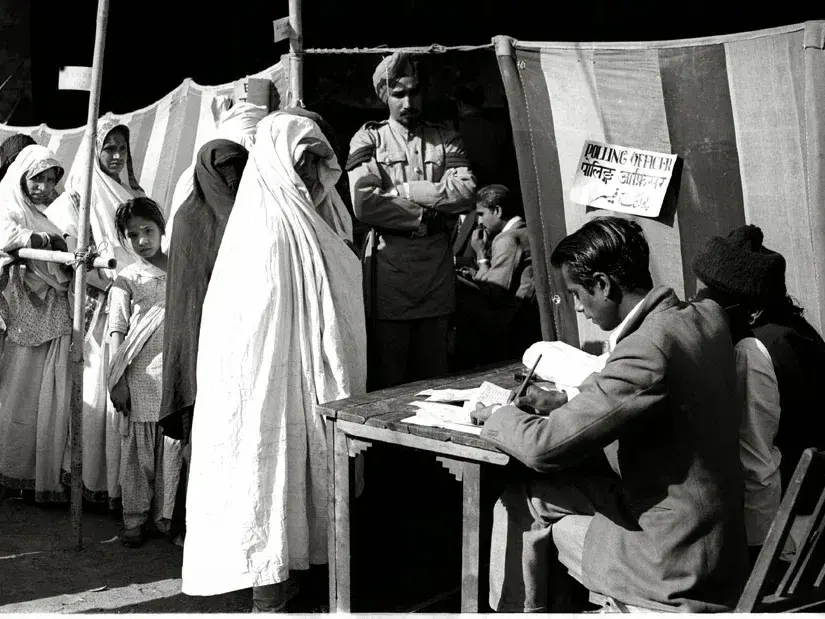
Colombo, October 1 – The disenfranchisement of millions voters is not new to India. If 130 million people have been struck off the voters’ list in 2026 on questionable grounds, 2.8 million women were disenfranchised ahead of India’s first general elections in 1952 for the simple reason that they had refused to reveal their “given names” recalls historian Ramachandra Guha in his book “Ïndia after Gandhi”.
As per the custom in the rural areas of North India, women at that time identified themselves not by the names given to them at birth, but as the “wife of or mother of so and so.”
The Indian Election Commissioner in 1952, Sukumar Sen, found that attitude unacceptable and struck 2.8 million women off the voter rolls. His justification was that, once disenfranchised, the women would get rid of that outdated custom soon or “before the next elections” as he put it.
While the current controversy over the disenfranchisement of 130 million voters in 2026 refuses to die down with street agitations across India continuing to call for the resignation or ouster of the Chief Election Commissioner Gyanesh Kumar and even that of Prime Minister Narenndra Modi, the controversy over the 2.8 million deletions in 1952 died down quickly.
This was because the deletions were meant to send a progressive, reformative message. The Chief Election Commissioner in 1952, Sukumar Sen, defended his action, saying that he wanted the disenfranchisement to make the women give up the outdated custom of not mentioning their personal or given names to strangers (even official enumerators). He felt that they would do so “before the next elections.”
The other reason why the “1952 controversy died down was that India, headed by Prime Minister Jawaharlal Nehru, was involved in the new and exciting task of conducting independent India’s first-ever general elections for the Central and provincial legislatures simultaneously and on the basis of universal adult suffrage involving 176 million voters, 85% if whom were illiterate. Sukumar Sen described the elections as the “biggest experiment in democracy in human history.”
Admittedly, sceptics were legion. Prime Minister Jawaharlal Nehru, the author of the idea of giving the vote to every Indian, himself told a UNESCO symposium on December 21, 1951: “The quality of men who are selected by this modern democratic method of adult franchise gradually deteriorates because of a lack of thinking and the noise of propaganda.”
A veteran Madras editor wrote that the elections would be the biggest “gamble” in history. Penderel Moon, a British civil servant who remained in India, wrote: “A future enlightened age will view with astonishment the absurd farce of recording the votes of millions of illiterate people.”
US Ambassador Chester thought that elections would be a “fiasco” but shed his scepticism after the elections were over, saying: “Asians would not need a series of Ataturks before people were ready for democracy.”
Commenting on Nehru’s gloomy forecast about democracy in India prior to the elections at the UNESCO symposium, historian Ramachandra Guha says that Nehru, being an introspective person, could see an existing situation from different angles. On the one hand, he sensed the dangers of ill-informed political choices, but on the other, he was committed to having universal adult franchise and free speech in India no matter how unsuitable and incongruous it might seem to be.
Humongous Task
When Sukumar Sen, an Indian Civil Service officer from West Bengal, was made the Indian Election Commissioner in 1950 and asked by Prime Minister Nehru to conduct the first General Elections in 1951, based on universal adult franchise, Sen asked for time till 1952.
Nehru granted him his wish, as the task was indeed stupendous. The electorate was estimated to be 176 million strong, 85% of whom were illiterate rural folk. Up for grabs were 4,500 seats of which, 500 were for the national parliament and the rest for the provincial legislatures. And the polls were to be held simultaneously.
224,000 polling booths had to be constructed. 56,000 presiding officers and 280,000 other staff were to be requisitioned, trained and deployed. To maintain law and order, 240,000 policemen had to be deployed.
There had to be separate identifiable ballot boxes, made for each party and each independent candidate, with the party symbol painted on them for easy recognition by illiterate voters.
Campaigning was through huge public meetings, door-to-door visits and impromptu wayside chats with bunches of people. Towns and villages were awash with flags, banners and posters. Nehru, with the highest stakes in the elections being the unquestioned leader of the Congress party, is said to have addressed 20 million Indians through 300 public meetings across the length and breadth of India.
The fight was intense because the Congress faced a stiff challenge both from the Hindu communal right wing and the communists, in their strongholds in North and South India respectively.
However, though exhausted, Nehru found the electioneering an enriching experience, because he saw a new India emerging.
Writing in the course of the campaign, to his friend Lady Edwina Mountbatten, wife of the last British Viceroy, Lord Louis Mountbatten, Nehru remarked: “As I wander about, the past and the present merge into one another and this merger leads me to think of the future. Time becomes like a flowing river in continuous motion with events connected with one another.”
Polling ended in the last week of February 1952. Sixty per cent of the electorate had voted, proving the scoffers wrong. The Congress won 364 out of 489 seats in the national parliament and 2247 of the 3280 seats in the provincial legislatures. Congress polled 45 per cent of the votes but won 74.4 per cent of the seats because of the First Past the Post System.
While Nehru won convincingly, Dr.B.R. Ambedkar, who skilfully piloted the Indian Constitution in the Constituent Assembly two years earlier but became an opponent of the Congress subsequently, lost in his home turf of Bombay to a milkman named Kajrolkar.
Shocking though Ambedkar’s defeat was, Kajrolkar’s victory signalled the onset of democracy in India, in which a humble milkman could defeat a highly educated legal luminary and an iconic leader.
As per the reading of contemporary observers, the image of Nehru and his vision of India as a non-communal, egalitarian and socialist country drew great support. Indeed, a running theme in Nehru’s speeches was his characterisation of Hindu majoritarian communalism as India’s main problem and a primary cause of disunity. Only five years earlier, India had been partitioned on Hindu-Muslim lines amidst bloody rioting.
The campaign themes of the 1952 elections were similar to those in subsequent elections in India, proving the adage that the more India changes, the more it remains the same. Even today, the nation is battling communalism, inequality and unbridled State power as it did in 1952 but less successfully than before.
END
RELATED NEWS
View all
Current Affairs
The 1948 UNSC resolution on Kashmir was in India’s favour
Sep 25, 2026

Current Affairs
Sri Lankan Presidential pardons- the good and the bad
Sep 11, 2026
Current Affairs
The pros and cons of joining BRICS- the dilemma of Pakistan and Bangladesh
Sep 09, 2026
Current Affairs
Disaster in Nepal gets embroiled in geopolitics.
Sep 08, 2026