Current Affairs
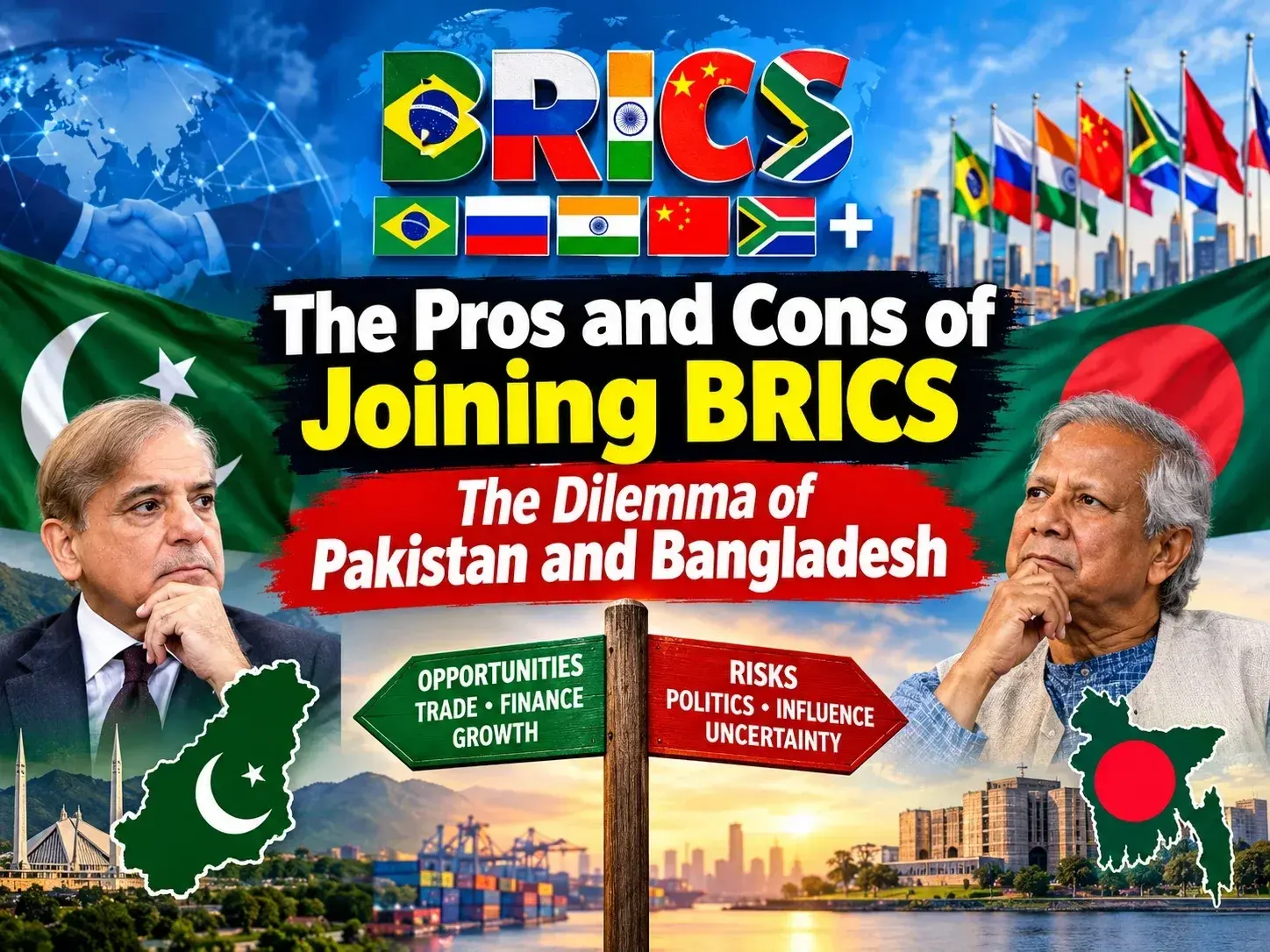
The pros and cons of joining BRICS- the dilemma of Pakistan and Bangladesh
By P.K.Balachandran
Colombo, September 9 - For small countries, being part of international forums or organisations provides visibility, access to institutions in other countries, and a sense of security, even if the forum is not defence-oriented. BRICS is an organisation that is attracting membership from countries of the Global South.
Pakistan and Bangladesh have been trying to get membership. But since membership is given only if there is consensus among the member States, admission is a challenge.
Pakistan’s efforts have failed so far, given India’s consistent opposition, as it has dubbed that country the “Mothership of Cross-Border Terrorism”, and terrorism is a principal concern of Russia, China, and India.
Bangladesh showed an interest in joining BRICS in 2023 under Prime Minister Sheikh Hasina, encouraged by South Africa. But under the current Prime Minister, Tarique Rahman, it is dragging its feet, partly on account of its standoff with India, this year’s Chair, over the extradition of the fugitive Sheikh Hasina and partly out of a doubt as to whether membership will be worthwhile.
Indian PM Narendra Modi had invited Rahman to attend the BRICS Outreach, but Raman has cold shouldered him. This week, some rethinking appears to be taking place. Foreign Minister Dr. Khalilur Rahman, who met his Russian counterpart, Sergey Lavrov, told the Bangladeshi media that Russia is willing to take up Bangladesh’s case for membership.
However, both in Pakistan and in Bangladesh, there is an opinion that while BRICS membership has its advantages, it is not necessary to be a member as such, because trade enhancement could be achieved regardless of membership.
Pakistan
Pakistan has been wanting to join BRICS, an organisation in which its ally, China, is one of the founding members. But its efforts have been thwarted by India which keeps labelling it as a cross-border terror sponsor. Ally China is unable to help because membership in BRICS is based on consensus, and India, a founding member with China, Russia, Brazil and South Africa, blocks it.
Looking at the positive side first, Maria Mansab, a research officer at the School of Politics and International Relations, Quaid-i-Azam University, Islamabad, notes that BRICS could enhance Pakistan’s trade diversification and access to development finance in a global order transiting to multipolarity, with emerging economies increasingly seeking alternatives to Western-led institutions. Further, BRICS has evolved into an influential geopolitical and economic platform representing the aspirations of the Global South.
BRICS is now BRICS Plus and BRICS Outreach too, representing 49.5% of the world's population. It accounts for 40% of global GDP and 26% of global trade. Trade among the BRICS Plus countries exceeded $1 trillion in 2025. Almost 40 countries have expressed interest in becoming a BRICS Plus member or a partner country so far.
Pakistan formally expressed interest in joining BRICS in 2023. Economically, BRICS Plus offers significant opportunities for Pakistan in trade, energy, industry, and food security. BRICS members collectively produce 40% of the world's oil and 42% of the world's food. Fast-growing BRICS Plus has a huge consumer market too, especially in Africa, where spending may reach US$ 2.5 trillion by 2030.
Thus, there could be demand for Pakistani textiles, rice, halal food, pharmaceuticals, surgical instruments, sports goods, and leather. Tariffs within BRICS have declined from 10–20% to single-digit levels.
However, Pakistan’s membership prospects remain uncertain and politically sensitive. Its own domestic economic vulnerabilities are a factor apart from India’s opposition, Mansab points out.
Further, access to lower tariff markets in BRICS countries would not necessarily result in export growth. Pakistan's ability to capitalise on BRICS Plus markets depends on product diversification, market competitiveness, and regional value chain integration, she says.
Pakistan's textile exports grew to US$ 17.88 billion in FY 2025. In this, BRICS Plus economies accounted for 22.5%. Therefore, the key variable is not membership as such but diversification beyond traditional Western markets. Domestic economic reforms are also essential to enhance export competitiveness, Mansab points out.
Pakistan has expanded mineral exports to China, including copper exports, to US$ 1 billion. Aluminium ore exports rose by 4,700% in 2025, providing a solid foundation for attracting foreign investment in the mining sector. Integrating into BRICS-led industrial and manufacturing networks would help. But it is not essential.
Situated at the intersection of South Asia, Central Asia, and West Asia, Pakistan can reinforce the BRICS Plus goals such as regional connectivity, trade corridors, maritime connectivity, and integration of the Eurasian continent. The China-Pakistan-Economic-Corridor (CPEC) investments valued at US$ 62 billion have reinforced Pakistan's infrastructure in the field of energy and connectivity.
BRICS Plus could broaden Pakistan's access to development finance through the BRICS New Development Bank (NDB). With an authorised capital of US$ 100 billion, the Shanghai-based NDB has financed 96 projects worth $32.8 billion so far. Pakistan is considering the purchase of 5,882 capital shares in the NDB worth approximately US$ 582 million.
Pakistan’s Drawbacks
But the Pakistani economy is weak. In FY25, Pakistan's GDP growth rate was 3.04%. Its per capita income was just US$ 1,812, and its economy’s size was just US$ 407 billion.
Pakistan is dependent on the IMF for macroeconomic stabilization and balance of payments support. NDB financing cannot be considered an alternative to IMF’s support. The NDB provides only project-based infrastructure and sustainable development financing.
Challenge of De-dollarisation
Pakistan will also have to take into account the move of BRICS Plus to de-dollarise its trade. BRICS is conducting nearly 67% of its intra-bloc trade in local currencies. Pakistan could potentially benefit from de-dollarisation in terms of reduced transaction costs. But the US President Trump has threatened to impose a 100% tariff on BRICS members pursuing alternative currency arrangements.
Mansab recommends that Pakistan should prioritise expansion of trade, economic competitiveness, and connectivity cooperation with BRICS Plus members individually while making efforts to improve its membership prospects.
Bangladesh
Bangladesh made an effort to join BRICS in 2023 and is now trying to get in with the support of Russia. But some dispute the need to be a member. It is pointed out that China is already one of Bangladesh’s largest economic partners and its biggest importer. India is already Bangladesh’s most important economic partner. Bangladesh can strengthen ties with Brazil, South Africa, Saudi Arabia, the UAE or Indonesia individually, without becoming a member of BRICS.
Membership itself will not give preferential access to BRICS’ markets. BRICS is not a free-trade area or a customs union. Bangladesh-made clothes will not gain free entry into China, Brazil or India simply because Bangladesh has become a part of BRICS. And membership will not automatically increase inward foreign investment.
Even though Bangladesh is not a member of BRICS, it is a member of BRICS’ New Development Bank and has access to its financing. All that Bangladesh needs to do is to use opportunities provided by the NDB to finance its development projects. If Bangladesh already has access to one of the most important economic institutions of BRICS, what additional economic benefits will accrue to it if its joins BRICS?
There is another misconception that membership in large multilateral organisations gives clout. But in almost all groups, there are a few top dogs who determine the agenda and the line. With China, Russia, India, Brazil, and Gulf countries in a dominant position in BRICS, the influence of small countries like Bangladesh will be minimal. Membership will fetch a place at the table but will not guarantee influence over the menu, says an analyst in The Daily Star of Dhaka.
However, the analyst suggests that Bangladesh should attend BRICS meetings, if invited, cooperate with BRICS economies, make full use of the NDB and establish trade and investment relations with every BRICS member willing to cooperate with Bangladesh on favourable terms.
END
Share this story
RELATED NEWS
View all
Current Affairs
UNHRC Special Rapporteurs write to Sri Lankan President their concerns about the NGOs’ bill
Oct 02, 2026
Current Affairs
Denial of the right to vote is not new in India
Oct 01, 2026
Current Affairs
The 1948 UNSC resolution on Kashmir was in India’s favour
Sep 25, 2026

Current Affairs
Sri Lankan Presidential pardons- the good and the bad
Sep 11, 2026