Current Affairs
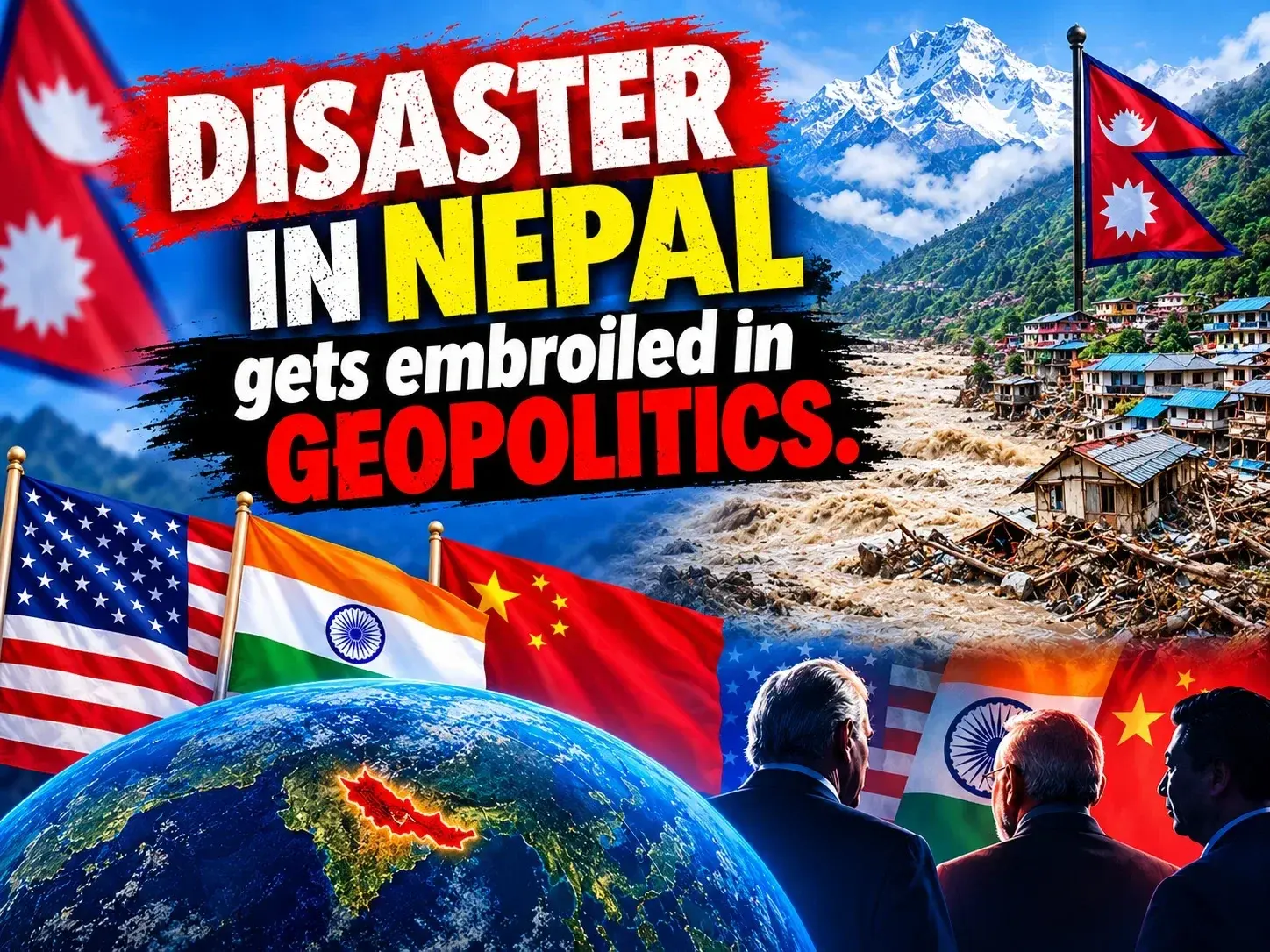
Disaster in Nepal gets embroiled in geopolitics.
By P.K.Balachandran
The devastating floods in Nepal on August 26, are now embroiled in geopolitics. On September 2, Nepal’s Foreign Minister, Shishir Khanal, blamed the world’s major greenhouse gas emitters, namely the US, India and China, for the glacial collapse that caused the floods. He also sought compensation from these countries instead of aid.
In addition, there is a charge that China, where a similar devastation occurred across the border in Tibet, did not give Nepal an early warning, though it might have had prior information.
Foreign Minister Khanal made his point while talking about Nepal’s diplomatic stance ahead of the UN General Assembly’s annual session, which will begin in New York later this month. He said that his country sees the crisis through the prism of “justice and compensation” and not “aid”.
“The major industrial emitters – such as China, which is the world’s top emitter, the United States at number two, and India at number three – have a historical responsibility to compensate vulnerable nations like Nepal,” he said.
However, he subsequently backtracked and denied asking the US, China and India for compensation and expressed “deep gratitude” for the help that India has been providing to Nepal.
No Early Warning from China
There is a feeling in Nepal that China, which is across the border, had not bothered to give an early warning of the disaster despite having the equipment for getting an early warning.
Dr Govind Raj Pokharel, who led Nepal's reconstruction effort after the Nepal earthquake of 2015 told NDTV, "I was expecting that because of the advanced satellite systems and technology they could have at least noticed an image or something like that. And they could have relayed the information to the Nepali side.””
"We need to have better coordination with China when it comes to disasters like floods or earthquakes...This border is very sensitive with climate change. There was an agreement or an understanding that they will share information regarding GLOF and other such disasters," Dr Pokharel added.
Even Relief and Compensation Are Not the Answer
In a seminal article in Kathmandu Post, Sameer Budhathoki, a Nepalese PhD scholar in International Relations, said that humanitarian charity is a sorely inadequate response to what could only be described as a “global crime.”
“Disaster response in vulnerable Least Developed Countries such as Nepal has always been discussed in a patronising way of charity for decades. The world offers relief funds and emergency supplies when a mountain collapses, or a glacier bursts. But Nepal does not suffer from a lack of local resilience, nor are its recurring ecological catastrophes mere acts of nature. They are the direct, measurable effects of an overheating planet, a crisis created thousands of miles away, in the fossil-fuel-consuming industrial capitals of the developed world.”
“Nepal is not just in need of sympathy or urgent relief supplies from abroad. The world urgently and rightly requires climate justice, structural reparations and the actualisation of compensation for climate change-induced loss and damage in Nepal.”
“ Nepal accounts for only 0.025 per cent of the global greenhouse gas emissions. It has one of the lowest carbon footprints in the world per capita, extensive rural communities subsisting on low-impact diets and its rivers producing hydroelectric power. But the country faces frontline effects of climate change despite contributing almost nothing to the carbon loading of the atmosphere.”
“This fundamental injustice has been expressed multiple times on the international political platform. Former Prime Minister Pushpa Kamal Dahal emphasised the moral essence of this crisis on September 21, 2023, during the 78th Session of the United Nations General Assembly in New York, reminding the global leaders that Nepal is bearing a punishment for a crime that it did not commit. He stressed the importance of the Himalayas helping to regulate the earth’s temperature but noted that they are melting at a much faster pace than expected, which is an injustice to Nepal.”
“The Himalayan peaks, serving as natural water towers for close to 1.4 billion people downstream in South Asia, are rapidly degrading. While the ice is melting, the permafrost is thawing, the integrity of the mountain slopes is deteriorating, and people living under those mountains have played no part in burning the responsible fossil fuels. ”
“The latest mudslides are part of a complex and interrelated eco-crisis affecting this nation at all elevations. Alarming glacial lakes such as Tsho Rolpa, Imja and Thulagi are expanding due to the rapid retreat of glaciers in the High Himalayas (above 4,000 m).”
“The losses incurred due to climate-induced disasters in Nepal range up to hundreds of millions of dollars per year, and during severe disaster years, it is estimated that as much as 1.5–2 per cent of the country’s Gross Domestic Product is lost.”
“The moral perversion of the current international financial architecture is that when Nepal’s infrastructure is wiped out by climate shocks, it often relies on multilateral loans from foreign institutions to rebuild. In short, Nepal is compelled to pay interest on foreign loans to repair the damages caused by the carbon emissions of wealthier nations, thus repeating the cycle of budget diversion, national debt growth, and decreased adaptive capacity, and increasing vulnerability to the next extreme climate event.”
“The international community needs to implement unconditional debt cancellation and Climate Debt Swaps, where externally held debts are discharged in favour of tangible investments in the mountains, forests and disaster management within the country. In this regard, there is a need for support from affluent countries in terms of investment in a transboundary Himalayan risk monitoring mechanism by establishing sophisticated early-warning systems, geological monitoring and satellite systems.”
“There is a need for robust internal governance in Nepal that will ensure accountability on the global front. Local governments should carry out strict environmental and geological impact assessments, and halt the indiscriminate and unprofessional bulldozing of fragile hill slopes for rural roads, thus greatly aggravating the landslide risk during heavy rains.”
“Compassion sustains a family for a week, and justice provides them with a future. Nepal can no longer tolerate a global arrangement whereby the key emitting countries privatise profits from carbon-based growth while shifting the devastating environmental effects onto the innocent people of the Himalayas. The time has come for the ‘Global North’ to pay its historical ecological debts to Nepal with the reparations it is rightfully owed,” Budhathoki wrote.
Indian Reaction to Nepal’s Contentions
Reacting to the Nepalese Foreign Minister, Khanal’s contentions, the Indian External Affairs Ministry’s spokesman Randhir Jaiswal said, “ India has consistently maintained that climate change is a common challenge and action in this regard must be based on the principle of common but differentiated responsibilities and respective capabilities. Developed countries which historically are responsible for the emissions and have contributed overwhelmingly to this present crisis must take the lead in reducing emissions and supporting developing countries by way of finance and technology transfer to meet this challenge.”
India has sent several consignments of relief assistance, including a large team of tunnel rescue specialists, to Nepal since the disaster struck on August 26., Jaiswal said.
Describing India as a “friend and partner” of Nepal, he added that India would continue to extend help as Nepal deals with the aftermath of this crisis.
"We need to have better coordination with China when it comes to disasters like floods or earthquakes...This border is very sensitive with climate change. There was an agreement or an understanding that they will share information regarding GLOF and other such disasters," Dr Pokharel added.
China’s Angry Retort
Beijing refuted accusations that landslides and flash floods in Nepal were due to a dam built on the Chinese side. It also refuted the charge that Beijing had failed to give an early warning to Kathmandu about an imminent disaster. The Chinese embassy in Nepal termed these allegations as fake news. “Accusations don’t help, cooperation saves lives,” the Chinese embassy added.
END
RELATED NEWS
View all
Current Affairs
The 1948 UNSC resolution on Kashmir was in India’s favour
Sep 25, 2026

Current Affairs
Sri Lankan Presidential pardons- the good and the bad
Sep 11, 2026

Current Affairs
The pros and cons of joining BRICS- the dilemma of Pakistan and Bangladesh
Sep 09, 2026
Current Affairs
Why Mecca Pact, and what does it imply for its members, Israel and India?
Aug 18, 2026