Current Affairs
Bangladesh PM’s August visit to India in jeopardy due to Hasina extradition issue
By P.K.Balachandran
Colombo, August 17 – India’s vigorous diplomacy in Bangladesh to get Prime Minister Tarique Rahman to come to New Delhi for bilateral talks with Prime Minister Narendra Modi to address multiple issues bedevilling the relationship has suffered a serious setback.
The proposed bilateral talks have stumbled on the seemingly intractable issue of the extradition of former Prime Minister Sheikh Hasina from India to Bangladesh to face a death sentence passed against her by the International Crimes Tribunal for her actions during the student unrest in July 2024.
After fleeing Bangladesh on July 5, 2024, Hasina has been living in India under State protection and also giving media interviews making serious charges against the government in Dhaka and the Bangladesh judiciary. She later declared her intention to return to Bangladesh in December to defend herself. On its part, Bangladesh feels threatened by Hasina, whose party, the Awami League, though largely discredited since 2024, still retains about 15 to 20% of the vote and is capable of fomenting street violence.
Time for Bilateral Not Opportune, says Foreign Ministry
On Sunday, Bangladesh made it clear that the time now is “not propitious” for talks with India as there is no firm commitment from India to extradite Sheikh Hasina. “We have made our position clear on this matter. We are of the view that a propitious environment needs to be created for the visit,” said AKM Shahidul Karim, the Bangladesh Foreign Ministry spokesman.
And the propitious environment can be deemed to exist only when Sheikh Hasina is extradited from India, where she is under the protection of the Indian government.
Shahidul Karim recalled that Bangladesh was involved in the process to make the bilateral talks possible, but the process was “vitiated” by Hasina’s open press interaction in New Delhi on August 5, where she had made serious charges against the Bangladesh government and the judiciary.
The Foreign Ministry spokesperson further said, “ We have requested the Indian authorities to expeditiously act on our request to extradite Sheikh Hasina and other fugitive criminals and to hand over to Bangladesh the accused killers of Shahid Sharif Osman Hadi in compliance with our bilateral extradition treaty. And we are awaiting their response.”
“We reiterate that we'll continue to pursue our Bangladesh First policy to promote friendly bilateral relations with other countries, including our neighbours, on the basis of sovereign equality, national dignity, non-interference in each other's internal affairs and mutual benefit,” he added.
August 22 to 25 Was the Window for Talks
The Indian and Bangladeshi Prime Ministers, Narendra Modi and Tarique Rahman, were to have bilateral talks in New Delhi between August 22 and 25. And both sides were working hard on it, given the fact both countries cannot afford to fight incessantly. Economic and strategic compulsions ordain cooperation, not conflict.
Landlocked Bangladesh (surrounded by India on three sides) would suffer grave economic hardship if the borders are closed, and India would have difficulty in reaching out to its sensitive North Eastern States - Assam, Meghalaya, Arunachal Pradesh, Tripura, Mizoram and Nagaland.
India’s North-Eastern States are in close proximity to the Tibet Region of China or the constantly disturbed North Myanmar. China and India have been having a boundary dispute since the mid-1950s. Though the boundary is now stable, it is still sensitive. In July, for example, local people in Subansiri district in Arunachal Pradesh State alleged in a memorandum that Chinese troops have seized their grazing and agricultural lands. The Indian army, however, denied the charge.
It was speculated in some political circles in Dhaka that in its eagerness to cultivate friendship with the Tarique Rahman-led Bangladesh Nationalist Party (BNP) government, India might restrain the fugitive former Prime Minister Sheikh Hasina from provoking Dhaka while continuing to give her shelter from the death sentence she faces back in Dhaka.
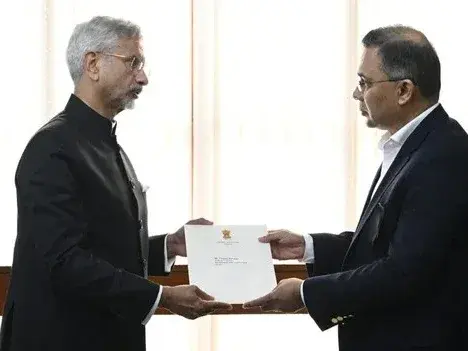
The Indian envoy in Dhaka, a Bengali-speaking veteran politician, Dinesh Trivedi, used his considerable political skills and his close ties with Prime Minister Modi to bridge the gaps between India and Bangladesh. He met Prime Minister Tarique Rahman and within hours flew to Delhi to report to Prime Minister Modi.
India’s external intelligence chief, Parag Jain, flew into Dhaka for talks with his Bangladeshi counterpart to settle some ticklish security issues. Sources in Dhaka speculated that Jain had sought an assurance that Bangladesh would not join the Makkah Defence Pact between Pakistan, Turkey and Saudi Arabia. It was said that India might have wanted to have an Indo-Bangladesh Defence Pact to counter the Makkah Pact and get Dhaka to loosen its dependence on Chinese arms.
After his high-level talks, High Commissioner Trivedi told the media that all problems could be sorted out, as both Prime Ministers, Modi and Tarique, were “people oriented” and would respond to the needs of the people. He also maintained that there were no problems between the two countries.
It is against this background that the media speculated that Tarique Rahman had been persuaded to go to New Delhi. But apparently, pressure was mounted on Tarique to avoid the meeting with Modi until there was a firm commitment from New Delhi on Hasina’s extradition. Given the public’s hostility to Hasina, Tarique had to prove to his people that he has the spine to face Delhi.
BRICS Meeting in September
Apart from the invitation for a bilateral with Modi, India had invited Tarique Rahman for the BRICS Summit Outreach in September as he is the chairman of BIMSTEC, which is the Bay of Bengal Initiative for Multi-Sectoral Technical and Economic Cooperation (BIMSTEC), an international organization of seven South Asian and Southeast Asian nations.
But Tarique had kept his cards on the matter of attendance close to his chest. It was said in Dhaka that a decision to attend would hinge on the outcome of the Tarique-Modi bilateral talks. Therefore, unless New Delhi extradites Hasina, further progress in talks is ruled out.
The current rupture in mutual goodwill might result in Hasina’s speaking out on human rights violations and other issues in Bangladesh. Her threat to go back to Dhaka in December and face the consequences no matter what they are, will raise the political temperature in Bangladesh. She would stir the political pot in Bangladesh and keep the fledgling BNP government on tenterhooks.
Exacerbation of Economic Problems
In the absence of bilateral talks, negotiations for the distribution of the waters of the river Ganga, which should begin in December, may get delayed. The distribution of the Teesta river waters is also waiting for an agreement since 2011. The development of the Teesta river basin got complicated with Dhaka and Beijing planning a joint project there, raising the hackles in New Delhi.
Mutual Dependence Makes Cooperation an Imperative
Neither India nor Bangladesh can afford to remain antagonistic to each other for long, given their mutual dependence.
Bangladesh badly needs energy support from India amid the US-Israel war on Iran that has affected global energy supplies. India has a deep interest in Bangladesh’s support to ensure the security of its Northeastern States, such as Assam, Meghalaya, Arunachal Pradesh, Mizoram, Nagaland and Tripura. India needs connectivity and trade with Bangladesh, a large trade partner.
According to The Hindu, India had communicated to the Rahman government that “if you get stuck with Hasina, you will miss the bus.”
Sources also told the paper that normalisation will have to be achieved soon, as the diplomatic window may close because of other visits and commitments scheduled for the Indian leadership in the remaining four months of the year.
END
RELATED NEWS
View all
Current Affairs
The 1948 UNSC resolution on Kashmir was in India’s favour
Sep 25, 2026

Current Affairs
Sri Lankan Presidential pardons- the good and the bad
Sep 11, 2026
Current Affairs
The pros and cons of joining BRICS- the dilemma of Pakistan and Bangladesh
Sep 09, 2026
Current Affairs
Disaster in Nepal gets embroiled in geopolitics.
Sep 08, 2026