Current Affairs
Why Mecca Pact, and what does it imply for its members, Israel and India?
By P.K.Balachandran
Colombo, August 18 - The defence pact signed in Mecca by Turkiye, Saudi Arabia and Pakistan on August 7, stemmed partly from a growing unease with the stance of the United States on security issues in West Asia, and partly from a recognition that the US under President Donald Trump wishes to lessen its involvement in West Asia and concentrate more on the Russian threat to Europe and China’s threat to Taiwan and the South China Sea.
But the Mecca Pact has other consequences. Israel’s relations with the US and India will be strengthened, and India’s relations with Pakistan and Turkiye will further deteriorate.
Arab Countries’ Rationale
Arab countries which had handed over their security to the US and given it bases on their soil, felt let down when Washington seemed more interested in defending and encouraging Israel’s aggression against other countries in the region than in protecting its Arab allies from a well-equipped and aggressive Iran.
It seemed to the signatories of the Mecca Pact and other countries in the region that the US had begun to use Israel as its satrap in the Middle East to carry out its policies for the region.
The US’s emerging attitude to West Asia suits Israel as it will have the freedom to carry out aggression in Gaza, Lebanon, Iran or wherever it wants while its access to American funds and armaments remains unchanged.
An Israel that is left free to do what it wants will be a permanent threat to every country in the Middle East. It is to defend themselves from a rogue State, that Saudi Arabia, Turkiye and Pakistan have forged the Mecca alliance.
While Saudi Arabia and Turkiye are directly threatened by Israel, Pakistan is not. But Pakistan has military manpower and has nuclear weapons, which are an excellent deterrent against any threat to it or its allies. Pakistan has a history of military involvement in West Asia. It sent its forces and fighter jets to Saudi Arabia as per an agreement. It has helped defend Jordan against the Palestinian rebels, killing thousands of them. In addition, Pakistan can also play a mediatory role between Saudi Arabia and Iran, having fraternal relations with both.
It is significant that the US has not objected to the Mecca Pact. It would want its defence responsibilities in West Asia off its shoulders. Israel, as expected, feels threatened by the pact. It has said that the pact will push normalisation with Saudi Arabia further out of reach. And Israel has always considered Turkiye a threat to it on par with Iran.
Israel is expected to respond along two parallel axes – strengthen its existing Mediterranean alliance with Greece and Cyprus, and form a new counter pact with the United Arab Emirates (UAE) and India. Israel already has a strong defence relationship with India.
Ms Oshrit Birvadker, a senior research fellow at the Jerusalem Institute for Strategy and Security (JISS) writes in www.israelhayom.com to say that the Mecca Pact is a 'Muslim NATO'. It marks a strategic turning point in the Middle East and South Asia, bringing together the custodian of Islam's holiest sites (Saudi Arabia), a nuclear power (Pakistan) and a NATO member (Türkiye). This combination is fit enough to accelerate the regional and global arms race.
The development poses significant challenges for Israel, pushes the prospect of normalisation with Saudi Arabia further out of reach and cuts short the vision of a "new Middle East" Envisaged by the Abraham Accords. Israel's appropriate response should be to immediately tighten coordination with the United Arab Emirates and India, Birvadker says.
Although the member states portray the agreement as a collective defence mechanism, a NATO-style mutual defence clause guaranteeing mutual military assistance, is far from a guarantee of action, as previous alliances have demonstrated, including the Saudi-Pakistani agreement signed in September 2025. Also, at this stage, there is no indication that Pakistan is extending a nuclear umbrella to its partners, she points out.
Roles the Trio Will Play
Turkey is emerging as a major threat to Israel, no less significant than Iran, Birvadker says. Turkiye will seek to use the alliance to expand its influence in the Gulf and challenge Israel both diplomatically and militarily.
Pakistan, for its part, continues to consolidate its position as an influential player while demonstrating the value of its strategic assets to the US amid the continuing deadlock and lack of a solution to the confrontation with Iran. Islamabad has a long history of cooperation with Riyadh. Their security relationship has traditionally rested on a bilateral arrangement in which Saudi Arabia provided financial and energy support while Pakistan supplied military capabilities and personnel.
The Ankara-Islamabad axis is gaining momentum, with security procurement and industry at its core. Turkey is now Pakistan's second-largest arms supplier, and the two countries are moving beyond off-the-shelf procurement toward deeper cooperation involving the joint development and production of technology from the ground up.
More recently, at an industry exhibition held in Pakistan with representatives from 32 institutions in the two countries, Turkish Defence Minister Yaşar Guler said an official agreement for Pakistani participation in the development and production of the KAAN fighter jet was close to completion. The relationship became particularly significant during the India-Pakistan confrontation in May 2025, when Turkish drones were deployed.
A trilateral framework modelled on the "Mecca Pact" could now give the trio a dramatic boost. Massive Saudi financial backing, from a country that ranks among the world's highest military spenders, would allow Riyadh to tighten its control over defence-sector supply chains. At the same time, Saudi Arabia and Pakistan would gain faster access to advanced defence technologies, intelligence cooperation, and Turkish expertise and training.
UAE
The UAE, which has watched the expansion of Turkish influence in the Middle East with concern, particularly because of Ankara's links to political Islamist movements including the Muslim Brotherhood, is likely to find itself at the centre of a new source of friction with Riyadh, Birvadker says.
The Emirates, it should be recalled, was the leading Arab state to break with the long-standing regional consensus and establish formal relations with Israel under the 2020 Abraham Accords. Since then, Abu Dhabi has further deepened and expanded its strategic and defence cooperation with Israel, despite public criticism from senior Emirati officials over Israel's fighting in Gaza and Lebanon.
Although the UAE imports fewer weapons than Saudi Arabia, it nevertheless ranks among the world's major arms buyers, reflecting a clear strategy: "small but lethal." Abu Dhabi's policy of diversifying its suppliers, born of necessity during the Obama administration, led it to deepen its strategic and defence partnership with Israel while rapidly strengthening its alignment with India. Cooperation with New Delhi has since moved to a new level with the signing of a strategic framework agreement, culminating in a multibillion-dollar deal now taking shape for the acquisition of BrahMos missiles, Birvadker says.
India
New Delhi is concerned not only about the military strengthening of its Pakistani rival, but also that Pakistan could become a conduit through which Turkey expands its strategic footprint in South Asia. Against this backdrop, India will likely have to deepen coordination with countries affected by Turkey's expanding reach, strengthen its defence and intelligence capabilities, and build additional regional partnerships in maritime security, intelligence and economics.
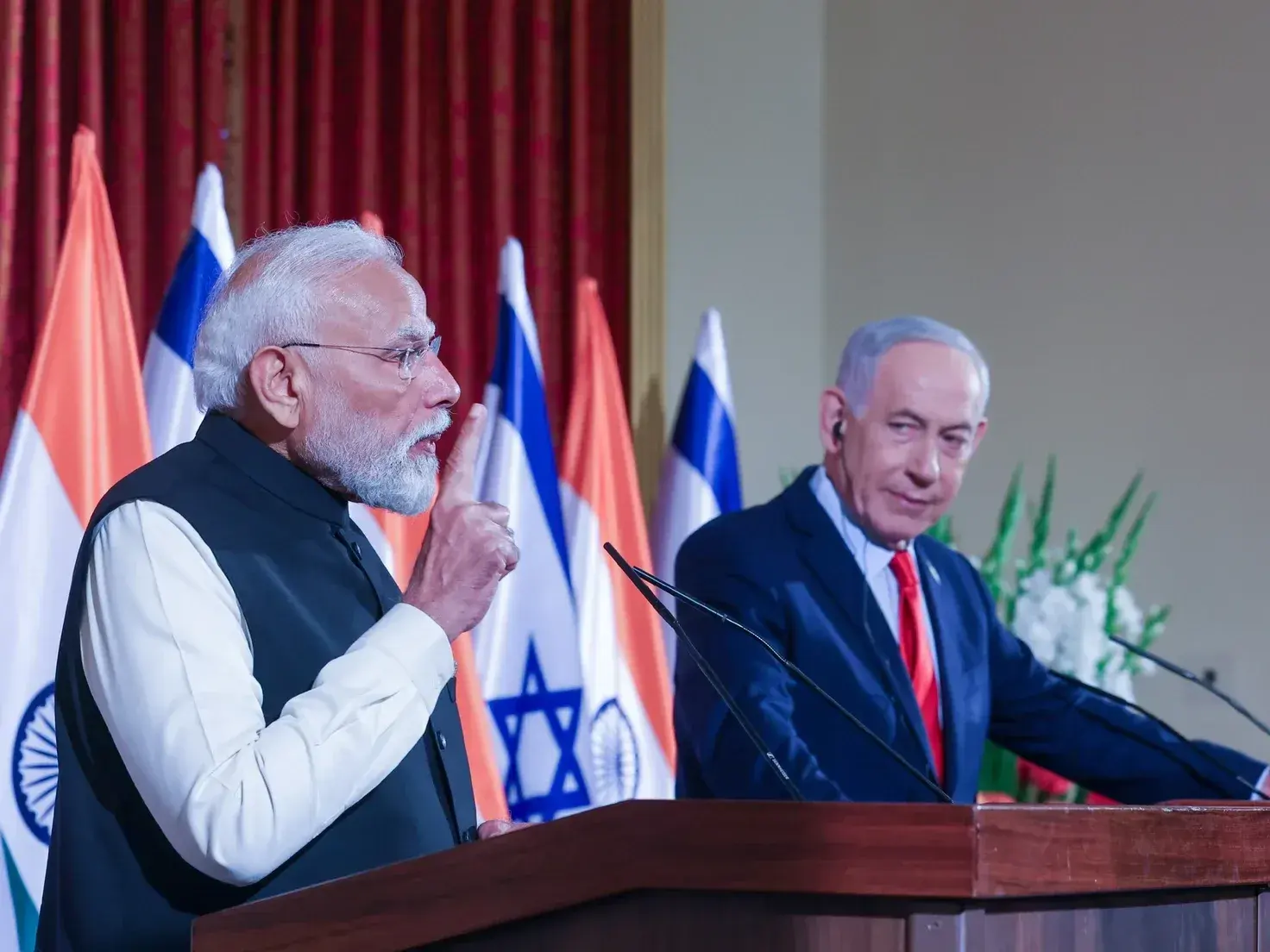
Strategic relations between Israel and India, which flourished under the leadership of Prime Minister Benjamin Netanyahu and Indian Prime Minister Narendra Modi and produced diplomatic backing, military assistance and an expansion of production lines, are emerging as a critical component of Israel's national resilience in the face of the threat of arms embargoes and international isolation, Birvadker says.
The UAE, India and Israel have been bound by overlapping interests, close relations and a deep foundation of mutual trust. That makes such an alliance an essential geopolitical anchor for stabilising the region and containing the threats now taking shape, according to Birvadker.
Thus, the Mecca Pact does not take West and South Asia toward peace. It ensures security for some and causes insecurity among others. Far from resolving conflicts, it strengthens some countries against perceived aggressors, who in turn are encouraged to beef up their defences.
END
RELATED NEWS
View all
Current Affairs
The 1948 UNSC resolution on Kashmir was in India’s favour
Sep 25, 2026

Current Affairs
Sri Lankan Presidential pardons- the good and the bad
Sep 11, 2026
Current Affairs
The pros and cons of joining BRICS- the dilemma of Pakistan and Bangladesh
Sep 09, 2026
Current Affairs
Disaster in Nepal gets embroiled in geopolitics.
Sep 08, 2026