Latest News
SC has already ruled judges' retirement age change requires referendum: Sajith
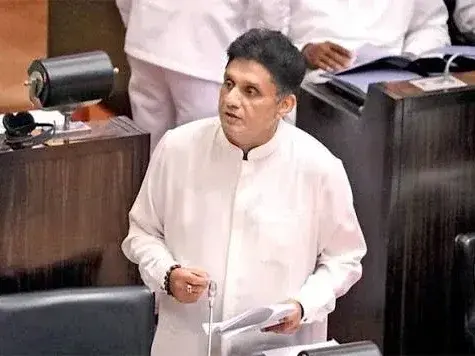
Opposition and Samagi Jana Balawegaya (SJB) Leader Sajith Premadasa on Tuesday (4) told Parliament that the Supreme Court had already ruled that any constitutional amendment seeking to extend the retirement age of Supreme Court and Court of Appeal judges would require approval at a referendum, as such a move would impinge on the independence of the judiciary.
Making a special statement under Standing Order 27/2, Premadasa cited the Supreme Court's 2022 determination on the constitutionality of the Inland Revenue (Amendment) Bill, delivered by Justices Buwaneka Aluwihare, PC, Murdu N.B. Fernando, PC, and Janak De Silva. Reading from the determination, he said the Court had held that, unlike other public officers, the retirement age of Supreme Court and Court of Appeal judges is specifically entrenched in the Constitution and that any constitutional amendment affecting the retirement age or tenure of incumbent judges, directly or indirectly, would violate Article 3 of the Constitution and therefore require approval at a referendum.
Premadasa urged the Government to heed the Supreme Court ruling, alleging that despite the determination, the Justice Minister and the Chief Government Whip had publicly stated that a referendum would not be necessary.
The Opposition Leader said the Government had justified the proposal as a measure to improve judicial efficiency, but noted that several organisations, including the Bar Association of Sri Lanka (BASL), had opposed it. He added that a 2023 report prepared for the Ministry of Justice with technical assistance from the Asian Development Bank (ADB) had identified other priorities for improving the administration of justice.
Questioning whether the retirement age proposal formed part of a broader judicial reform programme, Premadasa called on the Government to present the remaining reforms together with a clear implementation timetable. Referring to an estimated backlog of 1.1 million pending cases, he said meaningful reform should be based on a comprehensive feasibility study and questioned why the Government had not relied on the 506-page judicial assessment report prepared in 2024 or commissioned a similar study.
He also sought clarification on whether the Government had adequately consulted the BASL, the Law Commission, the Attorney General's Department and the Judicial Service Commission before proceeding with the constitutional amendment. He claimed judges themselves had rejected the proposal by a margin of 65-0 and said several international legal organisations had also expressed concern that the move could undermine judicial independence.
Premadasa further called on the Government to disclose studies demonstrating that extending judges' retirement ages, without first filling existing vacancies in the Supreme Court and lower courts, would reduce delays in the administration of justice. He also sought details of the performance indicators the Government intended to use to measure the success of judicial reforms, the expected impact of the proposed amendment, and the timeline for gazetting and presenting the Bill to Parliament.
Responding, Justice Minister Harshana Nanayakkara said the proposal to extend judges' retirement ages was only one element of a broader judicial reform programme that had been underway since the Government assumed office. He said the reforms included increasing the number of courts, establishing additional High Courts in areas with heavy case backlogs, recruiting judges and magistrates, and implementing recommendations contained in an ADB-supported judicial efficiency assessment comprising more than 160 recommendations.
The Minister said the Government had also considered proposals made by a Constitutional Council subcommittee headed by Rauff Hakeem and recommendations submitted by former BASL President Jeffrey Alagaratnam. He said the draft Bill had been received from the Legal Draftsman's Department on July 28, 2026, and certified by the Attorney General on July 31 as being consistent with the Constitution. It would be gazetted after Cabinet approval and presented to Parliament after the expiry of the mandatory seven-day period following publication in the Gazette.
RELATED NEWS
View all

Latest News
New Bill seeks to eliminate rabies and regulate dog ownership in Sri Lanka
Sep 24, 2026

Latest News
Screen time rising among Sri Lankan preschool children, Health Ministry warns
Sep 24, 2026

Latest News
China to deploy meteorological early-warning system in Sri Lanka
Sep 24, 2026

Latest News
Government moves to ease prison overcrowding as remand population falls, Justice Minister says
Sep 23, 2026