Columns, Volume 2
Why Not An Export Industry?
January 24, 2019

The Debate of export status
There has been some debate, of late, on whether tourism qualifies to be an export industry. This argument has been fuelled by the age old definition of an export industry as one which ‘exports goods and services produced and purchased by residents of another country’.
The problem stems from the wording ‘…purchased by residents of another country’.
However, the modern day interpretations are different from the classical one. What is the harm if such goods and services, are purchased by ‘residents of another country’ in the same country of production, provided they pay for it in foreign currency? Would this actually not be better for the economy, in general? There would not be the burden of shipping costs, insurance and other overheads needed to ‘export’ such goods to foreign countries. This will result in such goods and services being able to be more competitive and add greater value.
Tourism has, therefore, been labelled as an ‘invisible export industry’
The key factor in this argument is that the payment should be in foreign exchange.
Tourism clearly conforms to all these requirements. The goods and services are produced in one country, and ‘sold’ and consumed in the same country itself paid for in foreign currency.
Hence, today, many countries already accept the fact that tourism is an export industry.
Recognition of tourism as an export industry-
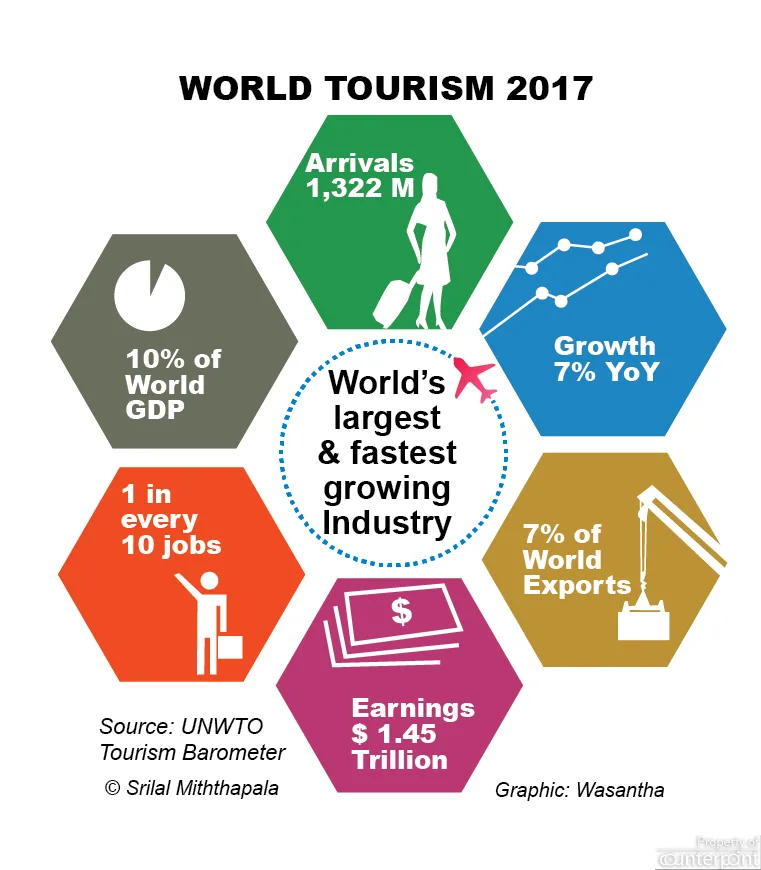 With South Asia showing the largest growth trends it is said that the Asia Pacific region will see the biggest economic impacts from growth of the tourism industry. Due to its large trickle down and multiplier effects (see below) the tourism industry has even a greater positive impact on emerging economies such as Sri Lanka.
Tourism has a large multiplier effect
Tourism supports and nurtures a wide range of peripheral activities generating potential livelihoods for a wide cross section of the people in the informal sector. It is estimated that in addition to tourism contribution in the South-Asian region from direct earnings to the GDP, there could be as much as an equal amount that comes from the informal sector. (Ref: TRAVEL & TOURISM ECONOMIC IMPACT 2018)
With South Asia showing the largest growth trends it is said that the Asia Pacific region will see the biggest economic impacts from growth of the tourism industry. Due to its large trickle down and multiplier effects (see below) the tourism industry has even a greater positive impact on emerging economies such as Sri Lanka.
Tourism has a large multiplier effect
Tourism supports and nurtures a wide range of peripheral activities generating potential livelihoods for a wide cross section of the people in the informal sector. It is estimated that in addition to tourism contribution in the South-Asian region from direct earnings to the GDP, there could be as much as an equal amount that comes from the informal sector. (Ref: TRAVEL & TOURISM ECONOMIC IMPACT 2018)
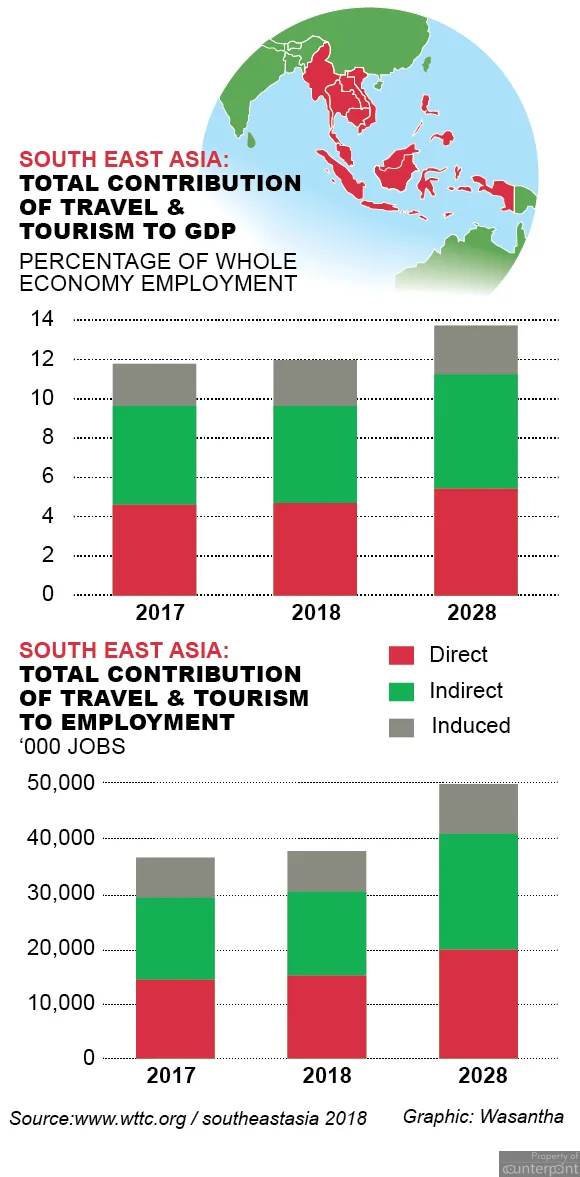 A large trickledown effect
Tourism, unlike any other industry, has a large trickledown effect on the informal sector, generating many diverse job opportunities. Here again for every job in the formal sector (direct) there will be more than one job opportunity created in the informal sector (indirect).
A large trickledown effect
Tourism, unlike any other industry, has a large trickledown effect on the informal sector, generating many diverse job opportunities. Here again for every job in the formal sector (direct) there will be more than one job opportunity created in the informal sector (indirect).
Sri Lanka tourism and Foreign exchange earnings
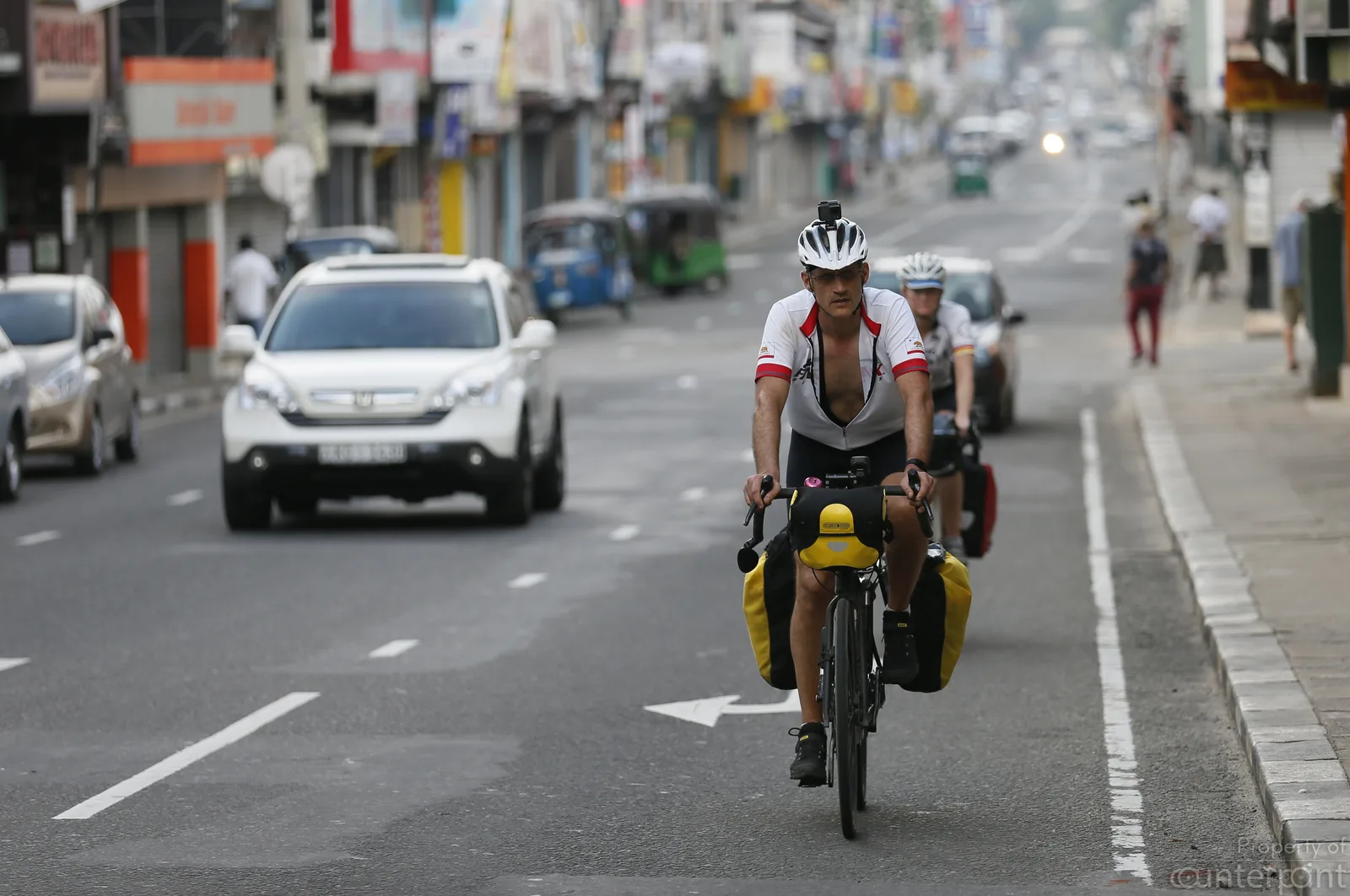 Many tourists enjoy travelling around the country using cheap modes of transport.[/caption]
All raw material and accessories for apparel manufacture is imported at around 18 per cent of our total import expense (based on data from World Integrated Trade Solution) in 2017. This means from the USD 5.0 B earnings, about USD 3.9 B was imported raw material cost. Hence the real value added of Textile & Garments is in the order of USD 1 B only (http://www.dailymirror.lk/article/Coming-out-of-this-Fools-Paradise--156769.html)
In the case of the tourism industry in Sri Lanka, it is estimated that about 90% of all foreign exchange earnings are based on value addition, with only marginal imports.
Many tourists enjoy travelling around the country using cheap modes of transport.[/caption]
All raw material and accessories for apparel manufacture is imported at around 18 per cent of our total import expense (based on data from World Integrated Trade Solution) in 2017. This means from the USD 5.0 B earnings, about USD 3.9 B was imported raw material cost. Hence the real value added of Textile & Garments is in the order of USD 1 B only (http://www.dailymirror.lk/article/Coming-out-of-this-Fools-Paradise--156769.html)
In the case of the tourism industry in Sri Lanka, it is estimated that about 90% of all foreign exchange earnings are based on value addition, with only marginal imports.
- Australia has a Tourist Export Council (https://www.atec.net.au/)
- The World Travel & Tourism Council (WTTC) (https://www.wttc.org/publications/other/travel-and-trade-linkages/)
- Jamaica Tourist Board (http://www.tourismandmore.com/tidbits/tourism-is-export/)
- The Singapore Tourism Board (STB) is a statutory board under the Ministry of Trade and Industry of Singapore, which indicates the importance placed in it as an export industry
- The Indian Tourism Industry( proposed) (https://www.indiainfoline.com/article/news-union-budget-sector-analysis/union-budget-tourism-tourism-industry-be-given-industry-export-and-infrastructure-status-117020100273_1.html)
- Pakistan – deemed export status (http://www.tourism.gov.pk/pdf/ntp_1990.pdf)
- US$ 8.3 trillion contribution to global GDP (10.4%)
- 313 million jobs, 1 in 10 jobs around the world
- US$1.5 trillion exports (6.5% of total exports, 28.8% of global services exports)
- US$882 billion investment (4.5% of total investment).
With South Asia showing the largest growth trends it is said that the Asia Pacific region will see the biggest economic impacts from growth of the tourism industry. Due to its large trickle down and multiplier effects (see below) the tourism industry has even a greater positive impact on emerging economies such as Sri Lanka.
Tourism has a large multiplier effect
Tourism supports and nurtures a wide range of peripheral activities generating potential livelihoods for a wide cross section of the people in the informal sector. It is estimated that in addition to tourism contribution in the South-Asian region from direct earnings to the GDP, there could be as much as an equal amount that comes from the informal sector. (Ref: TRAVEL & TOURISM ECONOMIC IMPACT 2018)
A large trickledown effect
Tourism, unlike any other industry, has a large trickledown effect on the informal sector, generating many diverse job opportunities. Here again for every job in the formal sector (direct) there will be more than one job opportunity created in the informal sector (indirect).
- Sri Lanka Tourism revenue exceeds USD 3.5 billion in 2017
- 2017 ref CBSL Economic Research Department-06.04.2018
- Worker Remittances USD 2B
- Textiles & Garments USD 5.0 B
- Tourism USD 3.9 B
Many tourists enjoy travelling around the country using cheap modes of transport.[/caption]
All raw material and accessories for apparel manufacture is imported at around 18 per cent of our total import expense (based on data from World Integrated Trade Solution) in 2017. This means from the USD 5.0 B earnings, about USD 3.9 B was imported raw material cost. Hence the real value added of Textile & Garments is in the order of USD 1 B only (http://www.dailymirror.lk/article/Coming-out-of-this-Fools-Paradise--156769.html)
In the case of the tourism industry in Sri Lanka, it is estimated that about 90% of all foreign exchange earnings are based on value addition, with only marginal imports.
RELATED NEWS
View all

WEELKY POLITICAL WATCH
Arrests eclipse battle over 22nd Amendment
Sep 04, 2026

Columns
Easter Sunday carnage probe: UNP makes strategic move
Jun 21, 2026

Columns
Indian Sinologist Shikha Pandey finds Xinjiang to be an appealing blend of the ancient and the ultra-modern
Nov 22, 2023

Current Affairs
World's medical fraternity wakes up to the need to study “medical atrocities”
Nov 16, 2023