Current Affairs
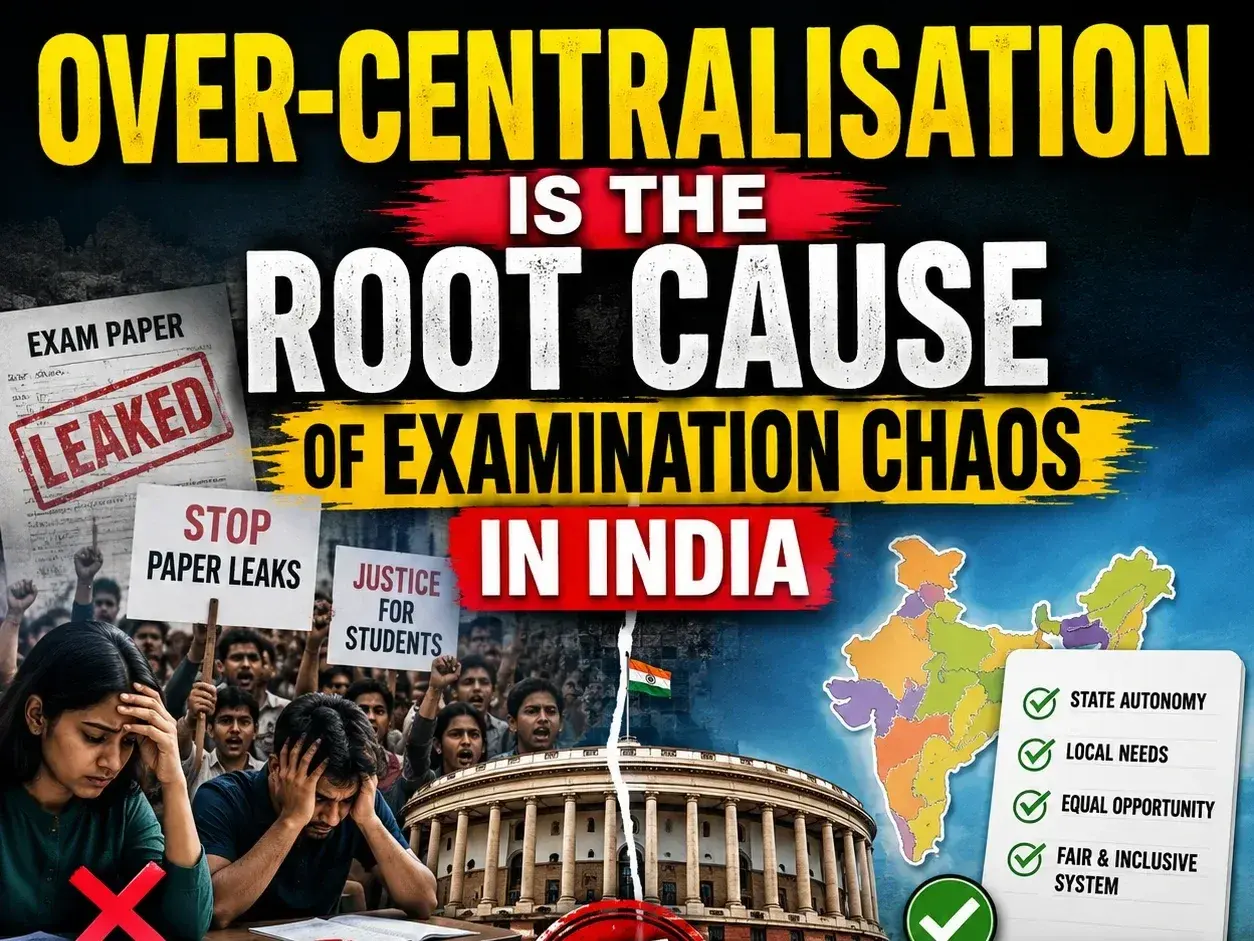
Over-centralisation is the root cause of examination chaos in India
By P.K.Balachandran
Colombo, July 28 – The birth of the Cockroach Janata Party (CJP) in India, its nation-wide agitation against the leakage of examination papers, and the eventual resignation of the Union Education Minister Dharmendra Pradhan, have made the Indian government set up a high- powered committee of experts to design a foolproof all-India examination system.
But it is feared that the committee could climb up the wrong tree by only plugging loopholes in the existing system that had led to leakage of exam papers year after year. The real problem is not these loopholes but the centralisation of exams wherein corruption or leakage in one place leads to the collapse of the whole system, affecting the careers of millions of aspirational Indians struggling to get an education and jobs.
The one-size-fits-all approach of the Bharatiya Janata Party-led Union government was reflected in the setting up of the National Testing Agency (NTA) for undergraduates in the field of medicine and engineering in 2017. The NTA’s activities have been the cause of nightmares for millions of students across India, says an analysis by www.newsminute.com
The agency’s inefficacy was exposed in a blizzard of question paper leak allegations in the run-up to the National Eligibility cum Entrance Test for undergraduates (NEET-UG) for admissions to medical courses on May 5, 2026.
NTA’s callousness led to the escalation of the situation on June 4, when the results of 2.4 million candidates were declared. What followed was a series of events that led the agency to cancel and postpone other major exams, causing colossal disruption, frustration and suicides.
The BJP government argued that a single agency to conduct exams would help tackle corruption, prevent backdoor entry and ensure uniform standards across India. The Narendra Modi government was committed to standardisation in all spheres of life in India to build a united India. But this disregarded local conditions and local social and economic structures. The government has been looking at India from New Delhi, or more precisely from the urban Indian and upper-caste and upper-class angle and designing systems to suit these forward sections of society.
The National Testing Agency (NTA) was registered in 2018 bypassing Parliament where it could have been debated, and a real consensus arrived at. The Union government was naturally accused of diluting the autonomy of States, which, under the Constitution, had the right to conduct education.
Education has been a bone of contention between the Indian States and the Union government since Independence. The NTA was oblivious to sharp variations between the Indian States, and to the diversity of social and economic conditions. It believed in imposing a “one size fits all” system for the whole of India.
When the NEET-UG exam system collapsed in May, June and July, the government was taken aback. But apparently no lessons were learnt. The new committee led by IT technologist Nandan Nilekani is not going to dilute centralisation; it will only tighten it, as the government’s brief for it is unlikely to be different given the Modi government’s fixation with centralization.
Over the years, a number of States have argued that NEET disadvantages students from rural areas, government schools and State boards while favouring those passing out through the Central Board of Secondary Education schools supplemented by expensive coaching institutes.
The NEET-UG paper leak in 2026 reignited demands to scrap the national medical entrance exam and allow state-specific alternatives. The States, especially Tamil Nadu, have also maintained that repeated controversies involving the NTA have eroded public confidence in the examination process. The Central government, however, continues to maintain that a common entrance test is essential to ensure uniform standards across the country.
Tamil Nadu Leads
Tamil Nadu has consistently led the opposition to NEET since it was made mandatory. Its current Chief Minister C Joseph Vijay has urged the Union government to respect the sentiments of students and the people by scrapping the examination, saying that abolishing it is the only lasting solution to the issue.
Seeking to replace NEET with a Class 12 (high school) marks-based admission system, Tamil Nadu State Assembly unanimously approved the “Tamil Nadu Admission to Undergraduate Medical Degree Courses Bill.” But the Indian President withheld assent to it, leading Tamil Nadu to challenge the decision before the Supreme Court.
Tamil Nadu has maintained that NEET adversely affects Tamil-medium students, candidates from government schools, rural backgrounds and first-generation learners, undermining Tamil Nadu's long-standing social justice-oriented admission policy.
Karnataka
Karnataka has joined the chorus against NEET. The Congress government there urged the Centre to scrap NEET-UG and revive the Karnataka Common Entrance Test (CET) for medical admissions. The State passed a resolution in the Assembly supporting the move, arguing that its own entrance test is better suited to local students and offers a fairer admission process than a national examination.
West Bengal
The West Bengal government under former Chief Minister Mamata Banerjee also opposed NEET, with its Assembly passing a resolution seeking to replace the national exam with a state-level entrance test. The State argued that excessive centralisation of medical admissions weakened the autonomy of States in education.
Andhra Pradesh, Telangana and Jammu & Kashmir have also challenged NEET legally. Kerala too raised concerns over the examination and advocated giving States more flexibility in medical admissions.
But States’ Hands are Tied by the Law
But under Section 14 of the National Medical Commission (NMC) Act, 2019, NEET is the mandatory entrance examination for undergraduate medical admissions across all medical colleges -- government, private and deemed universities, www.newsminute.com.
The constitutional position also favours the Centre. While medical education falls under the Concurrent List, the Union government has overriding powers to determine standards in higher education under Entry 66 of the Union List.
In case of any conflict between a Central law and a State law, Article 254 provides that the central law prevails unless the State legislation receives Presidential assent. Thus, the States are stuck.
And the Supreme Court has, on multiple occasions, upheld NEET as a valid mechanism for maintaining uniform academic standards and ensuring merit-based admissions. Challenges seeking exemptions, including those from Tamil Nadu, have not succeeded.
That the Central government is determined to pursue its centralising line is evident from the members appointed to the new Committee formed to reform the examination system.
The high-powered task force on “revamping examinations by the NTA” is almost completely filled with technocrats and bureaucrats who have little to do with education. It will be led by the IT company Infosys’ co-founder Nandan Nilekani; former Intelligence Bureau chief Tapan Deka (educational experience nil), former ISRO chairman S. Somanath (education experience nil), Indian Institute of Technology Madras Director V. Kamakoti; Gujarat cadre bureaucrat Anita Karwal (who was education secretary) and former Coal Ministry Secretary Amrit Lal Meena (education experience nil).
There is no sociologist or political scientist or any constitutional expert in the committee to advice on social and economic problems generated by NEET-UG. And technocrats and bureaucrats tend to think of centralisation and standardisation as the pathway to the foolproof functioning of any system, even as it has been proved that this is false.
END
Share this story
RELATED NEWS
View all
Current Affairs
Bloody killings mar the backdrop of Bollywood films
Oct 20, 2026

Current Affairs
UNHRC Special Rapporteurs write to Sri Lankan President their concerns about the NGOs’ bill
Oct 02, 2026
Current Affairs
Denial of the right to vote is not new in India
Oct 01, 2026
Current Affairs
The 1948 UNSC resolution on Kashmir was in India’s favour
Sep 25, 2026