Current Affairs, parliament
The motion that went nowhere
By Lobby Correspondent
There are many ways for a government to survive a no-confidence motion. It can defeat it, rally its MPs, defend its record and put the matter to a vote. Or, it can allow the motion to disappear into parliamentary procedure while the House moves on to other business.
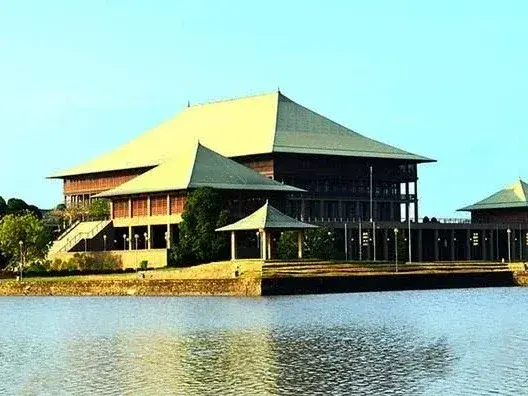
That is what makes the current situation particularly striking. While the Second Reading debate on Budget 2027 is now in progress in Parliament, the Opposition's no-confidence motion against Speaker Dr Jagath Wickramaratne remains unresolved: caught between the Order Book, Standing Orders and competing interpretations of parliamentary procedure.
The Opposition says it should have been allowed to proceed. The government says the Opposition failed to comply with the required procedure.
So, while MPs debate how the country should be governed and public money should be spent in 2027, Parliament has yet to decide a much simpler question: whether its Speaker continues to command the confidence of the House.
A government can allow the motion to disappear somewhere between the Order Book and the Standing Orders.
That, increasingly, appears to be the fate of the Opposition's no-confidence motion against Speaker Dr Jagath Wickramaratne.
The motion was submitted on October 9 by 44 Opposition MPs to Secretary-General of Parliament Kushani Rohanadeera. It contained 50 allegations or charges concerning alleged violations of laws, the Constitution and parliamentary rules. The allegations have not been judicially established. The motion was entered in the Order Book on October 12, apparently setting the stage for a parliamentary confrontation.
But the confrontation never happened.
On October 27, Parliament announced that a revised no-confidence motion would be debated on November 3. Three days later, Leader of the House Bimal Rathnayake announced that the debate would not take place, saying the Opposition had failed to amend and resubmit the motion by the October 28 deadline in accordance with the Standing Orders. He said the Government would provide time for a revised motion before the Budget debate if the Opposition resubmitted it properly.
The Opposition rejected that position.
On November 3, instead of debating the motion, Opposition MPs protested in Parliament, arguing that the Government had improperly prevented it from being taken up. The dispute produced tense scenes in the House.
The matter then moved from the floor of Parliament into the equally fascinating world of parliamentary privilege. On November 6, Deputy Speaker Rizvie Salih announced that five privilege complaints connected with the no-confidence motion had been rejected. The ruling was that matters concerning the Order Book, scheduling and parliamentary procedure did not amount to breaches of parliamentary privilege.
By November 10, the Opposition was still refusing to amend or submit a fresh motion. Chief Opposition Whip Gayantha Karunatilleka said the Opposition had no intention of withdrawing the existing motion.
Then, on November 12, SJB MP Ajith P. Perera said the original motion was now out of the parliamentary process after being rejected and that a fresh motion would therefore be necessary if the Opposition wished to pursue the matter. The SJB was also considering complaints to the Inter-Parliamentary Union and Commonwealth Parliamentary Association.
So, a no-confidence motion that began with 44 signatures and 50 allegations has ended, for the moment, without a vote. There is something almost comic about the situation. A no-confidence motion is supposed to answer a relatively straightforward question: does Parliament have confidence in the person holding office or does it not?
Yet before Parliament can answer that question, it has become necessary to decide whether Parliament can ask it at all. The Government says the Opposition must follow parliamentary procedure. Quite right. Parliament needs rules. Without them, the chamber would become little more than a particularly noisy public meeting.
But rules are most convincing when they are applied consistently and transparently.
The Opposition, meanwhile, cannot claim the moral high ground merely because it has been denied a vote. If parliamentary authorities identified procedural shortcomings, refusing to make the required amendments and then complaining that the motion cannot proceed is hardly an unanswerable argument either.
Both sides have therefore found refuge in principle.
The government has found refuge in procedure.
The Opposition has found refuge in political principle.
And the public is left wondering whether either side actually wants the matter settled.
A vote would produce a winner and a loser.
A procedural dispute produces something much more useful to politicians: continuing political ammunition.
The Opposition can accuse the Government of suppressing debate. The Government can accuse the Opposition of ignoring parliamentary procedure. Both can invoke democracy. Both can issue statements.
And the Speaker remains in the chair.
That is an almost perfect political arrangement.
The episode also comes amid a wider argument over the Government's approach to constitutional change, particularly the 22nd Amendment.
Critics have alleged that constitutional changes were politically motivated and designed to retain a person favourable to the Government in office. Those are political allegations, not established facts.
The official description of the amendment is considerably more prosaic. Among its provisions were increases in the retirement age of Supreme Court judges from 65 to 67 and Court of Appeal judges from 63 to 65, while the number of Court of Appeal judges increased from 19 to 24.
Whether those changes constitute necessary judicial reforms or political engineering is a legitimate subject for debate.
But the distinction between what an amendment actually says and what politicians say it was intended to achieve matters.
In Sri Lankan politics, constitutional amendments rarely remain merely constitutional amendments. When in government, politicians tend to describe constitutional changes as reforms. When in opposition, they are more likely to describe them as political engineering. The same political flexibility is visible in the current dispute over the Speaker.
There is nothing wrong with insisting on procedure. Nor is there anything wrong with challenging an interpretation of procedure. But procedure should ultimately facilitate parliamentary accountability, not replace it.
If the Opposition genuinely believes that the Speaker has committed serious wrongdoing, those allegations deserve to be tested in Parliament. If the Government believes the allegations are baseless, it should have the opportunity to defeat them.
That is what parliamentary accountability is supposed to mean.
Instead, the country has spent weeks discussing a no-confidence motion without discovering whether Parliament actually has confidence in the person against whom it was brought.
The public has seen the signatures. It has heard the allegations. It has watched the protests and the tense scenes in the House. It has heard arguments about Standing Orders, privilege and the Order Book.
What it has not seen is the one thing that could settle the political question: a vote.
If the motion was procedurally defective, Parliament should explain precisely why. If it was capable of being corrected, the Opposition should decide whether it wants to correct it. If a fresh motion is now required, the Opposition must decide whether it wants to bring one.
But a parliamentary democracy should not leave the public permanently suspended between an allegation and an answer.
The Government remains in government. The Opposition remains in opposition. The Speaker remains Speaker.
And the no-confidence motion?
It has travelled from the Order Book to procedural arguments, from the floor of the House to privilege complaints, and finally to the question of whether a fresh motion is needed.
Plenty has been said about confidence.
Parliament, however, has yet to express any.
Perhaps, that is the newest parliamentary art: winning without voting, losing without being defeated, and calling the whole thing procedure.
Share this story
RELATED NEWS
View all
Current Affairs
Killers of journalists go untraced in 90% of cases, the UN says
Nov 03, 2026
Current Affairs
India’s new privacy law would chain the media, leading publishers including Ambani and Adani tell the Supreme Court
Oct 28, 2026

Current Affairs
Netanyahu’s Likud trails Eisenkot’s Yashar in Israeli pre-poll surveys
Oct 23, 2026

Current Affairs
Bloody killings mar the backdrop of Bollywood films
Oct 20, 2026