Current Affairs
Afghan Foreign Minister’s Delhi visit could lead to diplomatic recognition
India is likely to join major countries that had shed reservations about the Taliban’s human rights record to exploit its locational advantages and rich mineral resources.
By P.K.Balachandran
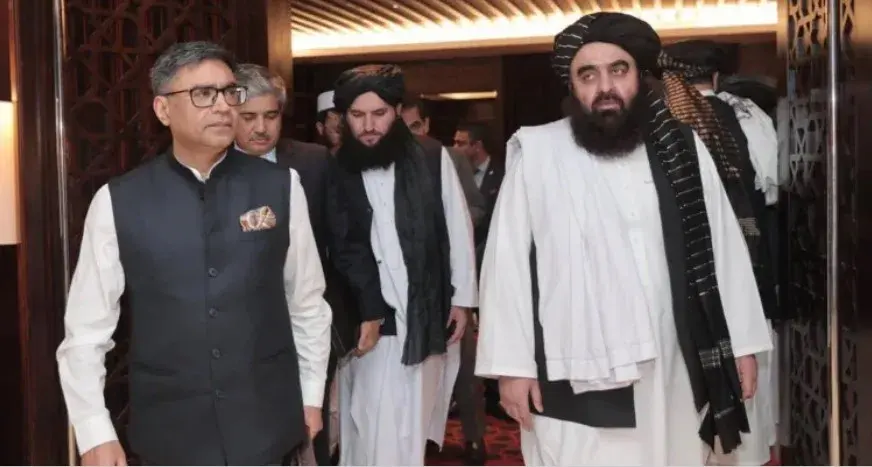
Colombo, October 7 – The visit of Afghanistan’s Foreign Minister Amir Khan Muttaqi to New Delhi on October 9 might well be a prelude to India’s giving formal diplomatic recognition to the Taliban-ruled country.
The reasons for recognising the Taliban as the legitimate ruler of Afghanistan are two: (1) major regional and global powers are now knocking at the door of the once despised Taliban, attracted by Afghanistan’s geographical location and its yet unexploited mineral wealth. (2) the courage shown by the Taliban when it supported India during Operation Sindoor against Pakistan and be among only three countries that did so.
India’s gratitude for the Taliban’s gesture was expressed by External Affairs Minister S. Jaishankar. And come October, India will have Foreign Minister Muttaqi in New Delhi to deepen bilateral relations. Significantly, the visit would be taking place with a UNSC sanctions waiver sought and secured by India.
Taliban-ruled Afghanistan was treated as an international outcaste since it came to power in 2021 for its callous treatment of women and girls. But now, in the fifth year of its rule, the Taliban is being wooed by regional and world powers, given the growing hunger for minerals and other natural resources in Afghanistan and its strategic location.
Powers with money such as the US and China are making a beeline to Kabul to get contracts for the extraction of resources believed to be worth US$ 1 trillion. The US and Russia are looking to build a deep- water Port in Pasni, not far from Gwadar in Baluchistan.
Boycott Frays at the Edges
Some countries are already operating embassies in Kabul and have accepted diplomats appointed by the Taliban, though without formal recognition. Few are aware that the Taliban control Afghan embassies in 14 countries.
Afghanistan's neighbours, concerned about security, trade, migration, and drug trafficking, have established unofficial ties with it to influence the Taliban’s policies.
In January 2025, China became the first country to formally accept the credentials of a Taliban-appointed Ambassador, though it did so, without officially recognizing the Taliban-led government. China later formed a contact group on Afghanistan with Russia, Pakistan and Iran.
In July, Russia became the first country to formally recognise the Taliban regime. Earlier in April, the Taliban were removed from Russia's list of terrorist organisations. President Vladimir Putin referred to the Taliban as an "ally" in fighting terrorism. Taliban representatives had visited Moscow for talks in 2018.
Pakistan had kept a link with the Taliban since October 2021 and allowed the Taliban to take over the Afghan embassy in Islamabad. However, Pakistan-Taliban relations soured because Pakistan accused the Taliban of supporting the radical Islamist Tehrik-e-Taliban Pakistan (TTP) and other terror groups like the Baloch Liberation Army and the Majid Brigade.
Afghanistan does not recognise the Durand Line as its border with Pakistan. Islamabad's decision to forcibly repatriate more than 80,000 Afghan refugees further strained ties with the Taliban.
India
India reopened its embassy in Kabul in 2024 but without giving diplomatic recognition. In March 2025, India decided to allow the Taliban to appoint a representative to lead Afghanistan’s embassy in New Delhi. India is now set to send personnel to fully resume operations at its embassy and consulates in Afghanistan. The Afghan Foreign Minister is visiting New Delhi on October 9, for which India requested and got a waiver from UNSC sanctions.
Strained Taliban-Pakistan relations has given India a new opening to Afghanistan. US President Donald Trump’s bid to retrieve the American airbase at Bagram in Afghanistan has added new dimension to India-Afghanistan relations, that New Delhi cannot ignore.
A decisive turning point in Indo-Taliban relations came on May 15 after India's military operations against Pakistan earlier that month. Taliban-led Afghanistan was one of three countries which supported India, a gesture that reinforced India-Taliban ties. Following the devastating earthquake in Afghanistan in September this year, India dispatched 1,000 family tents and 15 tonnes of food. This was followed by an additional 21 tonnes of relief material, including essential medicines, hygiene kits, blankets, and generators.
Since the Taliban's takeover of Afghanistan in 2021, India has supplied Afghanistan with nearly 50,000 tonnes of wheat, more than 330 tonnes of medicines and vaccines, and 40,000 litres of pesticides, along with a range of other essential items, which were critical for millions of Afghans grappling with food insecurity and health challenges.
Central Asia
Given the geographical proximity, Central Asian countries and the Taliban have forged close ties. Kazakhstan removed the Taliban from its list of terrorist groups. Uzbekistan has been engaging the Taliban. The Taliban appointed a diplomat to take charge of the Afghan Embassy in the Uzbek capital. Turkmenistan had accepted a Taliban ambassador in March 2022. The two countries worked on regional energy and transport projects. Azerbaijan has reopened its embassy in Kabul.
Tajikistan is the only country in Central Asia to publicly oppose the Taliban's return to power and has hosted some of the leaders of the National Resistance Front, an anti-Taliban resistance group.
In the Arab world, Qatar has been most friendly. Doha was the scene of negotiations between the Taliban and the US that paved the way for the complete withdrawal of all foreign troops from Afghanistan in 2021. The Taliban is expecting Qatar to give it entry into an Islamic alliance. The United Arab Emirates maintains an embassy in Kabul. The Taliban have appointed diplomats to the Afghan Embassy in Abu Dhabi and the consulate in Dubai.
Saudi Arabia has maintained an embassy in Kabul and continues to offer consular services for Afghans, thousands of whom work in Saudi Arabia as labourers. After the Taliban takeover, Riyadh helped establish an Organization of Islamic Countries mission in Kabul.
Turkiye, however, has been unfriendly with the Taliban. Several exiled Afghan political leaders are believed to reside in Turkey, including former Vice President Abdul Rashid Dostum.
Multilateral Forums
Afghanistan under the Taliban is being discussed in international fora by two “contact groups”. In August, representatives of Kazakhstan, Kyrgyzstan, Tajikistan, and Uzbekistan held a meeting of the contact group for Afghanistan. Uzbekistan’s Ministry of Foreign Affairs said in a statement that the meeting emphasized regional cooperation for ensuring Afghanistan’s stability, security, and sustainable development. It sought coordination in the fight against transnational crime, extremism, terrorism, and drug trafficking.
There is already another Afghanistan contact group, comprising Russia, China, Pakistan and Iran. In September, this quadrilateral group jointly expressed deep concern over the presence of terrorist organisations operating from Afghanistan, including Al-Qaeda, the Tehreek-e-Taliban Pakistan (TTP), the Baluchistan Liberation Army (BLA) and Majid Brigade.
The contact group urged the Afghan authorities to take “effective, concrete and verifiable actions” against terrorist outfits, dismantle training camps, cut off financing, and prevent recruitment and access to weapons.
But the Taliban have said that they do not support terrorism and have stated that narcotics will not be cultivated or trafficked and youngsters will not join terror groups if the international community begins to support Afghanistan economically, the US hands back its frozen funds, and countries accord diplomatic recognition.
Recently, the US had reached out to the Taliban and succeeded in getting an American, Amir Amiri, released. The US has also been wanting the airbase in Bagram to be restored to it, with Trump threatening that “very bad things will happen”, if the base is not handed over. The Taliban have categorically rejected the demand. But that does not mean that the US will leave Afghanistan alone, given its location and mineral wealth.
However, recognition by the US is unlikely to come anytime soon. At the moment, Washington’s main concern is the Taliban’s cooperation to eliminate Al Qaida and ISIS bases in Afghanistan and get the Bagram airbase back.
END
RELATED NEWS
View all

Current Affairs
Sri Lankan Presidential pardons- the good and the bad
Sep 11, 2026
Current Affairs
The pros and cons of joining BRICS- the dilemma of Pakistan and Bangladesh
Sep 09, 2026
Current Affairs
Disaster in Nepal gets embroiled in geopolitics.
Sep 08, 2026
Current Affairs
Why Mecca Pact, and what does it imply for its members, Israel and India?
Aug 18, 2026