Cover Story
Same old excuses, no PC elections
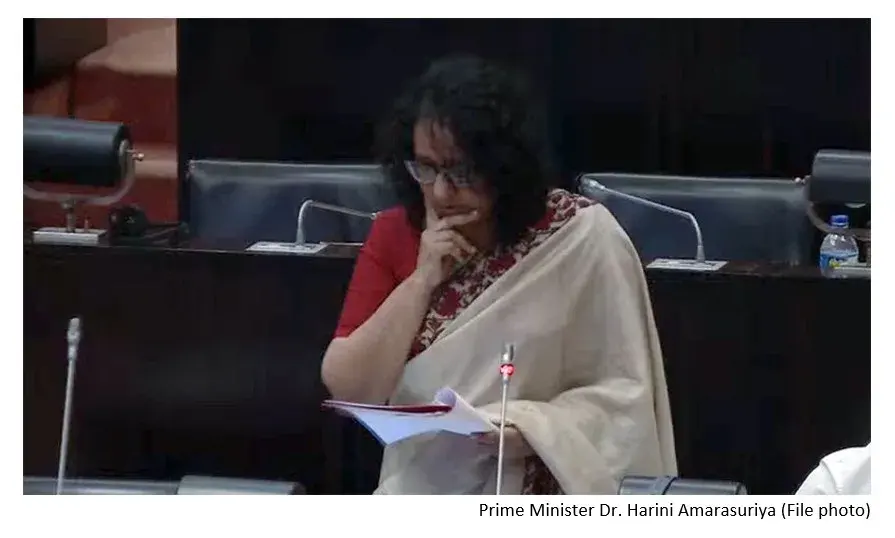
By Vishvanath
Governments in Sri Lanka are lucky that issues crop up at such a rate that none of them remains in
pubic focus for more than a few days. The proliferation of social media has upended the traditional
news cycles; news happens or is manufactured almost every second, in not every millisecond, unlike in
the past, when people had to wait for radio or television news bulletins and newspapers. So, it is only
natural that an important announcement made by Prime Minister Dr. Harini Amarasuriya, the other day,
about the delayed Provincial Council (PC) elections in the parliament has gone virtually unnoticed. Not
even the Opposition has taken it up. The controversy over the alleged mistreatment of former
intelligence chief retired Maj. Gen. Suresh Sallay, his hunger strike and the exchange of allegations
between the government and its rivals have eclipsed all other issues.
Prime Minister Amarasuriya told Parliament that the PC elections would not be conducted under
the existing proportional representation system, and they would instead be held under a new electoral
system. In answer to a question raised by an Opposition MP, the PM said there could be no justification
for holding the PC polls without ensuring adequate representation for women and the youth in the PCs.
Dr. Amarasuriya said that under Section 10 (a) of the Provincial Councils Elections Act No. 2 of
1988, the Election Commission (EC) was required to publish a notice of intention to hold an election
within one week after the dissolution or expiry of a council, following a direction from the President. She
noted that the Election Commission had not issued such notices due to the absence of enabling legal
provisions following subsequent amendments.
She further explained that under Section 3A of the Provincial Councils Elections (Amendment) Act
No. 17 of 2017, the holding of elections was linked to the completion of a delimitation process, which
required the appointment of a Delimitation Committee by the President to define electorates within
administrative districts and submit its report to Parliament, with elections to be held only after
parliamentary approval. She said the delimitation process had not yet been completed, and that had
prevented the conduct of Provincial Council elections under the new electoral system.
The PM informed Parliament that a parliamentary select committee had been appointed to
examine and make recommendations on whether PC elections could be conducted under the previous
electoral system through further amendments to existing legislation. The committee, named the “Select
Committee of Parliament to look into and report to Parliament on the matter of selecting the Electoral
System under which the Provincial Council Elections, should be held and submit its proposals and
recommendations in that regard,” comprises MPs Vijitha Herath (Chairman), Nizam Kariapper,
Chandana Sooriyarachchi, Darmapriya Wijesinghe, Samanmali Gunasingha, Shanakiyan Rasamanickam,
Lakshman Nipuna Arachchi, Mano Ganesan, Ranjith Madduma Bandara, Arun Hemachandra, Sunil
Watagala and Muneer Mulaffer.
Noting that all decisions regarding the holding of Provincial Council elections would be taken
based on the recommendations of the parliamentary select committee, the PM said that the
government’s position was to first finalise reforms to the electoral system before proceeding with polls.
The PSC is dominated by the NPP MPs, and it is only naïve to expect it to recommend anything
that may compel the government to hold the PC polls immediately.
What the government has left unsaid is that the EC has declared that t is ready to hold the PC
polls under the Proportional Representation system (PR), and all political parties have volunteered to
allocate 25% of seats for women and ensure adequate youth participation if the PC polls are conducted
under the PR system until the new electoral system is ready. So, all the government has to do to enable
the EC to hold the PC polls fast is to introduce a one-line amendment to the PC Elections Act.
The Prime Minister gave a detailed breakdown of when the terms of Provincial Councils expired,
noting that all nine councils had been without elected administrations for several years. According to
her, the Sabaragamuwa Provincial Council term ended on September 29, 2017, followed by the Eastern
and North Central Councils on September 30 and October 1, 2017 respectively. The terms of the Central
and North Western Provincial Councils ended on October 08 and 10, 2018, while the Northern Provincial
Council term ended on October 24, 2018. The Southern Provincial Council term expired on April 10,
2019, followed by the Western Provincial Council on April 21, 2019, and the Uva Provincial Council’s
term expired on October 8, 2019.
Thus, the Provincial Councils have been without elections for periods ranging from seven to nine
years. The UNP-led Yahapalana government postponed the Provincial Council polls indefinitely by
amending the Provincial Council Elections Act in 2017 under the pretext of increasing female
representation up tot 25%. The SLPP-UNP government also avoided the PC elections, unable to face
them, by citing the delimitation process as an excuse. The NPP government too has taken cover behind
electoral reforms.
The NPP government is obviously wary of facing an electoral context. It does not want its electoral
strength to be put to test at this juncture, for any setback will have an unsettling effect on it.
It is one thing to campaign hard and muster enough popular support to win elections. Politicians
and their parties make various promises and raise public expectations beyond measure to garner votes.
But it is quite another to deliver what votes are secured for.
Governments are like mobile phones. People get fed up with them after a while and tend to
dream of having new ones. They seek change. Time was when Sri Lankans voted the two main parties,
the UNP and the SLFP, into office alternately. This trend was disrupted in 1982 due to the cancellation of
the 1982 general election and JVP violence in the late 1980s, when the ruling UNP was able to stuff
ballot boxes and emerge the winner. The cycle of party alteration almost resumed in the early 2000s but
the defeat of the LTTE disrupted it in 2010. Since 2010, no government has been able to secure a second
term. Governments changed in 2015, 2019/20 and 2024. The JVP-led NPP government is still strong and
the Opposition has not been able to recover lost ground to the extent of being able to turn the tables on
the JVP/NPP anytime soon, but if the outcome of last year’s local government polls is anything to go by,
the NPP’s national vote share has shown signs of decline. The NPP has suffered quite a few defeats at
the cooperative society elections. So, the government is very likely to do everything possible to
postpone the PC polls in the hope that circumstances may improve. Hope is said to spring eternal.
RELATED NEWS
View all