Politics by Vishvanath, Cover Story
A clash of power centres in govt.?
By Vishvanath
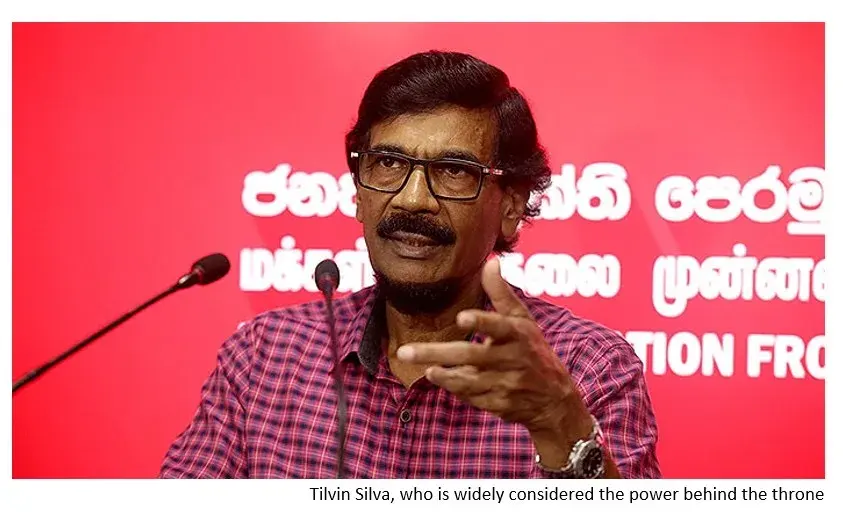
Some contradictory statements made by JVP General Secretary Tilvin Silva and NPP General Secretary Dr. Nihal Abeysinghe about the government’s position on the much-delayed provincial council (PC) elections have attracted much media attention during the past few days. They have become grist for the Opposition, which is now pushing for PC polls.
Silva recently said at a recent meeting in Jaffna that 2026 budgetary allocations for elections had been spent on post-disaster relief programs and therefore it would not be possible to hold the PC polls this year. His position is at variance with some NPP leaders’ statements indicating that the PC elections will be held this year itself. His public statement created quite a stir. The government has come under heavy criticism for “planning to postpone the PC polls as it is afraid of facing electoral contests”. Silva’s statement has been widely seen as an instance of testing the water for delaying the PC polls.
As pressure began to mount on the government to clarify its position on the PC polls, NPP General Secretary Dr. Abeysinghe said fund allocations would not stand in the way of the PC elections at all although Cyclone Ditwah had blown a huge hole in the public purse. He said sufficient funds were available for an election. However, he and other government politicians have been careful not to specify exactly when the PC polls will be held.
Previously, the NPP-JVP government claimed that the PC polls would have to be held under the new mixed proportional system, and the delimitation of the boundaries of electorates had to be completed first. The task of redrawing electoral boundaries is expected to take more than one year. The Election Commission (EC) has said it is ready to hold the PC polls either under the proportional representation (PR) system or the mixed proportional system, and it is up to the parliament to make a decision. The only thing the parliament has to do to hold the PC polls soon is to amend the Provincial Council Elections Act, enabling the EC to hold them under the PR system. If the parliament does so, the PC polls can be conducted within weeks. The Opposition has been calling for this option.
Silva is described as the power behind the throne due to his influence over the government as the General Secretary of the JVP, which is the main constituent of, and the driving force behind, the NPP coalition. Conflicting statements made by Silva and Abeysinghe are viewed as the manifestation of a power struggle in the JVP and a clash between the JVP and the NPP.
The NPP is not an organized political entity as such. It is only a collective of pressure groups and individuals brought together by a common mission. Dependent on the JVP for political traction and organizational work, the NPP lacks a support base and a vote bank but attracted a majority of floating voters who had previously backed Gotabaya Rajapaksa. The NPP is also without a leader as such, and therefore it is not possible for the non-JVP members of the NPP to challenge the JVP politically.
Dr. Abeysinghe and Silva are both JVP stalwarts and therefore their contradictory statements could be thought to emanate from an internal dispute of the JVP itself. This however does not mean the NPP, as a coalition, is free from dissension.
However powerful a government may be, its unity is determined by team power dynamics, or how authority, influence and status are negotiated and shared among the members of a group. Conflicting ideologies, ambitions and interests and idiosyncrasies influence and shape power dynamics, which are not inherently negative but have to be managed properly to preserve the unity of an organization, political or otherwise. Sri Lankan political parties usually fail in this endeavor. A natural outcome of power dynamics in a disparate group is the emergence of different power centers around prominent members of it, with attendant fault lines.
All governments are characterized by team power dynamics, competing power centres and fault lines that, in some cases,make them prone to splits. S. W. R. D. Bandaranaike’s breakaway from the UNP in 1951, the split in the UNP during President Ranasinghe Premadasa’s tenure, in 1992, mass crossovers from the governments of President Chandrika Bandaranaike Kumaratunga in 2001 and from President Mahinda Rajapaksa’s government in 2014 serve as examples ofthe disastrous consequences of mismanaged power dynamics.
Meanwhile, the possibility of dissension among the non-JVP NPP members coming to a head cannot be ruled out, given theirideological differences. Efforts being made by the JVP’s Marxist core, represented by Silva, to turn the NPP government into a tightly regimented political outfit in a bid to perpetuate the JVP’s hold on power cannot be to the liking of the non-JVP MPs espousing liberal views. The JVP MPs are used to strict party discipline, but the same cannot be said about others, drawn mostly from professional backgrounds; they cherish personal freedom. Reconciling these two different forces and preserving the NPP’ unity while furthering the JVP’s long-term interest is formidable challenge for President Anura Kumara Dissanayake and the JVP old guard.
Share this story
RELATED NEWS
View all
Politics by Vishvanath
Has 22A become the govt.'s Catch-22?
Aug 27, 2026
Politics by Vishvanath
22nd Amendment: A huge political gamble for govt.
Aug 21, 2026
Politics by Vishvanath
Move to raise retirement ages of judges: Options before govt.
Aug 05, 2026
Politics by Vishvanath
‘Cockroach’ uprising and echoes of Aragalaya
Jul 26, 2026