Politics by Vishvanath
‘Cockroach’ uprising and echoes of Aragalaya
By Vishvanath
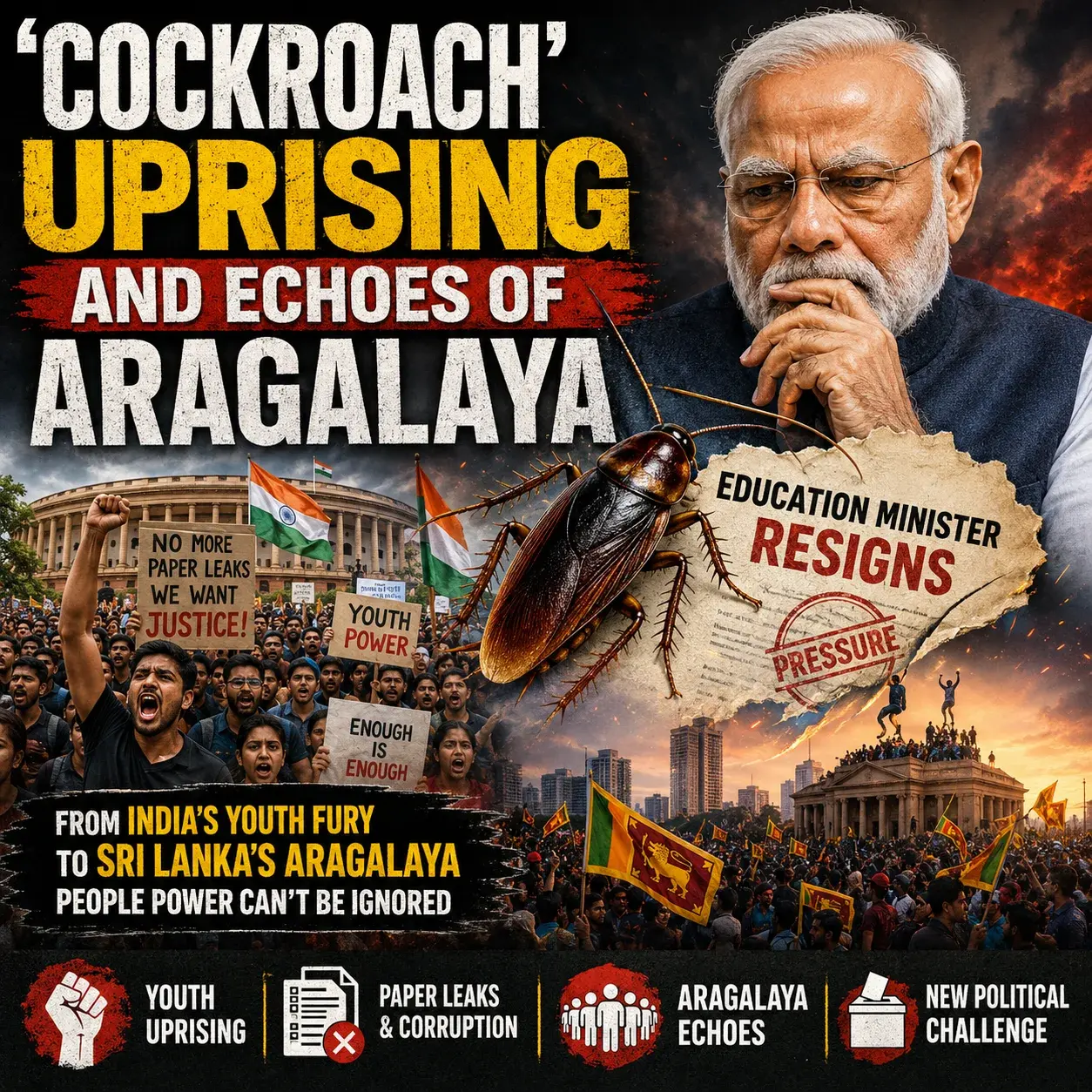
Indian Prime Minister Narendra Modi has managed to save his own skin by throwing his Education Minister Education Minister Dharmendra Pradhan to the wolves (or “cockroaches”?). Why he did not do so at the first sign of trouble to nip protests in the bud is the question. Indian Transport ministers resign over disastrous train accidents, and Modi’s Education Minister should have quit of his own volition when major examination paper leaks came into light or at least when the youth-led protests started. Perhaps, the Modi government did not expect the protests to gather momentum and sought to play a game of chicken with the protesters.
The so-called Cockroach Janata Party has exposed the political vulnerability of the BJP government, and has provided a mega boost to the morale of the youth and that of the mainstream Opposition, especially Congress, which obviously does not want protests to end. Rahul Gandhi has called for the continuation of the uprising until the collapse of the Modi administration. He and his party have their work cut out to achieve that end, as the resignation of the Education Minister has helped the BJP government defuse the massive pressure-build up in the polity. The Congress has a long way to go before being considered an alternative to the BJP if its past election results are any indication.
Emergence of new political force: Challenges
Now that the Cockroaches have flexed their muscles, mobilized the youth and tamed the Modi government, as never before, they are a problem not only to the ruling BJP but also to others. The Congress has Cockroaches to contend with on the political and electoral fronts. The Cockroach Janata Party has won over the youth disillusioned with the BJP and has the potential to emerge as a real political force, the way Aravind Kejriwal’s Aam Aadmi Party (AAP) about one and a half decades ago. Another formidable alternative political force has emerged with the potential to challenge the powerful BJP itself. The Congress will now have to compete with the Cockroaches as well.
Someone is sure to come forward to use anti-government sentiments roused by the Cockroaches and use them to build a political force. Kejriwal's political rise was due to his ability to transform a social movement into a formidable electoral force. As a key member of Anna Hazare's India Against Corruption movement in 2011, he helped channel widespread public anger over a series of high-profile corruption scandals involving the then Congress-led United Progressive Alliance (UPA) government. Hazare's prolonged hunger strikes, particularly at Delhi's Ramlila Maidan, drew massive crowds and ignited a
nationwide demand for a strong Jan Lokpal, an independent anti-corruption ombudsman.
From morals to politics
Hazare wanted his movement to remain non-political so that it could widen its appeal by transcending political boundaries, but Kejriwal argued that a lasting change could only be achieved by entering electoral politics. This difference of opinion led him to establish the AAP in November 2012. The party presented itself as a clean alternative to both the Congress and the BJP, promising transparent governance, citizen participation and an uncompromising fight against corruption. Kejriwal skilfully converted the moral authority generated by the anti-corruption campaign into a grassroots political movement, attracting volunteers, professionals, students and middle-class voters who had become disillusioned with traditional politics.
Kejriwal’s strategy paid off almost immediately. In the 2013 Delhi Assembly election, AAP emerged as the second largest party and formed a short-lived government with outside support from the Congress. Although that administration lasted only 49 days, it helped cement Kejriwal's image as a leader willing to challenge the political establishment. In the 2015 Delhi election, AAP swept to a historic victory by winning 67 of the 70 seats in the Assembly, a mandate it largely repeated in 2020. The party later expanded beyond Delhi, securing a landslide victory in the 2022 Punjab Assembly election.
AAP's governance record has been built around a combination of welfare measures and public service reforms. Its achievements include extensive improvements to Delhi's government schools, the establishment of Mohalla Clinics providing accessible primary healthcare, subsidised electricity and water, free bus travel for women, and efforts to make public services more citizen-friendly. These initiatives have received national and international attention and became central to the party's electoral appeal.
However, Kejriwal's political movement has not been free from corruption allegations. Kejriwal himself has drawn criticism from opponents who argue that the party has strayed from the ideals that inspired its birth. Even so, Kejriwal's success in transforming a mass anti-corruption movement into a formidable political party remains a significant chapter in India's democratic history and demonstrates how public anger, when effectively organised, can reshape electoral politics. The Cockroach party will pose a political challenge to AAA as well.
Farmers and Youth: India and Sri Lanka
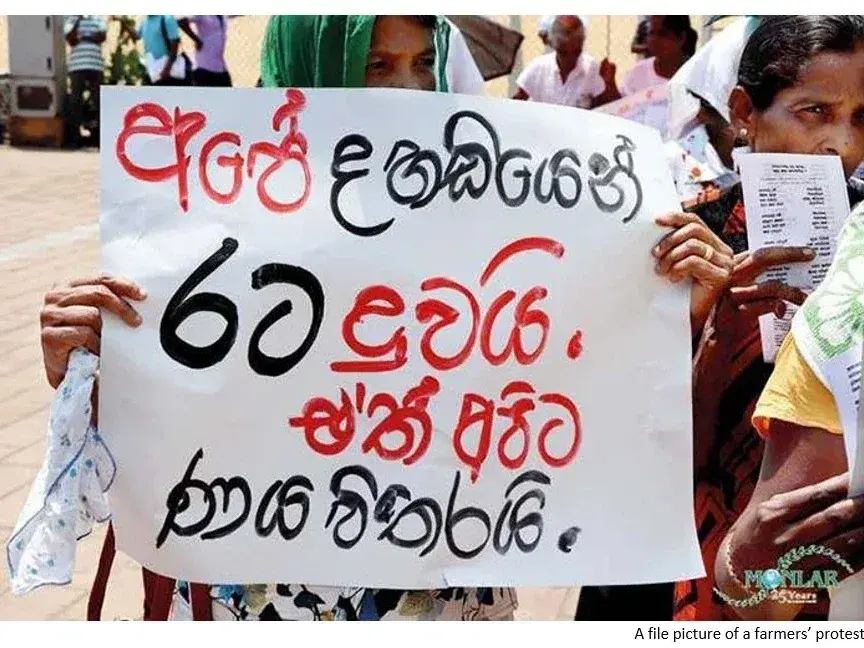
The Modi government succeeded in wearing down protesting farmers who even set up camps on the borders of New Delhi, and stayed there for a long time, but it had to give in to a youth-led protest movement. What went wrong?
Governments may ignore farmers’ protests and allow them to run their course, but it becomes a cause for serious concern to them when the politically influential middle-class people, especially the educated youth and their parents take to the streets. One may recall that President Gotabaya Rajapaksa took farmers’ protests against the non-availability of agrochemicals for granted, but had to flee the country and resign when the youth-led protests intensified. The mass uprising, or Aragalaya, started as in Colombo, with middle-class people protesting against shortages of essentials, especially fuel. It became a carnival of protests, as it were, at Galle Face. After several weeks, it began to show signs of disintegration but then a group of SLPP goons set upon the Galle Face protesters in May 2022, triggering a wave of retaliatory violence countrywide, giving Aragalaya a new lease of life and leading to its overpoliticization.
The JVP sought to keep the flames of public anger burning even after the resignation of President Rajapaksa, but the Aragalaya activists opted to wind down their protests for all intents and purposes. The Congress is also trying to win over the forces that rallied behind the Cockroach party, but whether it will succeed in its endeavor is in doubt.
Vulnerability of BJP regime
Overall, PM Modi has played his cards well albeit with delay. Having tried its hands at a crackdown, his government realized the futility of the use of force and how counterproductive it would be. It apparently learnt from the experience of Prime Minister Sheik Hasina, who made the mistake of trying to crush the uprising in Bangladesh with brutal force. There is no defence against ‘people power’, when it assumes the proportions of a tsunami. The India youth began to beat the police at their own game, and protests spread across the country.
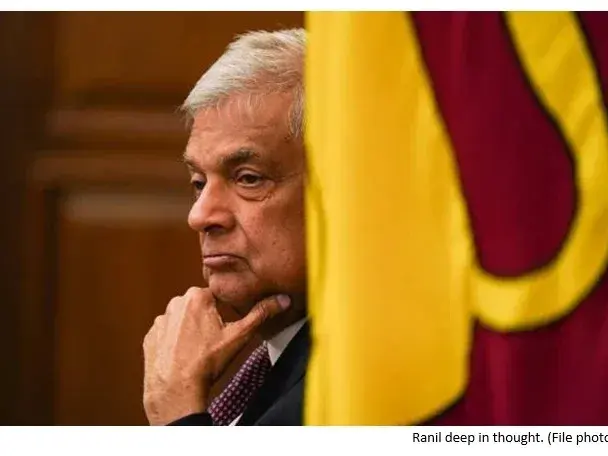
It may be recalled that Ranil Wickremesinghe, after assuming duties as the President, elected by the parliament, in July 2022, crushed what remained of Aragalaya at Galle Face by deploying the police and the armed forces. But by then the centre of gravity of the protest campaign had shifted to the political front, enabling the JVP to recover lost ground and repackage itself as a savior. The forces that propelled Aragalaya channelized their anger by acting as a pressure group and voting for the JVP-led NPP overwhelmingly. Now that the NPP government has failed to fulfil its main election promises and is facing corruption charges, many of the middle-class voters who supported it are apparently disillusioned, and the likelihood of their resentment finding expression in another mass protest campaign or Aragalaya II if the economy goes into an economic tailspin or the government fails to deliver cannot be ruled out.
The cockroach protests may fizzle out, but trouble won’t go away for the Modi government. Modi’s capitulation to Cockroach pressure, so to speak, has weakened the position of his administration, which had previously made other formidable forces blink. It may have its political rivals learning from the Cockroach party and tapping public resentment to fuel their anti-government protests.
Share this story
RELATED NEWS
View all
Politics by Vishvanath
Has 22A become the govt.'s Catch-22?
Aug 27, 2026
Politics by Vishvanath
22nd Amendment: A huge political gamble for govt.
Aug 21, 2026
Politics by Vishvanath
Move to raise retirement ages of judges: Options before govt.
Aug 05, 2026
Politics by Vishvanath
Stage set for no-faith showdown
Jul 24, 2026