Politics by Vishvanath
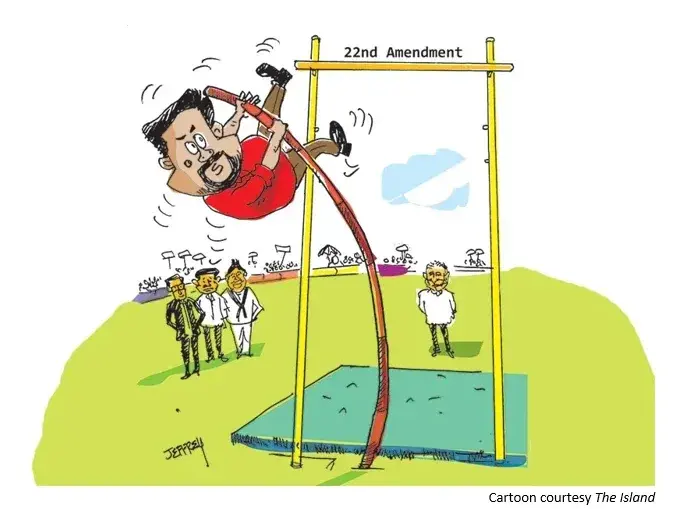
Has 22A become the govt.'s Catch-22?
by Vishvanath
The 22nd Amendment to the Constitution Bill, which, popularly known as 22A, seeks to increase the retirement ages of the judges of the Supreme Court and the Court of Appeal by two years to 67 and 65, respectively, has been challenged on both judicial and political fronts. Interestingly, the Judicature (Amendment) Bill, which seeks to increase the retirement age of the High Court judges to 63 and that of the District Court judges and Magistrates had not been challenged at the time of writing. The reason may be that their retirement ages have not been specified by the Constitution and placed under Judicial Independence, unlike the ages of the Supreme Court and Court of Appeal judges.
The government is bent on pressing ahead with the Bill and the Opposition is equally determined to scuttle it. The ongoing political battles over the controversial bid to amend the Constitution have overshadowed all other issues. Nobody is talking about the high cost of living, scandals under the current dispensation, and unfulfilled promises, which are legion. The media is also preoccupied with the 22nd Amendment, allocating more time or space for it than for other issues.
The government has gone into the attack mode and lashing out at its critics, so much so that one wonders whether the JVP-led NPP government has an Opposition mindset, and the SJB-led Opposition, which offers unsolicited advice to the ruling party on governance, has a government mindset. The JVP continues to do what it did while out of power; it bashes its political opponents. This can happen to any political party that captures power after being in the Opposition for a long time.
It took the SLFP-led People’s Alliance a very long time to begin to act the way a government should, after winning the 1994 general election. It kept on criticizing the UNP’s 17-year rule and bellowing the same old campaign rhetoric, both in and outside the parliament, for months. The JVP, founded in the 1960s, has never been in power before. Old habits are said to die hard. So, it is only natural that President Anura Kumara Dissanayake has decided to launch a countrywide propaganda drive, masked as an NPP reorganization campaign, from early Sept. It is usually the Opposition that launches suchreorganization campaigns to boost the morale of its rank and file and revitalize its grassroots organizations.
The Opposition is of the view that President Dissanayake has timed the launch of his propaganda campaign for the commencement of judicial examination of about two dozen petitions challenging the 22nd Amendment. All Opposition parties, including the ITAK, insist that a referendum will have to be held on the 22nd Amendment in keeping with two 2022 Supreme Court determinations and the legal maxim that no one should hear his or her case and the matter should be left to the people in whom sovereignty resides, according to the Constitution. Their line of reasoning is that the proposed extension of retirement ages will directly benefit the serving judges of the Supreme Court and the Court of Appeal, and therefore the 22nd Amendment must be placed before the people at a referendum. Among those who hold this view are the Bar Association of Sri Lanka and other independent legal associations.
President Dissanayake is going to put on a show of strength with an eye on 22nd Amendment, according to some political commentators. They opine that the President Dissanayake has sought to mobilize popular support for his government, whose popularity is on the wane, according to a recent Verite Research opinion survey. The Opposition has shown signs of recovering lost ground at the grassroots level. It has defeated pro-NPP groups in most cooperative elections so far. The President may have decided to strengthen his party at the village level and boost the morale of the JVP/NPP supporters.
A referendum is the last thing the government needs at this juncture; it is doing everything possible to postpone the Provincial Council (PC) election further. However, if the Supreme Court decides that the passage of the 22nd Amendment requires people’s approval, then the government will have to hold a referendum. Is the President trying to launch a campaign to get a head start in the event of having to face a referendum and/or the PC polls?
The Opposition has claimed that the President’s countrywide stumping tour on the card is an indication that its campaign against 22nd Amendment has had an unsettling effect on the government. This claim cannot be considered entirely false. The government has its work cut out to secure popular support for its bid to amend the Constitution, and is facing stiff resistance it did not anticipate. It would not have felt the need for a nationwide propaganda campaign, which will require a great deal of funds, time and energy, if it had been confident that the Opposition’s campaign against the 22nd Amendment was not effective and it was not facing serious political challenges.
There is a strong possibility that the government’s campaign may prompt the Opposition parties to close ranks and launch a counteroffensive. It is popularly said that Newton’s Third Law of Motion is applicable to political moves, for in politics, too, every action has an equal and opposite reaction.
Share this story
RELATED NEWS
View all

Politics by Vishvanath
Viral Vas Kaviya: ‘Release Gnanasara Thera’ campaign taken to celestial realm Canalization of aggression through curse poems and devil dancing rituals
Oct 24, 2026
Politics by Vishvanath
22nd Amendment: A huge political gamble for govt.
Aug 21, 2026
Politics by Vishvanath
Move to raise retirement ages of judges: Options before govt.
Aug 05, 2026
Politics by Vishvanath
‘Cockroach’ uprising and echoes of Aragalaya
Jul 26, 2026