Politics by Vishvanath
Stage set for no-faith showdown
by Vishvanath
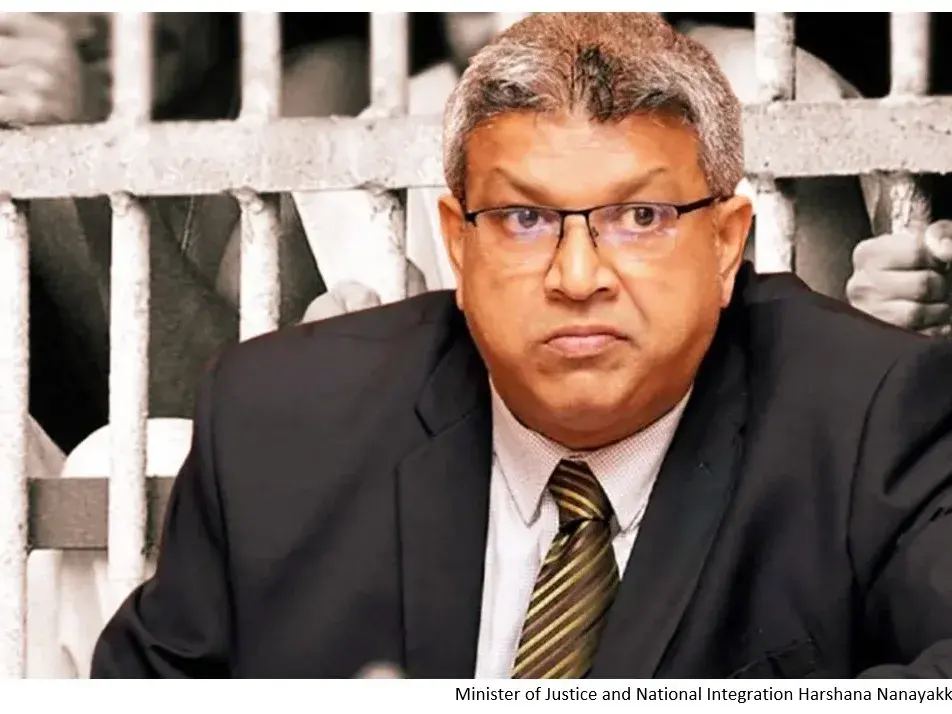
A motion of no confidence, submitted by the Opposition to Speaker Dr. Jagath Wickramaratne on Tuesday, against Justice and national Integration Minister Harshana Nanayakkara, is to be taken up for debate shortly. The Opposition is of the view thatMinister Nanayakkara failed to fulfil his responsibility to take action to prevent the recent Negombo Prison riot, where 21 inmates and 10 officers were killed and many others injured, and therefore he is not fit to remain the Minister of Justice.
The government has a two-thirds majority in the parliament, and there isn’t a snowball’s chance in hell that the Opposition will succeed in having its motion passed. A few months ago, its no-faith motion against the then Minister of Energy Kumara Jayakody was defeated. Then, why has the Opposition moved the no-faith motion against Minister Nanayakkara?
No-faith motions are high-risk political manoeuvres and intended to serve as strategic tools for the Opposition to gain wide publicity for its campaign against the government and rally public support. Allegations against individual ministers or governments carry more weight when they are made on the floor of the parliament than from political platforms. All governments with clear parliamentary majorities seek to ridicule no-faith motions againstthem or their members as an utter waste of time and energy, claiming that such moves only strengthen their unity. But no government wants to face serious allegations officially on the floor or the House, for they tend to stick. Hence, government members and their Opposition counterparts trade allegations in the parliament.
No government has been free from no-faith motions. A precise official cumulative number of all no-confidence motions tabled in the Parliament of Sri Lanka since Independence is not maintained in a single publicly available list. The record is complicated because motions have been moved against entire governments, prime ministers, cabinet ministers, and Speakers. The Constitution expressly provides for a no-confidence motion against a government, while motions against individual ministers have developed as parliamentary practice.
There are situations where the Opposition decides against going ahead with the no-faith motions they initiate. In January 2026, the SJB-led Opposition began collecting signatures for a no-faith motion against Prime Minister Harini Amarasuriya over the inclusion of the address of an adult website in the Grade Six English module and other such matter. But it did not proceed with the motion, prompting the government to ridicule it.
Perhaps, Sri Lanka may be the only country where a government has hijacked a no-faith motion submitted by the Opposition against it and defeated it. In 1980, the Opposition tried to postpone a no-confidence motion against the then Speaker Bakeer Markar for supporting President J. R. Jayewardene’s attempt to bypass a Court of Appeal ruling that unseated Abeyratne Pilapitiya in an election petition, and retain him as a UNP MP by appointing him to the Kalawana electorate. Sensing that Pilapitiya would lose the election petition, the Jayewardene government got himto be absent from the parliament without leave and lose his seat and thereafter reappointed him as an MP for Kalawana. It claimed that Pilapitiya was not an elected MP but an appointed member. Speaker Markar backed Jayewardene’s argument that the Kalawana electorate had not fallen vacant due to the court ruling and therefore there was no need for a by-election. In view of the by-election the UNP was trying to avoid, the Opposition decided to postpone the no-faith motion against the Speaker, scheduled to be taken up for debate on Dec. 23, 1980. However, claiming that the no-faith motion was of a matter of utmost national importance, the UNP government, with a five-sixths majority in the parliament, took it up, put it to the vote and defeated it. The Opposition boycotted the debate. The Commissioner of Elections went ahead with his decision to hold the by-election, which Sarath Muttetuwegama won in 1981.
A brief history of no-faith motions
The following are the major no-confidence motions against governments and individual members that were tabled and put to a vote:
1964 – Sirimavo Bandaranaike Government (SLFP-led coalition)
Target: Government of Prime Minister Sirimavo Bandaranaike.
Mover: United National Party-led Opposition.
Result: Defeated. The government survived the vote.
o Aftermath: The government later collapsed after some coalition MPs withdrew support, leading to a general election in 1965.
1975 – Sirimavo Bandaranaike Government
Target: Government.
Issue: Opposition criticism of economic policies and administration.
Result: Defeated. The government remained in office until the 1977 general election.
1980 – J. R. Jayewardene Government
Target: The Speaker
Issue: Opposition allegations regarding governance and policies.
Result: Defeated because the UNP commanded a large majority in Parliament.
2001 – Chandrika Bandaranaike Kumaratunga Government
Target: Government.
Issue: Allegations of poor governance and political instability.
Result: Defeated.
Aftermath: The government later lost its parliamentary majority, resulting in a general election in 2001.
2018 – Mahinda Rajapaksa Government formed during the constitutional crisis
Target: Prime Minister Mahinda Rajapaksa and his Cabinet.
Background: President Maithripala Sirisena removed Prime Minister Ranil Wickremesinghe and appointed Rajapaksa, triggering a constitutional crisis.
Result: Parliament passed no-confidence motions against Rajapaksa and his Cabinet in November 2018. However, the matter was resolved through constitutional and judicial processes rather than by a normal change of government.
2021 – Gotabaya Rajapaksa Government (SLPP)
Target: Udaya Gammanpila, Minister of Energy
Issue: Opposition criticism of fuel price increases and energy policy.
Result: Defeated, 61 votes in favour and 152 against.
2022:
Target: The SLPP Government, Prime Minister and Cabinet.
Issue: Economic crisis, shortages of essential goods and loss of public confidence.
Result: The motion did not bring down the government. Gotabaya Rajapaksa later resigned in July 2022 amid mass protests.
2023 – Government under President Ranil Wickremesinghe
Target: Minister Keheliya Rambukwella
Issue: Alleged failures in the health sector, including medicine shortages and procurement rackets.
Result: Defeated, 73 votes in favour and 113 against.
2024 – Government under President Ranil Wickremesinghe
Target: Speaker Mahinda Yapa Abeywardana
Opposition allegations concerning the Speaker’s conduct and parliamentary administration.
Result: Defeated, 75 votes in favour and 117 against.
2026 – Anura Kumara Dissanayake government
Target: Kumara Jayakody, Minister of Energy (National People’s Power Government)
Issue: Opposition allegations relating to energy sector matters.
Result: Defeated, 49 votes in favour and 153 against.
No Sri Lankan government has been removed through a successful no-confidence vote in the ordinary parliamentary sense since Independence. The closest was the 2018 constitutional crisis, where parliamentary votes against Mahinda Rajapaksa’s government contributed to the political settlement but did not directly install a new government.
Governments may shoot down no-faith motions with the help of their majorities, but the allegations they face are examined in the court of public opinion. Perceptions do matter as much as facts in politics. The JVP-led NPP used a host of allegations against the previous government very effectively, to capture power and has not since cared to substantiate most of them. No-faith motion debates also provide the Opposition politicians to wax eloquent in the House and capture headlines.
The Opposition will make the most of the no-confidence motion against Minister Nanayakkara. The government too will do its best to inflict maximum possible damage on the Opposition. The debate on it is very likely to get down and dirty.
RELATED NEWS
View all
Politics by Vishvanath
Has 22A become the govt.'s Catch-22?
Aug 27, 2026
Politics by Vishvanath
22nd Amendment: A huge political gamble for govt.
Aug 21, 2026
Politics by Vishvanath
Move to raise retirement ages of judges: Options before govt.
Aug 05, 2026
Politics by Vishvanath
‘Cockroach’ uprising and echoes of Aragalaya
Jul 26, 2026