Politics by Vishvanath
Move to raise retirement ages of judges: Options before govt.
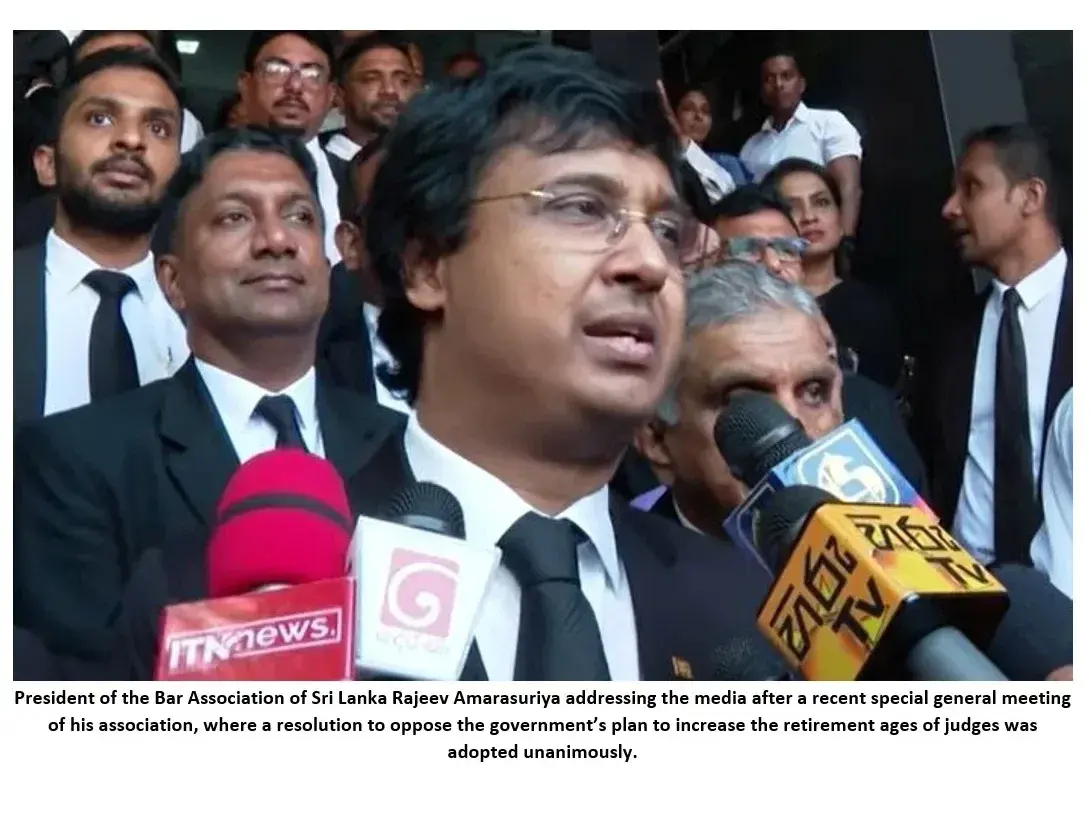
Holding a consultative referendum and PC polls on the same day an alternative
Politics by Vishvanath
Pressure is mounting on the government to hold the much-delayed Provincial Council (PC) elections. Representatives of an alliance of six Tamil-speaking and Muslim political parties met President Anura Kumara Dissanayake at the Presidential Secretariat, Colombo, last Sunday, to press for the long-delayed Provincial Council (PC) elections and a new Constitution. They represented the Ilankai Tamil Arasu Katchi, Tamil Progressive Alliance, Sri Lanka Muslim Congress, Ceylon Workers' Congress, All Ceylon Makkal Congress, and the Democratic Tamil National Alliance (DTNA). A collective of election monitors and civil society organizations, too, has called upon the government to uphold people’s franchise and conduct the PC polls by amending the Provincial Council Elections Act.
Former Chairman of the Election Commission Mahinda Deshapriya has stated that allowing the PCs to function without elected representatives under bureaucrats is a continuous, grave violation of the Constitution and democratic principles. He is reported to have asked the government announce, on or before Sept. 15, when the World Democracy Day is celebrated, a timeframe for conducting the PC polls and thereby avoid trouble. He is expected to resort to legal action.
The government is also coming under increasing pressure to abandon its plan to amend the Constitution to raise the retirement ages of judges. On Tuesday, the International Association of Judges (IAJ), which represents 93 national organizations of judges across five continents, endorsed the position of the Judicial Service Association (JSA), which represents Magistrates and District Judges, and the Commonwealth Lawyers’ Association (CLA), on the government plan. Both the JSA and the CLA have taken exception to the government’s plan. The IAJ has asked government to withdraw the proposed constitutional amendment that seeks to extend the retirement ages of judges. Thus, the government’s controversial plan has now become an international issue.
Even the opponents of the government’s move are not against revising the mandatory retirement ages of judges or other public officials in keeping with the changes in age demographics; governments the world over adjust the retirement thresholds to protect public finances and ease labour shortages and stress on pension systems as old-age dependency ratios climb. Their position is that such a revision of retirement ages should not apply to incumbent judges, as it can be construed as a favour, if not a bribe, and could lead to a quid pro quo, and the government should consult all stakeholders and act in a transparent manner. They are of the view that if the government is to go ahead with the proposed constitutional amendment, it will have to hold a referendum. Opposition Leader Sajith Premadasa told the parliament on Tuesday that the Supreme Court (SC) had already ruled that any constitutional amendment seeking to extend the retirement ages of Supreme Court and Court of Appeal judges would require approval at a referendum because such a move would impinge on the independence of the judiciary.
Making a special statement under Standing Order 27/2, Premadasa cited the Supreme Court's 2022 determination on the constitutionality of the Inland Revenue (Amendment) Bill, delivered by Justices Buwaneka Aluwihare, PC, Murdu N.B. Fernando, PC, and Janak De Silva. Reading from the determination, he said the Court had held that unlike other public officers, the retirement ages of Supreme Court and Court of Appeal judges are specifically entrenched in the Constitution and that any constitutional amendment affecting the retirement ages or tenure of incumbent judges, directly or indirectly, would violate Article 3 of the Constitution and therefore require approval at a referendum.
So, the government is now apparently left with a few choices. It can proceed with its constitutional amendment to increase the retirement ages of judges with or without a referendum. Holding a referendum at this juncture is an unsettling proposition for the government. Or, it can bite the bullet and abandon its constitution amendment project. This is the safest way. An about-turn will inevitably be seen as a comedown for the government and a win for its critics, but it will be forgotten soon. Or, the government can hold a consultative referendum on the issue at hand (but not on the proposed constitutional amendment) and strengthen its position both politically and morally if it can secure people’s approval for its plan.
The cost of a referendum is prohibitive. The government will not be able to justify spending a colossal amount of money. However, there is a way out. Since the government will have to hold the PC polls sooner or later due to increasing pressure, it can conduct the PC elections under the proportional representation system soon and hold a consultative referendum on the issue of judges’ mandatory retirement ages, on the same day. After all, the government politicians and propagandists have set social media ablaze over an NGO survey that has placed President Anura Kumara Dissanayake’s approval rating at 75%. If President Dissanayake and his government actually believe that the survey finding is accurate, there is no reason why they should be wary of facing and election and consulting the people on a matter that it considers to be of national importance at a referendum.
Article 86 of the Constitution gives the President discretion to submit any matter he considers to be of national importance directly to the people by referendum, without requiring prior judicial sanction, subject to the provisions of Article 85. That discretion, however, cannot be used to circumvent the constitutional procedures governing amendments to the Constitution. Article 85 (2) states: “President may in his discretion submit to the People by Referendum any Bill (not being a Bill for the repeal or amendment of any provision of the Constitution, or for the addition of any provision to the Constitution, or for the repeal and replacement of the Constitution, or which is inconsistent with any provision of the Constitution), which has been rejected by Parliament.” The outcome of a consultative referendum is not legally binding, as is obvious, but if the government could secure people’s approval for its move, it would be able to leverage that fact to silence its critics and proceed with its constitutional amendment through the constitutionally prescribed process confidently, allowing the SC to decide whether the Bill can be passed by the parliament with a special majority alone or a referendum will have to be held in keeping with Article 85 (1).
There are numerous precedents for holding an election and a referendum on a national issue on the same day. In 1993, New Zealand held a general election on the same day as a binding referendum on whether the country should adopt the Mixed-Member Proportional (MMP) electoral system. MMP won with about 54% of the vote. In the United Kingdom, a nationwide referendum on replacing the first-past-the-post system with the Alternative Vote system was held on the same day as elections to the Scottish Parliament, Welsh Assembly, Northern Ireland Assembly and numerous local councils.
The UK government, in response to a parliamentary inquiry into the possibility of holding a referendum and an election on the same day, has said there is “no reason in principle” why a referendum could not be held on the same day as other planned polls, while acknowledging that the practical and political circumstances should be considered case by case.
It is up to the NPP government to take a high-risk gamble in mid-term or beat a tactical retreat or adopt a low-risk alternative.
Share this story
RELATED NEWS
View all

Politics by Vishvanath
Viral Vas Kaviya: ‘Release Gnanasara Thera’ campaign taken to celestial realm Canalization of aggression through curse poems and devil dancing rituals
Oct 24, 2026
Politics by Vishvanath
Has 22A become the govt.'s Catch-22?
Aug 27, 2026
Politics by Vishvanath
22nd Amendment: A huge political gamble for govt.
Aug 21, 2026

Politics by Vishvanath
‘Cockroach’ uprising and echoes of Aragalaya
Jul 26, 2026