Point of View
EMERGING TRENDS IN DRUG TRAFFICKING IN THE SOUTH ASIAN REGION: A SRI LANKAN PERSPECTIVE
INTRODUCTION
Over time, the illicit drug trade has evolved into one of the most lucrative global industries, its tendrils now extending across multiple regions and presenting a profound challenge to global peace and stability. Drug trafficking is a transnational illegal commerce involving cultivators, manufacturers, transporters, suppliers, and distributors, all operating in defiance of drug prohibition laws. According to the Global Financial Integrity report published by the Washington-based think tank in March 2017, the global business of transnational crime is estimated to generate between $1.6 trillion and $2.2 trillion annually. This study, The Pathfinder Foundation team, which assessed the criminal market across 11 categories, revealed that drug trafficking accounted for the second-highest value, ranging between $426 billion and $526 billion in 2014 alone, constituting approximately 1% of total global trade in that year. The United Nations Office on Drugs and Crime (UNODC) World Drug Report 2022 highlighted that in 2020, an estimated 284 million individuals aged 15-64 globally used drugs within that year, with 209 million consuming cannabis, 61 million using opioids, and 31 million engaging with amphetamines, reflecting a 20% increase over the decade. Furthermore, the report highlights that in 2022, approximately 7 million people were in formal contact with the police for drug-related offences, and over 1.6 million people were convicted globally.
Transnational criminal syndicates traffic a range of drugs, including cannabis, cocaine, heroin, and synthetic substances, across various regions, generating substantial financial gains and perpetuating violence and criminality within societies. Drug trafficking is an enterprise primarily driven by monetary incentives, serving as a significant revenue source for organised criminal factions. Many of these syndicates are also involved in other heinous activities, such as arms and human trafficking, money laundering, immigration offences, and they are even implicated in the financing of terrorism. The trade in illicit drugs has the most harmful societal, political, and economic consequences, threatening the very fabric of societies through addiction, criminality, and the spread of disease. Technological advancements, liberal economic policies, poverty, endemic corruption, and, notably, the lack of robust national legislative frameworks capable of addressing the evolving dynamics of drug trafficking, have become key contributors to the proliferation of this illicit trade, thereby jeopardising global security structures.
AIM
In this context, The Pathfinder Foundation in this study aims to investigate the interconnected roles of cultivators, producers, transporters, suppliers, and dealers within the drug trafficking network and to identify the potential threats and security challenges posed to the South Asian region, particularly from a Sri Lankan perspective.
OVERVIEW OF DRUG TRAFFICKING IN SOUTH ASIA
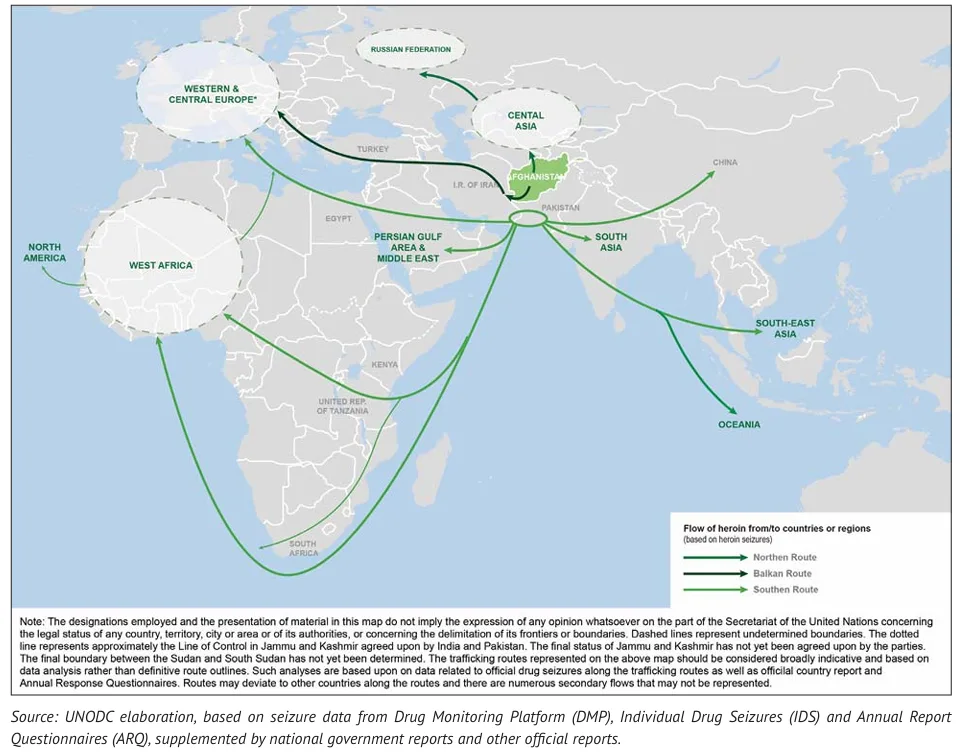
The South Asian region has increasingly become a significant conduit for illicit drugs destined for the international market, with the "Golden Crescent," covering the mountainous peripheries of Afghanistan and Pakistan, extending into eastern Iran and known to be the largest supplier of narcotic substances globally. Additionally, the "Golden Triangle," a mountainous region bordering Thailand, Myanmar, and Laos, has been identified as one of the world’s foremost areas for the production of synthetic drugs, alongside traditional opium cultivation. The opium production originating from these two regions, located at the crossroads of Central, South, and West Asia, accounts for approximately 90% of the global illicit drug trade. Opium production in Central and West Asian countries is transported via the Arabian Sea towards the final destinations in the West and the East. Consequently, India, Sri Lanka, and the Maldives have become key transit points in the eastern maritime path known as the “Southern route.”
Indicative Afghan Heroin Trafficking Routes
OVERVIEW OF DRUG TRAFFICKING IN INDIA
India’s strategic proximity to both the "Golden Crescent" and the "Golden Triangle," along with its extensive pharmaceutical industry, has made the country vulnerable as both a destination and transit point in the global drug trade. According to the Narcotic Control Bureau (NCB), approximately 70% of the illegal drugs entering India are smuggled via sea routes from the Bay of Bengal and the Arabian Sea. The World Drug Report 2022 states that India ranks fourth in the volume of opium seized in 2020, with 5.2 tons confiscated, and third in the amount of morphine seized, totalling 0.7 tons in the same year. The Indian coastal belt, which stretches across the Bay of Bengal and the Arabian Sea, along with neighbouring countries such as Sri Lanka, Bangladesh, Pakistan, and the Maldives, is particularly vulnerable to maritime trafficking, given their exposure to trafficking routes across the Indian Ocean.
OVERVIEW OF DRUG TRAFFICKING IN SRI LANKA
Sri Lanka’s geographic location has invariably positioned the country as a pivotal conduit in the international drug supply chain, linking the East to the West. In Sri Lanka, most illicit drugs, originating overseas, are trafficked into the country via the Arabian Sea. The trafficking operations are notably complex, involving multiple actors: growers, producers, transporters, dealers, and local distributors. Often, the dealers are of Sri Lankan origin who reside in the Gulf region. The suppliers originate from tribal areas in Pakistan, and the transporters or smugglers, typically of Iranian origin, operate across the Indian Ocean. The local distributors, often based along Sri Lanka’s coastal belt, are directly linked to criminal syndicate leaders in the Middle East. In addition to maritime routes, trafficking occurs via container shipping, airline passengers, and postal services, including fast parcels.
Drug Related Arrests in Sri Lanka (2019-2023)
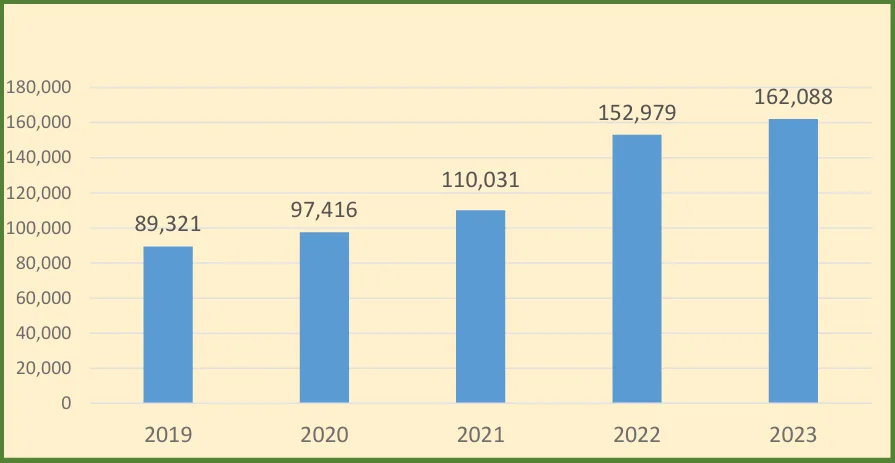
Quantity of Drug Seized in Sri Lanka (2019-2023)
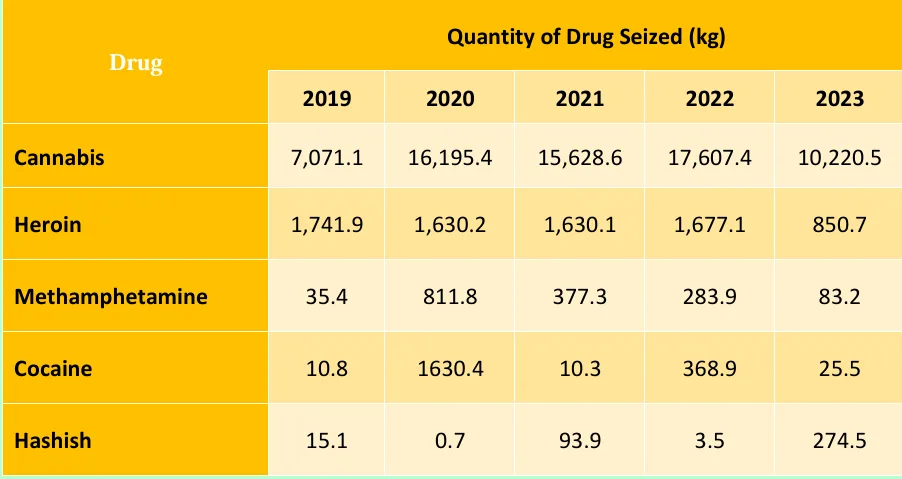
Source: The National Dangerous Drug Control Board (NDDCB) publication on Drug Related Statistics, Arrests & Treatment, January - December 2023
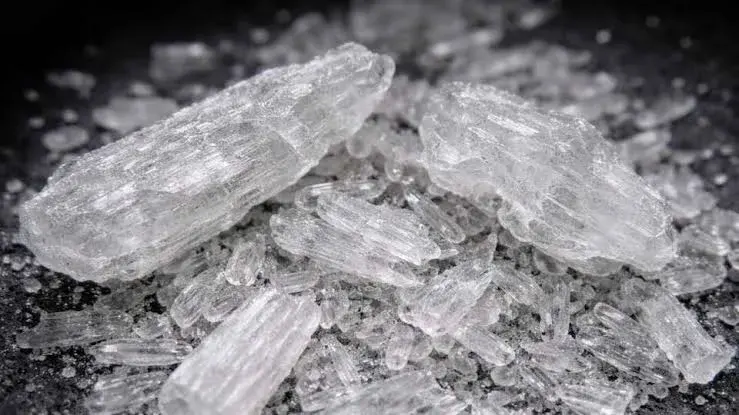
Recent studies conducted by the NDDCB on illicit drug use in Sri Lanka indicate a significant shift in consumption patterns. Initially, cannabis was the predominant drug consumed, particularly by those residing in urban townships. However, over time, there has been a marked transition towards methamphetamine use. Several studies, undertaken by both government and non-government research institutions in the region, have further corroborated this alarming trend, highlighting a sharp rise in the use of synthetic drugs. While the timeframes for these shifts may vary across different destinations due to a range of factors, the overall trend underscores the growing prevalence of artificial drugs within the region.
EMERGING TRENDS AND CHALLENGES
A report released by the Research and Trend Analysis Branch of the United Nations Office on Drugs and Crime (UNODC), based on a survey of opium cultivation and production in Afghanistan, following the ban imposed by the de facto authorities in Afghanistan (DfA) on poppy cultivation and all narcotic substances in April 2022, reveals a dramatic 95% decline in cultivation in 2023. Notably, however, the same research found that, in contrast to opiates, methamphetamine trafficking continues to surge within the region. An analysis of emerging trends and evolving patterns in drug trafficking indicates a significant shift from traditional narcotics to synthetic drugs, such as amphetamine-type stimulants and chemical precursors. In the long term, these developments may result in a change of heroin purity coming into the market, an increase in addiction, particularly among youth and potential demand for opiate treatment facilities, etc.
The centralisation of command structures, the use of advanced technology, and the decentralisation of distribution networks, in response to increased demand, have generated larger profits for criminal syndicates and facilitated the expansion of trafficking networks across regions. The evolution of digital communication platforms has introduced a novel dimension to both the demand and distribution of illicit drugs. With rapid technological advancements, drug traffickers are leveraging online platforms to identify, market, and deliver their products to end users at competitive rates while minimising risk for both suppliers and recipients. Moreover, access to these illicit substances has become easier than ever, resulting not only in an increase in demand but also in a significant potential threat to the social fabric of societies.
PATHFINDER WAY FORWARD
Development and Implementation of an Effective National Drug Control Strategy: The South Asian region is characterised by a mix of post-conflict, least-developed, and middle-income states, each facing common and unique challenges. Regional cooperation is essential for an effective and coordinated response to the drug problem. A reformed, coordinated, and concentrated effort involving all stakeholders, including government agencies, civil society, academia, and other relevant segments, is imperative for the development and implementation of an effective strategy in combating drug trafficking in the region.
International Cooperation, Collaboration, and Coordination: International cooperation remains fundamental in developing a comprehensive solution to the drug trafficking threat. Sharing data, knowledge, and expertise with international partners will enable the identification of new trends and facilitate the design of programmatic responses to address these emerging issues. Creating a common regional information-sharing platform to share intelligence and real-time information would further strengthen cooperation, collaboration, and coordination among inter- and intra-regional agencies to disrupt drug trafficking in the region.
Incorporation of UN Drug Control Conventions into Domestic Legal Frameworks: Although almost all nations are currently parties to the UN International Drug Control Conventions of 1961, 1971, and 1988, their provisions are not fully incorporated into domestic legal frameworks. Therefore, it is vital to include the said provisions into local legislations and policies in compliance with international drug control conventions, as this would significantly contribute to combating drug trafficking.
Research and Survey: Understanding the intricate connections between cultivators, producers, transporters, suppliers, dealers, and the complex web of individuals and criminal syndicates involved in drug trafficking and consumption presents significant challenges. The effectiveness of current global and regional anti-narcotic measures further adds to the uncertainty in predicting the threats posed by drug trafficking. Therefore, continuous research and surveys are essential. These efforts not only assist in combating drug trafficking but also help nations identify emerging trends, assess potential threats to national security, and develop strategies to mitigate their impact.
Enhancement of Capacity and Capabilities of all Stakeholders: It is of paramount importance to enhance the capacity and capabilities of relevant government agencies, civil society, academia, and other relevant segments, particularly through the provision of financial and technical assistance aimed at combating organised crime, corruption, and terrorism.
This is the First in the series of ‘PATHFINDER NATIONAL SECURITY BRIEF issued by the Pathfinder Foundation. Readers’ comments via email to pm@pathfinderfoundation.org are welcome.
Share this story
RELATED NEWS
View all

Point of View
Protesting monks’ challenge: Govt. picks up the gauntlet
Oct 17, 2026

Point of View
Robe-sarong controversy eclipses all other issues
Oct 10, 2026

Point of View
A Speaker in the crosshairs, an Opposition in search of relevance
Oct 07, 2026
Point of View
When an oil shock reaches Sri Lanka
Sep 22, 2026