Current Affairs
India’s outreach to Taliban could pay off despite contradictions
By P.K. Balachandran
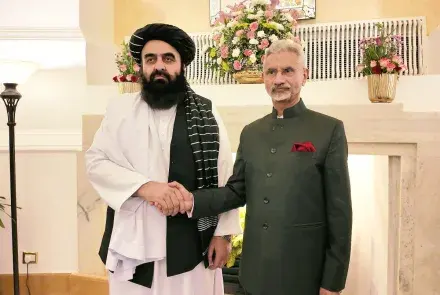
Colombo, October 16- The 6-day visit of the Afghan Foreign Minister Amir Khan Muttaqi to India earlier this week came under heavy fire from those who found the bonhomie between India and the Taliban distasteful. But it cannot be denied that there were economic and strategic gains to be made through the bold departure from tradition.
While the government laid out the red carpet for the visitor, liberals, women’s rights activists and opposition parties tore into the Modi government for befriending Taliban-ruled Afghanistan when its leaders were sanctioned by the UN for sponsoring cross border terrorism and blatantly discriminating against women and girls.
New Delhi’s highly publicised outreach to the Taliban did not gel with its loud and consistent campaign against cross border terrorism, directed principally against Pakistan but also against the Taliban.
India had waged wars against Pakistan on the charge that it sends terrorists to stage attacks in Kashmir and other parts of India. Attention turned to the Taliban in 1999, when Indian Airlines flight IC 814 from Kathmandu to Delhi was hijacked by Pakistani terrorists and flown to Kandahar in Afghanistan.
India had to negotiate with the hijackers through the Taliban. It was after an excruciating week of negotiations that Indian minister Jaswant Singh managed to secure the release of the 155 passengers. But, as part of the deal, Pakistani terrorists Ahmed Omar Saeed Sheikh, Masood Azhar, and Mushtaq Ahmed Zargar were released from Indian prisons. The ordeal of the passengers rankles in Indians’ minds even now.
Back in New Delhi, Muttaqi’s refusal to invite women journalists to his first press conference received heavy flak from women’s rights activists and journalists. The Modi government was slammed for kowtowing to the fundamentalist leader disregarding India’s constitution which gives equal rights to men and women.
The bonhomie between Muttaqi and the Indian officials seemed to be contrary to the established policy of not having any truck with forces which support cross border terrorism.
New Delhi did not explain why it invited Muttaqi for such a long visit and why it rolled the red carpet for him, leaving it to the pro-government media to do the needful. However, it did persuade Muttaqi to hold a second press conference and invite women journalists. Angry women journalists grilled him on the treatment of women in Afghanistan.
New Delhi’s cosying up to the Taliban was also out of sync with the stance of other nations in the neighbourhood. Afghanistan’s Central Asian neighbours, Pakistan in South Asia, Russia and China had held meetings to appeal to the Taliban to stop Islamic terror groups from using Afghanistan’s soil to launch attacks on them.
Just before Muttaqi’s visit to India, the Central Asian nations, Iran, Pakistan and Russia had met in Moscow under the “Moscow Format” to make a joint appeal to the Taliban not to harbour terror groups.
Pakistan even resorted to aerial bombing and a limited land invasion of Afghanistan to destroy camps of terror groups like Afghan Taliban and the Tehrik-i-Taliban Pakistan (TTP), which have been on a killing spree in the border province of Khyber Pakhtunkhwa.
However, in the Trumpian-era marked by realpolitik and disdain for ideology, New Delhi’s unorthodox move to cosy up to the Taliban makes sense. As pro-government commentators pointed out, New Delhi’s moves were dictated by the Chanakyan dictum that one’s enemy’s enemy is a friend.
Pakistan and Afghanistan consider each other as enemies. And India considers Pakistan an enemy. Therefore, India and Afghanistan should be friends.
Pakistan is sore with the Taliban because the Taliban has shown no gratitude for the help it got from Pakistan when it was fighting the Soviets and later the Americans for decades. Lakhs of Afghans found shelter and work in Pakistan in those troubled times.
But after the Taliban took over Afghanistan in 2021, it dropped Pakistan like a hot potato and opted to cultivate friendship with India, which till then had been ant-Taliban and pro-Northern alliance. India had supported the pro-West governments in Kabul headed by Hamid Karzai and Ashraf Ghani.
One of the main reasons for the Taliban’s switch over to India was economic. Being the government in Afghanistan, Taliban’s thoughts got diverted from war and security to rebuilding the country’s devastated infrastructure and providing social services, long denied to the Afghan masses.
While India was ready to help in these spheres, Pakistan had no such plans. It was blissfully unaware of the need of the hour, harping on the old military relationship in which the Taliban was no longer interested.
India had been helping the Karzai and Ghani governments with economic and technical help. India had pumped in US$ 3 billion into infrastructure projects in Afghanistan.
Meanwhile, inspired by the Islamic Jehad movement in Afghanistan led by the Taliban, Pakistani Islamic radicals wanted to establish a government based on the Islamic Shariah in Pakistan. Groups like the TTP and Labbaik gained ground and started attacking Pakistani forces and government institutions.
Pakistan’s appeals to the Afghan Taliban to rein in the TTP fell on deaf ears. The Afghan Taliban maintained that they had no links with the TTP.
In addition to troubles from terrorists, Afghanistan would not recognise the Colonial-era Durand Line as the border with Pakistan. Complicating matters on the ground, smugglers from both countries were doing a roaring business across the border with the connivance of local politicians, criminals and officials.
Accusing the Afghan refugees of indulging in crimes, Pakistan expelled thousands of Afghan refugees, an act which was deeply hurtful.
Matters came to a head last week when Pakistan launched a drone attack targeting a top TTP leader in Kabul city itself. On the night of October 11-12, Pakistan bombed and attacked several terrorist camps inside Afghanistan and occupied a number of them. Afghanistan fought back inflicting heavy casualties.
Significantly, Pakistan attacked when the Afghan Foreign Minister Muttaqi was being entertained in India. Muttaqi told the Indian media, that the Taliban were not afraid to take on any country as they had driven out powerful invaders in the past such as the British, the Russians and Americans. However, Muttaqi made it equally clear that the Afghans had no animosity towards Pakistan and even asked for the reopening of the road link between India and Afghanistan through Pakistan for trade.
Considering Afghanistan’s pressing requirement for economic recovery and development, India pledged to Muttaqi that it would invest in healthcare, public infrastructure and capacity-building in Afghanistan.
India will be establishing a Thalassemia Centre and a Modern Diagnostic Centre. Additionally, India will construct a 30-bed hospital in Kabul’s Bagrami district, an Oncology Centre and a Trauma Centre in Kabul, and five Maternity Health Clinics in the provinces of Paktika, Khost, and Paktia.
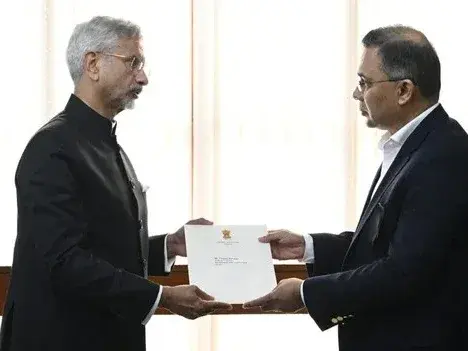
India will gift twenty ambulances to the Afghan people. A symbolic handover of the ambulances was done by the External Affairs Minister S.Jaishankar following his meeting with the Afghan Foreign Minister.
In the field of capacity-building, India continues to offer scholarships to Afghan students. India expressed its willingness to assist the Afghan government in reconstructing residential buildings in the earthquake-affected areas. The two sides reviewed the progress of Indian humanitarian assistance programmes to Afghanistan, which include supply of food grains, social support items, school stationery, disaster relief materials and pesticides.
Looking further into the future, India is eyeing, along with other advanced countries, the prospect of mining and processing minerals in Afghanistan, which is said to have minerals and rare earths worth US$ 1 trillion.
END
RELATED NEWS
View all

Current Affairs
Sri Lankan Presidential pardons- the good and the bad
Sep 11, 2026
Current Affairs
The pros and cons of joining BRICS- the dilemma of Pakistan and Bangladesh
Sep 09, 2026
Current Affairs
Disaster in Nepal gets embroiled in geopolitics.
Sep 08, 2026
Current Affairs
Why Mecca Pact, and what does it imply for its members, Israel and India?
Aug 18, 2026