Current Affairs
Perceived tilt towards Israel in a statement in the US dents Rahul Gandhi’s image
By P.K.Balachandran
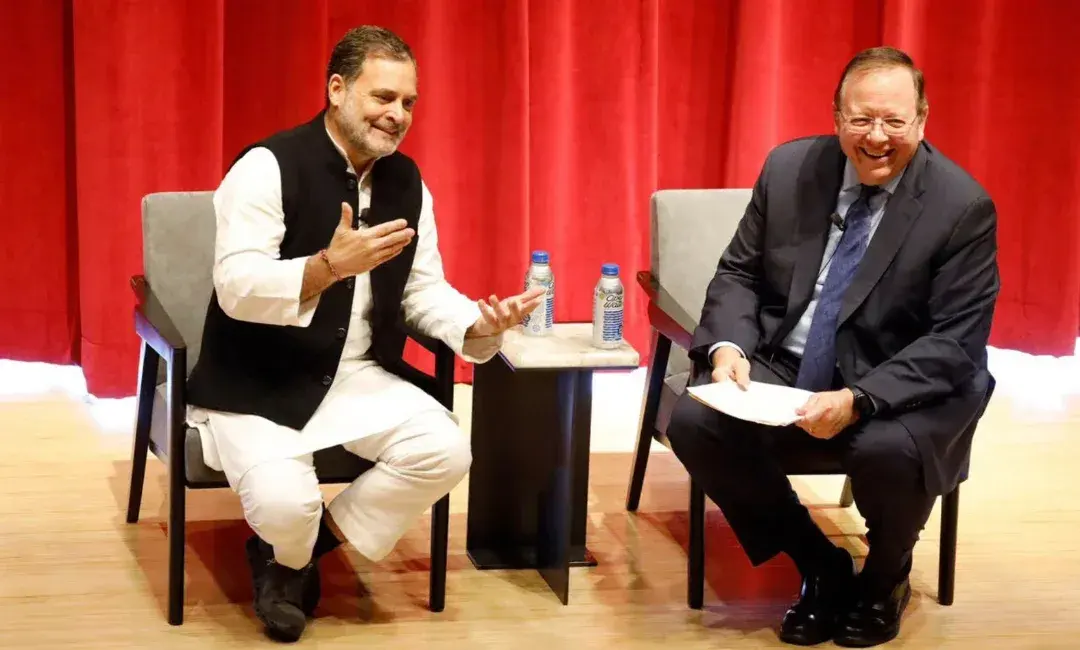
Colombo, November 25 – A perceived tilt towards Israel in a statement he made in Chicago University in the US recently has dented Rahul Gandhi’s image as a left- and human rights-oriented Indian politician.
At first glance, Rahul did seem to have glossed over Israel’s genocidal attacks on civilians of Gaza. While he condemned Hamas’s attack on Israeli civilians on October 7, 2023, he did not describe Israel’s brutal response as “genocide”, thus diluting the Congress party’s traditionally strong support for the Palestinian cause and the people of Gaza.
His critics on this matter (mostly Left-wing leaders and Muslim commentators) pointed out that he had also veered from the Gandhi family tradition. Both his mother, Sonia Gandhi and Priyanka Gandhi had spoken in favour of the people of Gaza.
Rahul’s Statement
In an answer to a question, Rahul said, “I support a strong relationship with Israel. We have strategic interests, including buying the best weapons for our armed forces. But that cannot mean silence on Gaza. I condemn the October 7th attacks and the killing of innocent people. I also condemn what Israel has done in Gaza. One wrong cannot justify another.”
"We have a good relationship with Israel. We buy weapons from Israel, and that's good. But with all due respect, we are bigger than Israel. We are a country of 1.5 billion people, and our foreign policy should be based on what's good for us and not based on what's good for someone else. India’s foreign policy must be guided by what is good for India.”
“We are a nation of 1.5 billion people. No country - Israel, USA, Russia or China - should hold us back from playing our rightful role on the global stage. India must stand for what it believes in.
Rahul had also said, "As far as relationship with Israel goes, there are strategic reasons why we have a relationship with them... but... India has to show its weight on the global stage, and that shouldn't be hampered by anybody, whether that's Israel, the US States, Russia, China..."
However, Rahul was torn apart by leftist and Muslim commentators in India for his apparent partiality towards Israel. They said that he had not only deviated from the Congress party’s consistent policy of supporting the Palestinian cause but also avoided characterising Israel’s actions as genocide.
In an article published by Indian Express, Sonia had criticised the Narendra Modi government, questioning its silence over a June UN report on Gaza condemning Israel. The UN Independent International Commission of Inquiry had alleged that Israel had targeted children with the intent of destroying the Palestinian population in Gaza. Sonia noted that the commission was chaired by former Indian judge, S. Muralidhar.
The 94-page report alleged that Israel's actions were aimed at eradicating the Palestinian population in Gaza, including children. Sonia said that at least 20,000 children were killed and 44,000 injured in Gaza, with many left permanently disabled. According to the report, children accounted for 27% of those killed or injured in Gaza. It also stated that 97% of schools were damaged or destroyed, while attacks on hospitals, including children's hospitals, had severely affected healthcare, leading to a sharp rise in pregnancy and childbirth complications.
Sonia said that the Hamas attack on Israel was "horrific, heinous and completely unacceptable", but added that Israel's subsequent military response had been marked by "indiscriminate cruelty and barbarism". She pointed out that India was the only voice that had remained silent on the report.
Communist Party of India (Marxist) leader, Pinarayi Vijayan and CPI (Marxist Leninist) chief Dipankar Bhattacharya lashed out against Rahul’s apparent equivocation in Chicago.
Mahatma Gandhi's great-grandson, Tushar Gandhi, expressed his disappointment over Rahul’s stand and said that it had hurt the Muslims of India. He demanded that Rahul meet the Palestinian ambassador in New Delhi to pledge support for the Palestinian cause.
However, on Sunday, Tushar tweeted to say that Rahul had clarified his statement. As per Tushar, Rahul conveyed to him that Israel's actions in Gaza were wrong, and while India had relations with Israel for defence reasons, its foreign policy could not be based on the interests of Israel.
Other critics said that Rahul was playing to the pro-Israel gallery in India and the US. Opinion is influenced by the large and well-endowed Zionist lobby in the US and anti-Muslim sentiments are widespread in India. Some ideologues warned that Rahul’s bid to woo these Israeli and anti-Muslim lobbies will be futile given his party’s strong pro-Palestine background.
In Defence of Rahul
In defence of Rahul, some commentors pointed out that a careful reading of his remarks would show that he had not deviated from the Congress party’s ideals. Rahul had condemned the October 7, 2023 Hamas attacks as "absolutely horrible" while also “condemning” Israel's action in Gaza. He further said, "one cannot get away from both the wrongs."
On Israel-India relations, Rahul said, "As far as relationship with Israel goes, there are strategic reasons why we have a relationship with them... but... India has to show its weight on the global stage, and that shouldn't be hampered by anybody, whether that's Israel, the US States, Russia, China..."
Read in totality, he had maintained a balance. His stance recognised the fact that most Indians do not reject Israel outright, as Israel had come to India’s aid in times of war with Pakistan. It has shared its defence technology while Western nations had been reluctant to do so.
Importance of Defence Ties with Israel
Rahul‘s apologists point out that it would have been imprudent for Rahul to have been anti-Israel given its role in the defence of India as a supplier of advanced equipment and as a technology sharer in contrast to Western nations.
Indians are aware that India is Isael’s single largest defence customer. Between 2020 and 2024, 34 per cent of all Israeli arms exports by value went to India, totalling about $20.5 billion.
The relationship is structurally distinct from Israel's defence ties with most other partners. It is dominated by complex platforms (radars, missiles, air-defence systems, drones) rather than small arms, and has shifted increasingly toward co-development and co-production in India rather than off-the-shelf purchases.
Industrial Partnerships
According to www.knowisrael.org, four major Israeli defence firms run substantial Indian industrial partnerships as of mid-2026. The Rafael Advanced Defence Systems runs a joint venture with the Kalyani Group (Kalyani Rafael Advanced Systems, KRAS) for missile production and related systems.
Rafael also has industrial cooperation arrangements with Bharat Dynamics Limited (BDL) for the Ice Breaker air-to-surface missile, and an equity investment in Centum Electronics (Bengaluru) for electronic warfare systems. Rafael's products in India include the SPYDER air-defence system, the Spike anti-tank missile family, and the Litening targeting pod.
Israel Aerospace Industries (IAI) is the largest Israeli defence presence in India by revenue. Its partnerships include long-running cooperation with Hindustan Aeronautics Limited (HAL), Bharat Electronics Limited (BEL) and Larsen & Toubro (L&T). IAI products in Indian service include the Barak family of naval air-defence missiles, the Phalcon airborne early-warning system, the Heron family of unmanned aerial vehicles, and the LORA family of ballistic missiles.
Elbit Systems runs partnerships including a joint venture with Adani Defence and Aerospace (Adani Elbit Advanced Systems India, focused on UAVs) and works with multiple Indian partners on EO/IR sensors, targeting pods, and the Hermes UAV family. Elbit's Rampage air-to-ground missile is being inducted into the Indian Air Force.
The Arrow consortium (Israel Aerospace Industries with US partners) provides the upper layer of Israel's missile defence. India is reported to be evaluating Arrow components as part of Mission Sudarshan Chakra.
Sharing Technology
According to META, unlike the US, which sells with end-use conditions and refuses to share the source code, Israel has moved to joint development plus co-production. Barak 8 (also known as LR-SAM or MR-SAM) is an Indo-Israeli jointly developed surface-to-air missile system, designed to defend against any type of airborne threat including aircraft, helicopters, anti-ship missiles, and UAVs as well as ballistic missiles, cruise missiles and combat jets. Both maritime and land-based variants of the system exist.
In February 2026, Israel signalled willingness to transfer the “Iron Dome” technology and not just sell batteries. The Indo-Israeli "Special Strategic Partnership" involves joint development, joint production, and technology transfer. META says that the focus is on "modular integration" - Israeli seekers, radars, and EW suites are embedded into Indian systems.
On November 18, 2026, India signed a $211 million deal with Israel Aerospace Industries (IAI) to upgrade the Barak naval system with new hardware and software. Israel supplied Harpy and Searcher drones urgently during Kargil in 1999.
However, Israel does hold back some source code and algorithms, says META. Source code is the human-readable set of instructions written in a programming language that defines the behaviour of a software application. Algorithms enable computers to perform complex and repetitive tasks.
For the Iron Dome, David's Sling, and Arrow, Israel will give the system and production, but the core battle-management algorithm and the radar's most sensitive modes stay under Israeli-control. Israel gives India the ability to use and make, not to fully redesign, META explains.
US Hold
These restrictions are put in place because some technologies are under US control. Therefore, the most advanced cyber tools are offered as services or joint R&D, but full transfer of technology is not. The hold-back is often American, not Israeli, META says.
Intelligence Sharing
Defence cooperation runs in parallel to a strategic intelligence relationship between the Indian and Israeli national security establishments, which is acknowledged in general terms but rarely detailed in public.
Rahul Gandhi’s statement in Chicago has upset ideologues, who view international relations from an ideological standpoint. But practicing politicians, especially those within reach of power as Rahul is, have to keep in mind various aspects of the ground reality.
END
Share this story
RELATED NEWS
View all
Current Affairs
Sri Lanka counts the cost of two failed Chinese deals
Nov 23, 2026

Current Affairs
The motion that went nowhere
Nov 16, 2026
Current Affairs
Killers of journalists go untraced in 90% of cases, the UN says
Nov 03, 2026
Current Affairs
India’s new privacy law would chain the media, leading publishers including Ambani and Adani tell the Supreme Court
Oct 28, 2026