Mirror Wall
Where goes the Opposition?

By Kassapa
While the country is kept entertained by ‘satyagraha’s from the Buddhist clergy and motions of no confidence against the Speaker and the government is carrying on regardless, the opposition, expected to perform the role of the alternative government, is stumbling from one blunder to another.
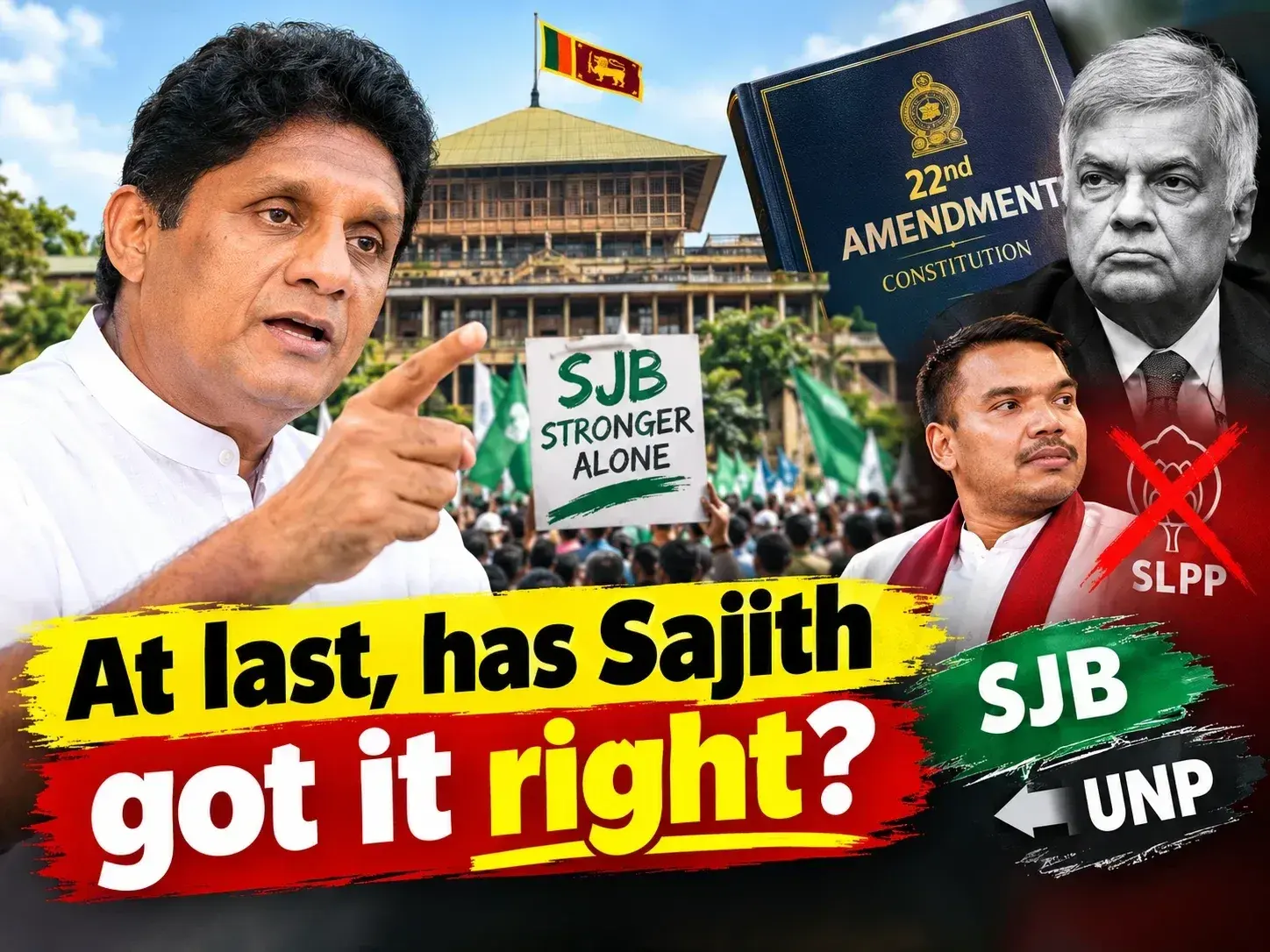
There was a momentary flash of unity when, rightly or wrongly, they combined their resources to oppose the 22nd Amendment. Since that was written into the legislative history books, that unity has all but disappeared with the four major parties- the Samagi Jana Balavegaya (SJB), the United National Party (UNP), the Sri Lanka Freedom Party (SLFP) and the Sri Lanka Podujana Peramuna (SLPP)- going their separate ways.
The SLPP is arguably the worst hit. Its National Organiser and heir apparent for the leadership Namal Rajapaksa is in remand custody. Even a plea that his mother Shiranthi is about to undergo heart surgery didn’t move the courts sufficiently to grant him bail. All he can do is attend Parliament where he vents his frustration with a show of bravado. Looking beyond this immediate predicament, the future is even bleaker.
The SLPP is a party of the Rajapaksas, founded by the Rajapaksas for the Rajapaksas. There has never even been a discussion about a leader who does not carry that name. For instance, in 2019, when Namal Rajapaksa was deemed to young to contest the presidential election and there was a cloud over Gotabaya Rajapaksa’s candidacy because of his American citizenship, the ‘spare wheel’ they picked ‘just in case’ was another Rajapaksa, Chamal.
Those old enough and with long memories will recall the crisis the Sri Lanka Freedom Party (SLFP) was plunged into when Sirima Bandaranaike was deprived of her civic rights. There was no Bandaranaike who was ready and able to take over and they relied on Hector Kobbekaduwa, a distant kinsman not bearing the Bandaranaike name, to do the honours. The SLPP does not even have that luxury, or so it seems.
This is the problem with parties built on a dynastic foundation. If Namal Rajapaksa were to be incarcerated for a significant period of time, that could spell the end of the SLPP as a viable entity. One does not expect the likes of Janaka Tissa Kuttiarachchi to carry the SLPP forward. Those who may actually be capable of doing so, such as Kanchana Wijesekera may not be entrusted the task of taking on the leadership for fear of eclipsing Rajapaksa.
Comparatively, the SJB’s problems appear trivial. It does have a stable leader in Sajith Premadasa but his leadership skills are being called into question time and again. Most recently, the SJB’s implied support of Gnanasara thero’s plea for a second pardon, creates a sorry narrative for a party that relies on Tamil and Muslim votes for its survival.
The SJB has competent politicians and others who genuinely want to see the nation surge forwards. They are however hamstrung by a leadership which has ill-defined policies which waver from one crisis to another. They seem to be devising policies on the run, coming up with whatever they feel will please the ‘gallery’ at a given time. The result is consistent inconsistency, resulting in a loss of faith among voters.
As with the SLPP, there is also no one in the SJB capable of or wanting to ‘bell the cat’- challenge Premadasa’s leadership. If they do so, they would be purged from the party, so they remain, sulking but silently hoping against hope that by some miracle, voters would turn to the second largest party in Parliament to form the next government. Voters didn’t do so at the last major elections and there is no reason to believe that they will do so at the next general election either.
Some see the solution to this leadership vacuum in the SJB as reuniting with the UNP. That has been a baby many years in the making. There have been informal discussions, formal negotiations, behind the scenes moves, but nothing concrete has emerged, shattering the hopes of even the most optimistic. The best we have heard is that they will ‘come together at the right time’ or some such words to that effect.
A major obstacle is the stance of the leaders of the two parties. Ranil Wickremesinghe, now seventy-seven years of age, will be eighty at the next presidential and general elections but he doers not want to hand over the reins to Premadasa who will also be sixty in a few months’ time. Wickremesinghe, the man who presided over the demise of the UNP from the Grand Old Party it was during J.R. Jayewardene’s time, has not yet prepared a succession plan.
Navin Dissanayake, Ruwan Wijewardene, Vajira Abeywardena and Ravi Karunanayake, in no particular order are all waiting, believing that they will be the ‘chosen one’ but Wickremesinghe is in no hurry to anoint a successor. If some misfortune was to befall Wickremesinghe suddenly, all hell would break lose in the UNP and the party would shatter into smithereens. Wickremesinghe probably believes that the country will suddenly plunge into economic chaos again and he will be summoned to rescue it. Wishful thinking indeed, not least because Anura Kumara Dissanayake has been following Wickremesinghe’s economic policies even better than the latter did, minus the corruption that was prevalent during the former’s tenure.
In terms of dividing into as many factions as possible, there is no better example than the SLFP. One does not even know who the leader of the party is anymore. The names of Maithripala Sirisena, Nimal Siripala de Silva and even Dayasiri Jayasekera come to mind, but the legal tangles the party is embroiled in is too difficult to unravel that easily. The SLFP is now merely a nameboard party, just like parties of the ‘old left’, a sad end to a political entity that ruled the country for the longest period of time, albeit in coalition with other parties.
So, if the NPP emerges victorious at the next general and presidential elections, it wouldn’t be because they have done spectacularly well in government. They haven’t. It would be because the average voter, presented with the question ‘if not them, who?’ would not able to find a satisfactory answer.
Share this story