Current Affairs
Woes of IndiGo, India’s largest airline
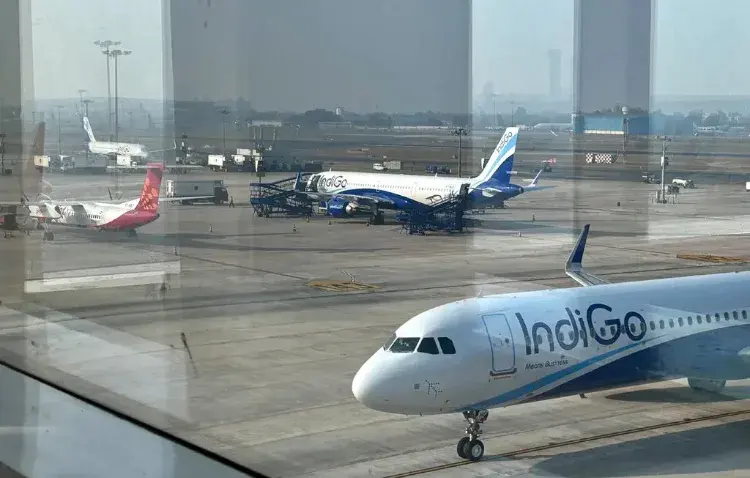
The unprecedented cancellation of over 2000 flights by India’s largest airline IndiGo earlier this week leaving thousands of passengers stranded across the country, is attributed to the monopolistic system, greed for profits, shortage of pilots and sloppy management practices.
By P.K.Balachandran
Colombo, December 6 – Earlier this week, IndiGo airlines, India’s largest passenger carrier, cancelled more than 2000 flights to multiple places leaving thousands of passengers stranded and fuming across the country. The indefinite dislocation was unprecedented in the annals of civilian aviation in India.
Significantly, none of India’s other major airlines, including Air India, has faced such issues.
IndiGo was rated highly in the scale of service and affordability. It has an undisputed position as India’s biggest airline, operating around 2,300 flights a day, and accounting for about 118 million passenger arrivals as of last year.
Formed in 2006, IndiGo had captured roughly two-thirds of the booming air travel market as of August 2025, adding 58 aircraft in 2024 alone. Its initial appeal was its sleek but practical style. It cut costs, like other low-cost carriers, while staying focused on punctuality and reliability, according to reports.
The government of India has appointed a high-level committee to inquire into the massive breakdown in IndiGo’s systems. However, with the available information, the collapse appears to have stemmed from a set of inter-related factors. These are -
(1) The Narendra Modi government’s entrepreneurial model in which select companies are given a virtual monopoly over a line of business.
(2) The Indian capitalist classes’ unsatiable greed for profits.
(3) Sloppy Third World management practices.
(4) The poor state of back up services.
(5) Shortage of pilots
(6) Government’s actions to regulate the working hours of pilots to ensure flight safety.
Monopoly Model
Pointing out to his column published in “The Indian Express” last month, Rahul Gandhi, Leader of the Opposition in the Indian parliament, blamed the “IndiGo fiasco” to the Modi government’s “monopoly model” and asserted that India deserves fair competition in every sector, not “match-fixing monopolies”.
He said - “The IndiGo fiasco is the cost of this government’s monopoly model. Once again, it’s ordinary Indians who pay the price — in delays, cancellations and helplessness.”
Reporting from New Delhi, the UK’s paper “Independent” said that at the heart of the turmoil is a regulatory overhaul which involves stricter rostering rules known as “Flight Duty Time Limitations” (FDTL) imposed by the Directorate General of Civil Aviation to enable better working conditions for pilots and airline crews.
The new rules were to be implemented in two phases, with the first rolled out in July and the latest tightening coming into force on November 1.
The rules drastically cut the number of hours pilots and crew could fly; mandated longer rest periods; limited night-time landings; and redefined night duty periods.
The new standards increased the mandatory rest period for pilots by 12 hours a week to 48 hours and stated that pilots could make no more than two night-time landings in a week, down from six earlier.
Airline companies were required to submit quarterly fatigue reports on pilots. The long-term vision of the government was towards a full-fledged fatigue risk-management system to combat pilot fatigue, a major risk factor.
Government’s Statement
The Civil Aviation Ministry said in a statement that the disruptions arose primarily through misjudgement and planning gaps in IndiGo’s implementation of the new rules.
But IndiGo assigned the disruptions to the introduction of the new rules, along with adverse weather conditions, heightened congestion and technical glitches.
Aviation experts told the media that the breakdown was because of IndiGo’s sheer size as well as negligence. Indigo operates over 2,200 domestic and international flights daily, twice as many as Air India, according to NDTV.
Airlines were given a preparation time of nearly 18 months before the full implementation of the revised rules, which were first announced in January 2024. But Indigo was way behind schedule in implementing the new rules.
Pilots Shortage
According to the Federation of Indian Pilots IndiGo was not able to make timely roster adjustments in line with the new rules and plan its schedule properly. The Federation also blamed a “pilot pay freeze” and “hiring freeze” at IndiGo.
The “New York Times” reports that IndiGo and the pilots’ union agree on one thing: There are too few trained personnel to safely fly the vast number of flights that IndiGo operates. Its network has been growing at a frantic pace, running ahead of its ability to hire.
“Despite the two-year preparatory window before full Flight Duty Time Limitation implementation, the airline inexplicably adopted a hiring freeze, entered non-poaching arrangements, maintained a pilot pay freeze through cartel-like behaviour, and demonstrated other short-sighted planning practices," the Federation of Indian Pilots was quoted as saying by the news agency Press Trust of India (PTI).
Captain Amit Singh, an aviation safety expert, told the “Times of India” that the crisis was the result of “wilful negligence” as winter schedules were planned months ahead.
“IndiGo ought to have resolved its crew-shortage issues before seeking approval, rather than putting the travelling public through this,” Captain Singh said. “It’s wilful negligence," he added.
More Time Sought and Granted
In the wake of the widespread disruptions, IndiGo sought more time from the aviation regulator to implement the provision of the new rules limiting pilot duty hours at night. The airline said its operations would be fully restored by 10 February as it warned of more cancellations in the coming days.
On Friday, government agreed to withdraw a part of the rules with immediate effect. “In view of the ongoing operational disruptions and representatives from various airlines regarding need to ensure continuity and stability of operations, it has been considered necessary to review the said provision,” it said.
Government also exempted night-time flights from the rules until February 10. This marked the second revision to the rules in under 24 hours. The regulator had previously raised the limit on consecutive flying hours for pilots from 12 to 14.
Pilots Oppose Revision
Calling the move “wrong,” the President of the pilots’ union, C.S. Randhawa, said, “You cannot compromise safety for commercial interest.”
The government released a statement later saying that the decision had been made for those “who rely on timely air travel for essential needs” and denying that the move would jeopardize safety.
IndiGo CEO’s Statement
In a video statement, Pieter Elbers, IndiGo’s chief executive, said that a “reboot” of its systems and schedules resulted in the surge of cancellations on Friday, which was necessary to put the airline back on track starting this weekend.
The current snarl would persist for a few more days, Elbers said, and that the airline expected a “full, normal situation” to return between Dec. 10 and 15.
IndiGo apologized multiple times and released a statement saying that “a multitude of unforeseen operational challenges” were responsible for the disruption, including weather and technological glitches. The airline noted also that new rules requiring more rest time for pilots and flight crew were behind a lot of the trouble.
But the Federation of Indian Pilots said that those rules, which were announced almost two years ago and went into effect last month, were not to blame.
“All other airlines have provisioned pilots adequately and remain largely unaffected,” the union said in a statement. Instead, it added, the cancellations were “the direct consequence of IndiGo’s prolonged and unorthodox lean manpower strategy.”
The country’s aviation authority released another memo that laid the blame on IndiGo’s “internal oversight, operational preparedness and compliance planning,” resulting in an acute shortage of staff and crew. It appointed a four-member committee to investigate the causes.
Ambition Sans Infrastructure
India’s aviation sector has been growing by leaps and bounds in recent years, making it a standard-bearer of Prime Minister Narendra Modi’s push to upgrade the country’s infrastructure. According to media reports, the number of airports roughly doubled, from 74 to 157, during his first 10 years in office, since Modi came to power. It is projected to exceed 200 by 2030.
But the ambition is not matched by the creation of infrastructure in terms of facilities and personnel. Aircraft maintenance facilities are also inadequate and below par as reported after the Air India Express Dreamliner plane crash at the Ahmedabad airport earlier this year.
END
RELATED NEWS
View all

Current Affairs
Sri Lankan Presidential pardons- the good and the bad
Sep 11, 2026

Current Affairs
The pros and cons of joining BRICS- the dilemma of Pakistan and Bangladesh
Sep 09, 2026
Current Affairs
Disaster in Nepal gets embroiled in geopolitics.
Sep 08, 2026
Current Affairs
Why Mecca Pact, and what does it imply for its members, Israel and India?
Aug 18, 2026