Point of View, Counterpoint Political Desk
Eventful week: Judge’s lightning transfer, Colombo floods, controversial laws and protests
By Counterpoint Political Desk
The past week has been quite eventful. It has seen the country’s political debate dominated by proposed controversial security legislation, parliamentary tensions, proceedings of high-profile court cases and corruption investigations, while the approaching 2027 Budget and continuing adverse weather have also featured prominently.
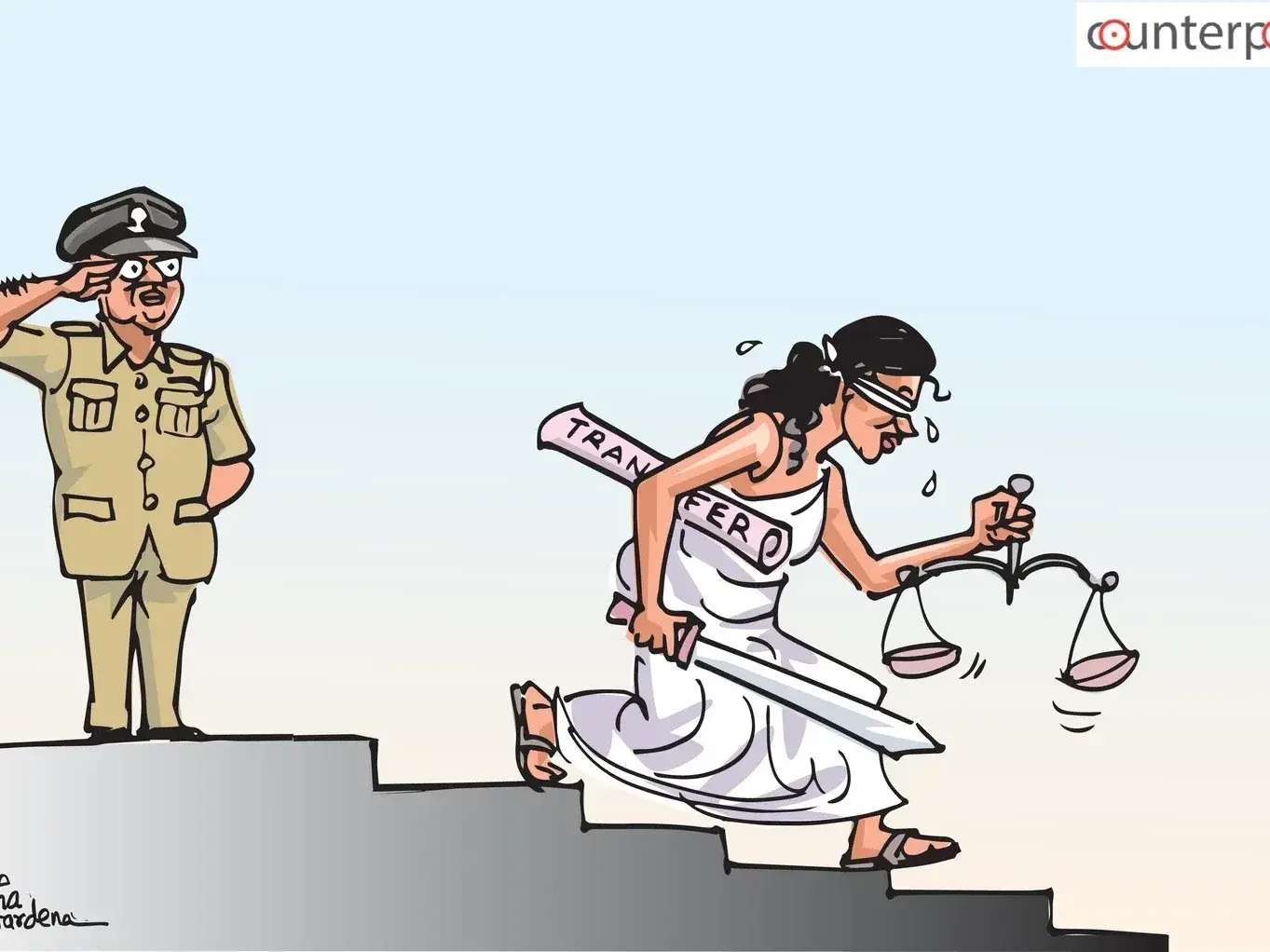
What stood out among the issues that grabbed headlines last week was the transfer of Gampaha Magistrate Bandula Gunaratne, who had sought to initiate contempt of court proceedings against IGP Priyantha Weerasooriya for not carrying out a court order that a circular be issued to all police officers instructing them not to institute baseless legal proceedings against innocent members of the public.
According to media reports, Magistrate Gunaratne’s transfer order was issued by Judicial Service Commission Secretary Prasanna Alwis.
The Opposition took up the judge’s transfer in the parliament on Friday, calling it an assault on judicial independence.
Tensions in Parliament
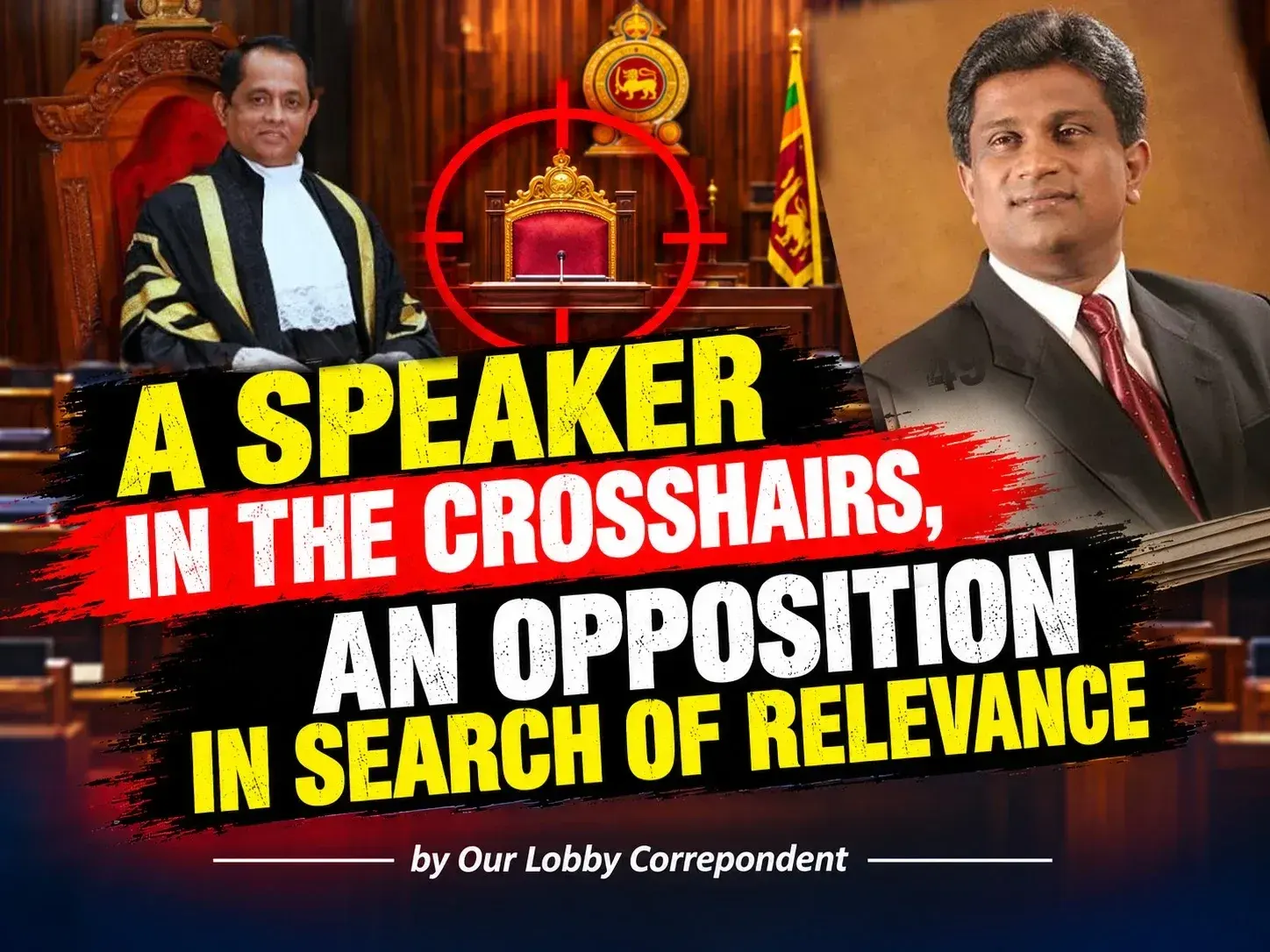
The government has effectively stifled the Opposition's attempt to secure a parliamentary debate on its no-confidence motion against Speaker Jagath Wickramaratne. It has refused to take up the motion, signed by 44 Opposition MPs and containing 50 allegations, claiming that some sections of it contravene Standing Orders and are sub judice.
Tensions escalated in Parliament on November 3 and 4, with the Opposition accusing the government of obstructing scrutiny of the Speaker’s conduct, on a false pretext. The government maintained that the motion needed revision in accordance with Standing Orders, prompting the Opposition to point out that once a no-confidence motion was placed on the agenda, nobody could put it on hold. MP Dayasiri Jayasekera argued in the House on Friday that there had been several instances where no-confidence motions were debated and put to the vote while court cases were pending.
Another important development in the parliament was the proposed inquiry into Black July. NPP MP Thanura Dissanayake proposed a parliamentary select committee be appointed to examine the 1983 anti-Tamil pogrom and its consequences brought the issue back into the political spotlight. The proposed inquiry is intended to examine reconciliation, relief and compensation for victims' families among other things. This proposal has prompted some Opposition members to ask the JVP-led government why it has not appointed a special probe committee to investigate JVP founder Rohana Wijeweera, who was killed while in state custody.
Protests against repressive laws
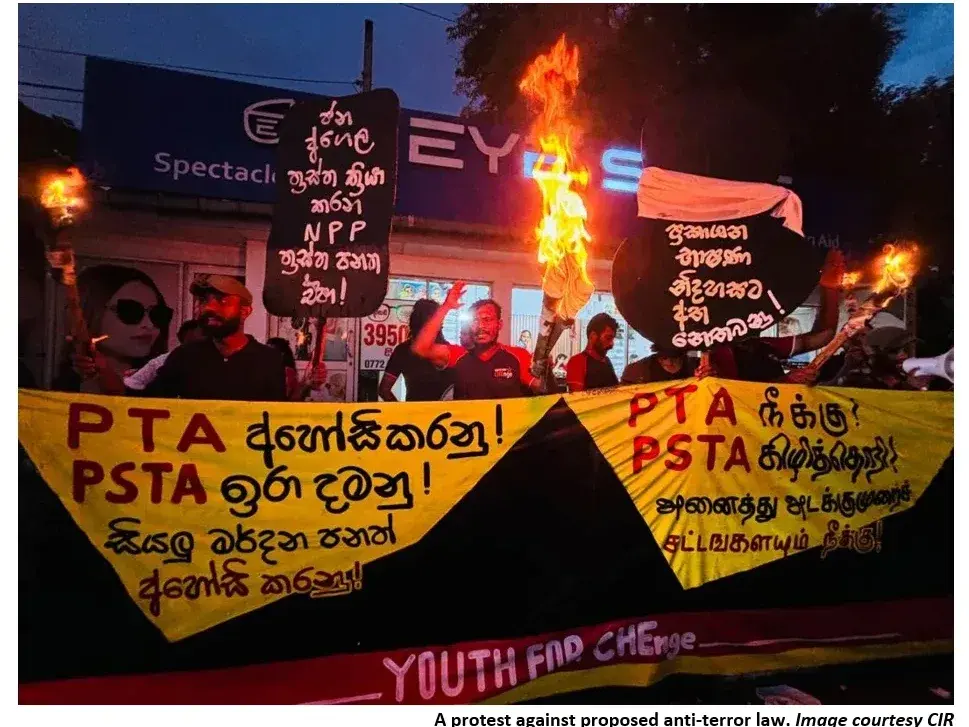
The NPP government continues to provide the Opposition with rallying points. All Opposition parties, trade unions and activists have intensified their campaign against the proposed Protection of the State from Terrorism Bill (PSTB) and Prevention of Organised Crime Bill (POCB). They have condemned the proposed legislation vehemently as part of what they describe as a government strategy to suppress democratic dissent and establish one party-rule.
Protesters warn that the proposed legislation could expand police powers, facilitate arbitrary detention and undermine civil liberties. Human Rights Watch, Amnesty International and the United Nations have criticised the counterterrorism proposals for inadequate judicial safeguards and sweeping powers of arrest and search. The government has rejected allegations that the bills threaten trade unions or media freedom.
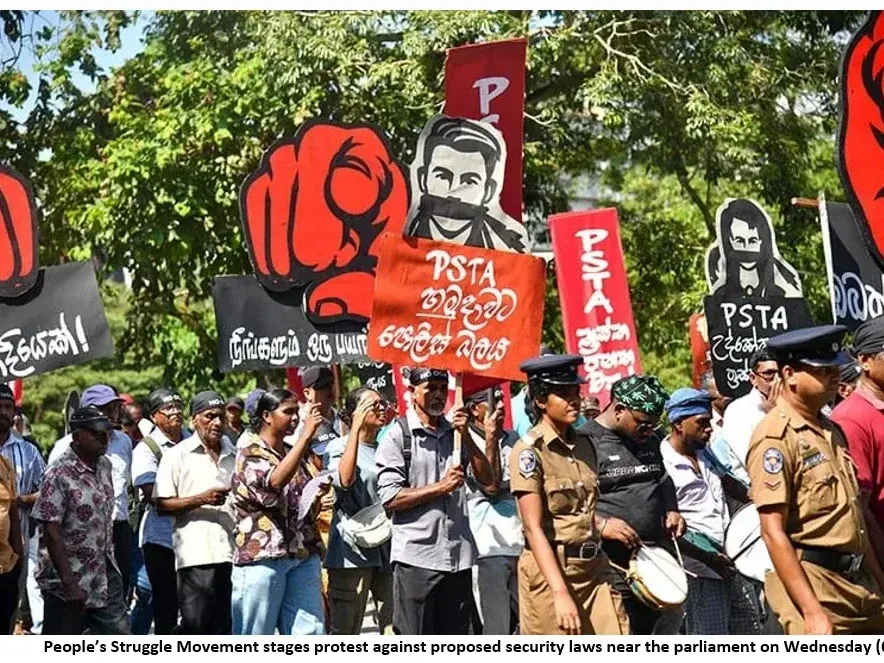
The People’s Struggle Movement staged a colorful protest near Parliament on November 4, demanding withdrawal of the proposed Protection of the State from Terrorism Bill (PSTA) and Prevention of Organised Crime Bill. Backed by the Frontline Socialist Party, demonstrators warned that the legislation could suppress dissent, undermine democracy and curtail civil liberties. The protest proceeded despite police obtaining a court order restricting it .
A softening of the controversial law
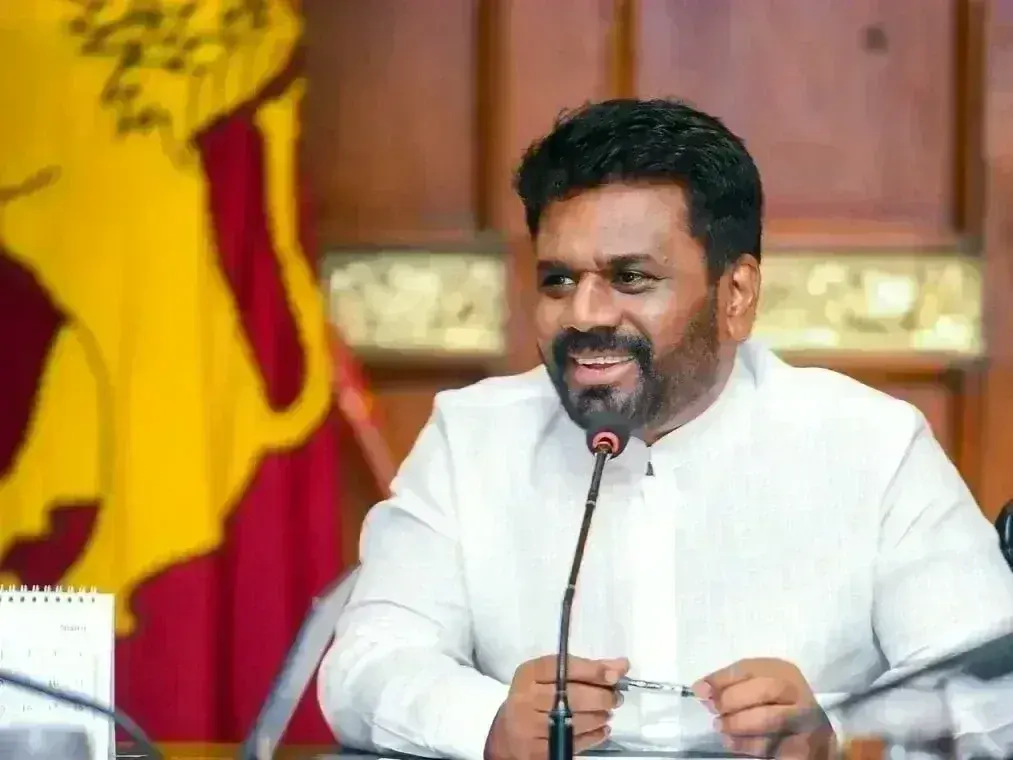
President Anura Kumara Dissanayake recently made a special statement at the Ratama Ekata national conference on drug prevention held at Temple Trees.
The statement concerned the proposed Protection of the State from Terrorism Bill and the Prevention of Organised Crime Bill. In the presence of the Anunayake Theras of the Malwathu and Asgiri Chapters and other religious leaders, the President said that three provisions in the two Bills which had attracted considerable public controversy would be amended.
The first is a reduction in the period of detention of a person arrested for an offence from 72 hours
to 48 hours. He also said that the provision relating to tattoos would be removed and that the organised crime law would not apply to other offences covered by the Excise Ordinance. The relevant amendments, he said, would be submitted to Parliament.
The government appears to believe that this announcement will help ease opposition to the Bills to some extent. Nevertheless, allegations continue that certain provisions in the proposed laws are vague and lack clear definitions or interpretations.
Corruption investigations and court proceedings
Several investigations involving politicians and former public officials have attracted attention. Namal Rajapaksa has been further remanded. He was released on bail on November 3 in connection with the alleged Rs. 70 million bribery case involving the Krrish transaction, but his remand stay continues due to his indictment in another case involving a questionable Airbus deal.
Former State Minister and Badulla MP Chamara Sampath Dassanayake was further remanded on November 6 in an alleged Rs. 8.4 million bribery case involving phosphate-importing companies.
Former Foreign Minister Rohitha Bogollagama was granted bail in a corruption case but remained in prison because he could not fulfil the bail conditions.
Both Namal and Chamara are bitter critics of the government. They carry out scathing attacks on the government in Parliament. The Opposition has claimed that the government is misusing legal and judicial processes to launch political witch-hunts against its critics who have the potential to challenge it politically. The government has denied this charge.
Controversial payment and sudden resignation
The government's payment of Rs. 104 million to the organizers of the Asia-Pacific Broadcasting Union's General Assembly, in Colombo, became a major controversy this week.
The initial news reports stated that the payment had been made with Cabinet approval. Subsequently, Cabinet Spokesman and Minister Nalinda Jayatissa said that the money had been paid through the Sri Lanka Tourism Promotion Bureau. He also said that the Cabinet had been informed of the payment.
Meanwhile, S. Hewawasam, who served as the Chairman of the Tourism Promotion Authority, suddenly resigned. Several people also visited the Commission to Investigate Allegations of Bribery or Corruption (CIABOC) and lodged complaints concerning the payment.
Commenting on the matter, MP Chamara Sampath Dassanayake said that the present administration had instituted legal proceedings against Basil Rajapaksa for obtaining money from the Tourism Promotion Bureau and using it for a purpose unrelated to his assigned subject. He questioned why the same law should not apply in the present instance.
Problems within the SJB
Reports indicate that some problems have arisen within the Samagi Jana Balawegaya (SJB), owing to remarks made by some leaders of the party.
SJB MP Rishad Bathiudeen recently declared at a public meeting in Kurunegala that his party was not a slave of the SJB.
After the remark circulated on social media, Ranjith Madduma Bandara, General Secretary of the Samagi Jana Sandhanaya, contacted Bathiudeen and questioned him about it.
When the General Secretary asked, “When you say things like this, the media come and question us. What happened?”, Bathiudeen replied: “That is not what I said. The media have reported it incorrectly. I did not criticise the alliance.”
Some leaders of the constituents of the SJB are discussing the need to form an alliance with the United National Party (UNP) and other parties if the SJB is to win an election.
UNP leader Ranil Wickremesinghe recently said that an alliance between the SJB and the UNP alone would not be sufficient to win an election. He proposed a broader alliance of Opposition parties. Former President Wickremesinghe said that they would have to join forces with other Opposition parties as well.
Unconfirmed reports have suggested that unofficial discussions are also taking place behind the scenes between the former President and a group within the SLPP.
Economy and the forthcoming Budget
The government's 2027 Budget, scheduled for November 12, is emerging as a major economic and political event. Sri Lanka's economy has expanded for 12 consecutive quarters, with foreign reserves reaching US$6.9 billion in October. A primary surplus of 5.4% of GDP was recorded in 2025. The 2027 Budget targets a primary surplus of 2.6% of GDP and an overall fiscal deficit of 4.5%.
Rising energy costs and inflation, reported at 8.3%, are increasing pressure on households. The upcoming Budget will be important for retaining IMF support and preparing for the conclusion of the current IMF programme in March 2027. The government is reportedly considering a proposal that Sri Lanka seek another IMF programme so as to be able to resume foreign debt payment in earnest in 2028.
The National System Operator (NSO) initially sought a 2.88% tariff increase citing a projected revenue shortfall of Rs. 4.4 billion. Following a preliminary review, the Public Utilities Commission of Sri Lanka (PUCSL) reduced the proposed adjustment to 1.46%. Subsequently, the NSO withdrew its request, claiming that had done so after an assessment of improved reservoir storage and expectations of above-normal rainfall.
Addressing Parliament on Thursday, Energy Minister Anura Karunathilaka lambasted the PUCSL, claiming that there was absolutely no need for public consultations because the NSO had already decided against a tariff hike.
Colombo flooded and CMC blamed
Heavy rainfall on November 6 inundated several roads in Colombo and its suburbs, causing severe traffic congestion and damage to vehicles and shops. The Meteorology Department recorded 129 mm of rain at its Colombo station within a few hours.
The Colombo Municipal Council (CMC) has drawn criticism for its failure to maintain the
stormwater drainage system properly in Colombo.
The NPP pledged to modernize the Colombo city by developing its infrastructure, among other things. Immediately after the NPP took control over the CMC in 2025, Deputy Minister Sunil Watagla, who spearheaded the NPP’s mayoral campaign, said Colombo would undergo radical changes that the public could not imagine. Now a video of his speech has resurfaced and gone viral.
The past week's developments point to three major challenges confronting the NPP government: Political accountability: The controversy over the Speaker's no-confidence motion has exposed continuing tensions between the government and Opposition over parliamentary procedures and scrutiny; threat to civil liberties: The proposed counterterrorism and organised-crime legislation has revived concerns about executive power, police authority and the protection of fundamental rights, and Economic recovery and public hardship: The forthcoming Budget will have to reconcile fiscal discipline and IMF commitments with rising living costs, inadequate household incomes and demands for greater public investment. This is a tall order for the government, which came to power, raising the expectations of the public beyond measure. Now it is struggling to deliver on its promises and resorting to political theatre.
The renewed flooding of Colombo and adverse weather events elsewhere have underscored the urgency of improving urban drainage and disaster preparedness. This means the government will have to increase expenditure significantly, which will take its toll on Treasury funds.
Share this story
RELATED NEWS
View all
Point of View
Raging battle over no-confidence motion and intl. concern over proposed security legislation
Oct 31, 2026
Point of View
Game of chicken between govt. and protesting monks continues
Oct 25, 2026
Point of View
Why Bali’s fuel queues should worry Sri Lanka
Oct 19, 2026
Point of View
Protesting monks’ challenge: Govt. picks up the gauntlet
Oct 17, 2026