Point of View, Counterpoint Political Desk
Robe-sarong controversy eclipses all other issues
President meets Prelates, promises way out
by Counterpoint Political Desk
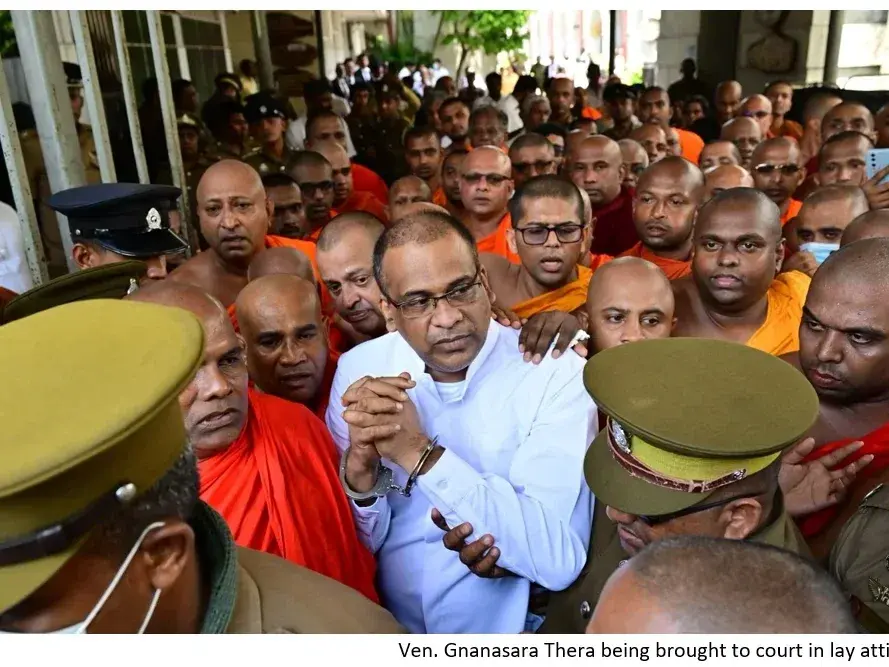
Prisons are dominating news again. This time around, they are in the centre of a controversy over bringing a prominent Buddhist monk to court in lay attire.
General Secretary of the Bodu Bala Sena Ven. Galaboatte Gnanasara Thera has a regular online presence due to his controversial statements and actions. He has been sent back to prison following the annulment by the Supreme Court of a presidential pardon he received from President Maithripala Sirisena during the UNP-led Yahapalana government. Curiously, the apex court ruling itself drew almost no criticism. The uproar erupted over what happened next.
Government Spokesman and Minister Nalinda Jayatissa has said 63 other monks are in prison, all in prison uniform, and that Ven. Gnanasara has been treated no differently. The Prison Department has made a similar announcement.
The prison authorities have explained that Ven. Galagoda Aththe Gnanasara Thera was produced before court in civilian clothing instead of his Buddhist robes because prison regulations require inmates serving rigorous imprisonment or sentences exceeding three years to wear prison-issued uniform.
Prisons Commissioner and Media Spokesman Senaka Pallethenna gave the following explanations: Inmates serving rigorous imprisonment must wear prison-issued clothing, irrespective of their status or position. A prison superintendent may permit a convicted person serving a sentence of less than three
years to appear in court in civilian clothing worn before conviction. In the case of a Buddhist monk, permission may be granted to wear robes. The same rules apply to other Buddhist monks in prison. The authorities said that more than 63 Buddhist monks were serving prison sentences and that they were also required to wear prison uniforms.
Cabinet Spokesman and Minister Nalinda Jayatissa likewise said the action had been taken in accordance with the Prisons Ordinance and that no special procedure had been introduced specifically for Gnanasara Thera.
Protests by Buddhis monks
The Mahanayake Theras have disputed the prison authorities' interpretation of the rules and regulations. In a strongly-worded letter to the Commissioner-General of Prisons, they have cited Regulation 550 of the Prison Regulations, arguing that convicted prisoners should be allowed to wear the clothing they were accustomed to wearing before conviction, which, in the case of Buddhist monks, should mean their robes. They have also maintained that decisions concerning a monk's ordained status fall within the authority of the Buddhist clergy and lay institutions cannot decide on such monastic matters.
The prison authorities insist that they have only enforced the existing prison regulations governing the clothing of convicted prisoners, rather than having sought to revoke Gnanasara Thera's monastic status. The dispute centres on whether those regulations required his robes to be removed and whether the authorities had the power to do so.
Ven. Gnanasara rejected the Prison Department’s claim when he appeared in court dressed in white. He said he had been jailed under two or three earlier governments, and none had taken his robe off. "This time, even that has happened," he told reporters.
Backlash from Sangha and Parliament
In Parliament, Opposition Leader Sajith Premadasa and SLPP national organiser Namal Rajapaksa protested vehemently against the prison authorities producing Gnanasara Thera in court in civilian clothing. They urged the government to act in consultation with the Mahanayake Theras and reminded it that the Constitution makes protecting and fostering Buddhism a core state duty.
Ven. Medagama Dhammananda, Chief Secretary of the Asgiriya Chapter, has issued a forceful statement, calling the removal of the robe of Buddhist monk a grave legal and ecclesiastical offence and saying that the prison authorities have acted against Buddhist ethics. He has noted that since Ven. Gnanasara has effectively been disrobed, arrangements are expected for his re-ordination. The Mahanayake Theras of the three main chapters also wrote to the Commissioner-General of Prisons to register their objections.
The President meets prelates and protest
President Anura Kumara Dissanayake invited the Mahanayake Theras' representatives to meet him on Wednesday afternoon at the Presidential Secretariat. Eight senior prelates from the three chapters attended at the Presidential Secretariat, joined by the Ministers of Justice and Buddhasasana. The meeting followed a preliminary discussion at the Pelawatte office.
The President said he had been shocked to see a monk he had honoured the day before wearing lay clothes the following day. The prelates' letter suggested prison officials had erred, but the President argued that blaming them was pointless because they had only followed existing regulations. The practical remedy, he said, was to amend those regulations, which could be done within two weeks. A committee consisting of the Attorney General and officials from the Justice and Buddhasasana ministries would draft the changes and show them to the Mahanayake Theras before finalising them. The prelates accepted the plan.
Ven. Kotapitiye Rahula Thera has protested against the government’s failure to invite his Maha Sangha Sabha, to which Ven. Gnanasara belongs, to the meeting President Anura Kumara Dissanayake held with senior Buddhist prelates on 8 October 2026 to discuss the removal of Ven. Galagoda Aththe Gnanasara Thera’s robes.
Shiranthi’s arrest
Arrests are continuing. Last week, speculation was rife that former President Mahinda Rajapaksa, too, might be arrested. That however did not come to pass, but the net closed around his wife Shiranthi Rajapaksa, while Namal Rajapaksa was already in remand prison.
While Shiranthi was leaving the BIA for Singapore, where she said she would undergo treatment, she was directed to report to the Criminal Investigation Bureau on her return. On Mahinda Rajapaksa's instructions, an anticipatory bail application was filed at the Maligakanda Magistrate's Court. Before it could be heard, Bribery Commission (CIABOC) officers visited the Rajapaksa family residence, recorded her statement and arrested her. She was named second accused. The first accused, former National Savings Bank Chairman Pradeep Kariyawasam, was also arrested.
Both appeared before a Colombo Additional Magistrate. Mrs Rajapaksa was remanded until the 13th, while Kariyawasam was released on bail.
Confusion over Shiranthi’s hospital transfer
The media reported that Shiranthi would be moved to Nawaloka Hospital the following day in keeping with her lawyers' request that she be treated by her regular eye specialist, Dr Charith Fonseka. She was later told no transfer order existed. The Prison Department's Spokesman said prison doctors had directed that she be taken to the National Eye Hospital. Her lawyers said the court order had been breached and they would complain to the court.
Former ministers in custody
Former minister Rohitha Bogollagama was also arrested. Among the prominent politicians now behind bars are Nalin Fernando, Mahindananda Aluthgamage, Sarana Gunawardena, Namal Rajapaksa, Chandana Kathriarachchi, Piyankara Jayaratne, Rohitha Bogollagama and S. M. Ranjith.
Deputy Minister Sunil Watagala told Parliament that 55 of the 226 people arrested by the Bribery Commission recently were politicians. Reports say the total includes 16 former Cabinet ministers, three former State ministers and a former Chief Minister. Opposition figures such as Shiranthi Rajapaksa, Shanthi Chandrasena and Sugishwara Bandara have also been remanded.
Will the Budget deliver?
Amidst all this, President Anura Kumara Dissanayake, who is also Finance Minister, will present next year's Budget on Monday. Government sources promise a well-funded Budget with substantial
relief for the public.
The timing matters, because fuel queues reminiscent of the crisis years appeared a few days ago. The Opposition says the government taxes fuel unconscionably without passing enough of the proceeds back to the people. It says the government keeps saying that the Treasury is overflowing with funds. If so, it should be able to spend some of those funds to provide relief to the public.
Whether the government is meeting that responsibility is disputed. The Ceylon Petroleum Corporation Chairman D. J. A. S. De S. Rajakaruna has said it earned profits running into billions of rupees. President Anura Kumara Dissanayake has said that although the West Asian crisis has pushed up fuel costs, the government would spend about Rs. 41 billion on subsidies instead of passing the entire burden on to consumers. Yet prices were revised at the end of last month with several fuel types rising sharply.
People now hope the Budget will bring some relief, and the government will deliver some election promises such as lower electricity bills and no taxes on schoolbooks and medicines.
Catching thieves while the economy struggles
Senior ministers say the IMF's Extended Fund Facility will end next March, concluding the arrangement. Fidel Castro once compared borrowing from the IMF to kissing the devil. The current Sri Lankan leaders said something similar about the IMF before coming to power but they had to come to terms with reality and stick to the IMF programme.
The Treasury has been replenished in recent times under IMF guidance and oversight, and international assessments reportedly show an improved sovereign credit rating. However, there are formidable challenges before the government on the domestic front. They include growing poverty and unemployment.
Rebellious youth and disconcerting statistics
Youth unemployment can lead to serious socio-political repercussions. It was youth unrest that fueled the JVP’s two armed uprisings, the first in 1971 and the other in the late 1980s. The 2022 Aragalaya, which led to the ouster of President Gotabaya Rajapaksa, was also driven by the resentful youth. In India, the youth are leading the online phenomenon, the Cockroach Janatha Party, which has already staged a successful uprising and seen the back of a powerful minister in the Modi Cabinet.
So, the governed would do well to launch a comprehensive programme to solve the problems facing the youth as a national priority.
The World Bank estimates that 16.9% of Sri Lanka's population lived in poverty in 2025, while the official unemployment rate stood at 4% in the second quarter of 2026. Although the economy has recovered, poverty remains well above pre-crisis levels, and the relatively low unemployment rate does not fully reflect the extent of household financial hardship.
Sri Lanka's youth unemployment problem is considerably more serious than the country's overall unemployment rate suggests. According to the Department of Census and Statistics, 18.7% of people aged 15–24 were unemployed in the fourth quarter of 2025, compared with an overall unemployment rate of 3.8%. The World Bank's ILO-based estimates put youth unemployment at 18.6% in 2025, against a
South Asian average of 15.4% and a global average of 13.4%. Among young Sri Lankans, women are particularly disadvantaged, with an unemployment rate of 21.6%, compared with 17.1% for men. These figures highlight the challenge of creating sufficient employment opportunities for young people and ensuring that economic recovery translates into meaningful livelihood opportunities.
The Opposition's reading is that whenever the country experiences economic problems, the government causes the arrest of prominent opposition figures and cries, "Look, we are catching the thieves!" Senior opposition politicians ask whether that can solve the crisis. The government replies that the people have given it a mandate to catch thieves, and that doing so is its duty.
While that argument goes on, ordinary people are struggling to make ends meet and crying out for relief.
Share this story
RELATED NEWS
View all
Point of View
A Speaker in the crosshairs, an Opposition in search of relevance
Oct 07, 2026

Point of View
When an oil shock reaches Sri Lanka
Sep 22, 2026
Point of View
Week of constitutional fireworks expected in House
Sep 20, 2026
Point of View
UNP-SJB betrothal announced at JRJ’s birth anniversary commemoration
Sep 19, 2026