parliament
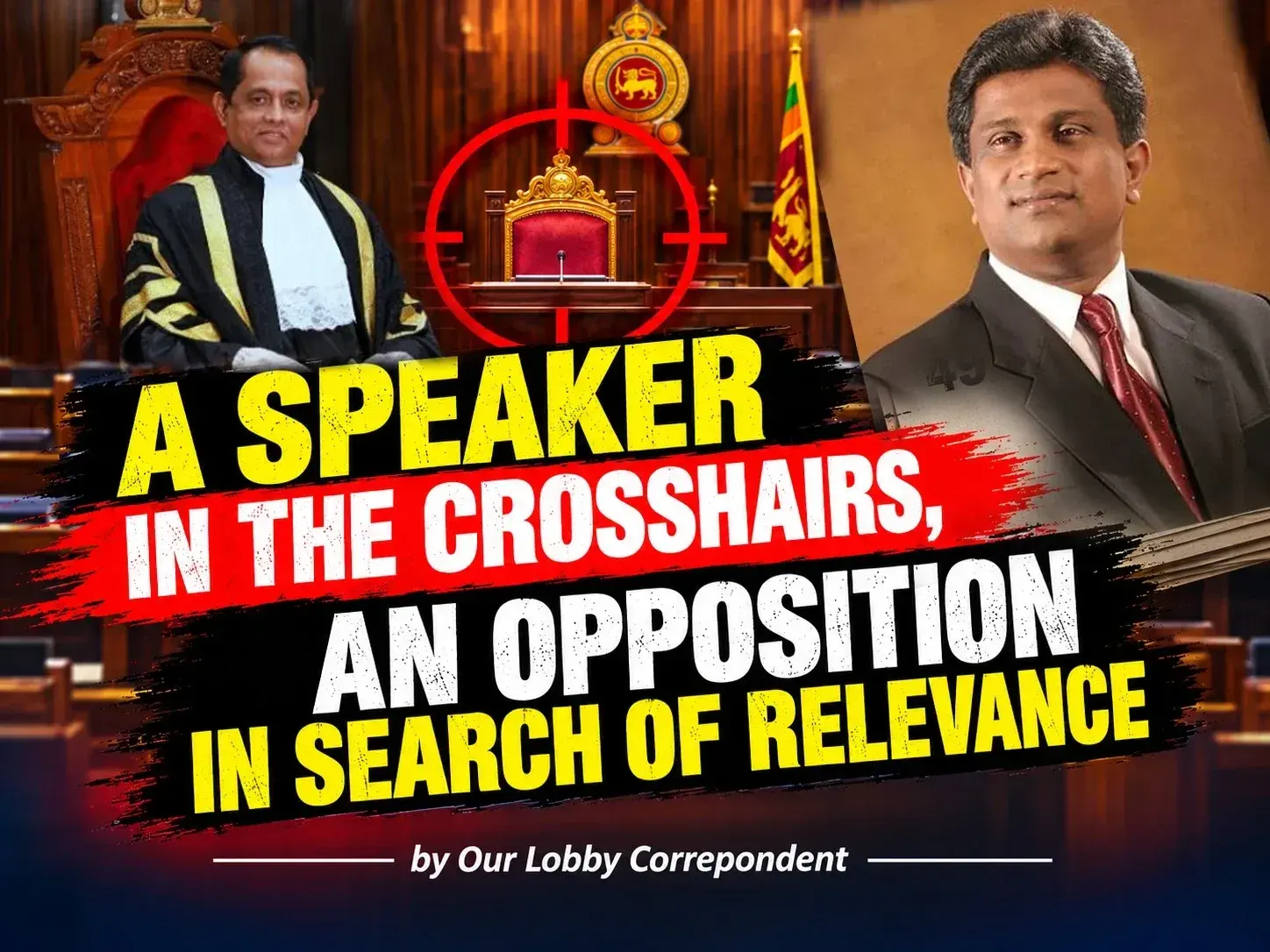
A Speaker in the crosshairs, an Opposition in search of relevance
Share this story
By Our Lobby Correpondent
The Opposition appears to have discovered a new weapon in its increasingly frustrating battle with the government — the no-confidence motion.
The SJB parliamentary group, which met on Monday (5) evening, decided to collect signatures for a no-confidence motion against Speaker Dr Jagath Wickramaratne. The motion, reportedly containing 49 charges, is expected to be handed over on Friday (9).
The motions contains forty-nine charges. That sounds impressive enough until one remembers that the Opposition has already tried this parliamentary game twice during the present Parliament, with little more to show than lengthy debates and even longer division lists.
The latest move comes at an interesting time. The SJB seems to have been prodded into action by an unlikely source: the Frontline Socialist Party (FSP), the JVP splinter group which has recently shown that in politics, having numbers is not always necessary to attract attention.
The FSP’s latest protest caught the public eye not merely because of what it was protesting but because of the manner in which it protested. The party, which has considerable experience in the politics of the street, staged an innovative and spectacular demonstration that managed to generate publicity despite its limited parliamentary presence, resources and funds.
Indeed, the FSP reportedly spent more than Rs. 1.5 million on the protest, including around Rs. 1.4 million collected through a ‘till campaign’ conducted over the preceding months. For a party with no sizeable parliamentary group, this is hardly pocket change.
But it was money apparently well spent at least in terms of publicity.
The FSP has been trying to establish that its existence is not merely a footnote to the JVP’s political history. Many had expected the party, following its emergence from the JVP orbit, to develop into a serious radical Opposition force. It has never acquired the numbers to make that expectation a parliamentary reality. Yet it has managed, from time to time, to remind everyone that it still knows how to make noise outside Parliament.
That may have caught the attention of the SJB.
The SJB cannot compete with the FSP on the streets. It cannot stage the same sort of dramatic protest and expect the same political novelty. But it has something the FSP does not have, a substantial parliamentary group.
So, naturally, the answer is a no-confidence motion.
SJB Kalutara District MP Ajith P. Perera has already advertised the coming parliamentary offensive on Facebook, tagging the office of Opposition Leader Sajith Premadasa. “49 charges against the Speaker. The handing over of the no-confidence motion is on Friday,” he announced.
The government, of course, has a choice. It could allow the motion to gather dust or agree to bring it before the House. Given its comfortable majority, the latter appears quite likely.
If it does, the motion could be debated during the next parliamentary sitting week beginning October 20.
And then comes the predictable part.
The government has a 158-member voting bloc at its disposal. The Opposition knows this. The government knows that the Opposition knows this. The Speaker knows that both sides know it.
Yet Parliament will probably spend hours debating whether the Speaker deserves the confidence of the House.
It will be the third no-confidence motion against a government minister or parliamentary office-holder during the life of the present Parliament. The first, against Energy Minister Kumara Jayakody, was defeated on April 10 by 153 votes to 49 — a majority of 104.
The second, against Justice and National Integration Minister Harshana Nanayakkara over the Negombo Prison controversy, fared even worse. It was defeated on July 24 by 152 votes to 36, a majority of 116.
The latter was also notable for its speed. Handed over on July 21, it was debated and disposed of just three days later. Parliamentary efficiency, it seems, can be remarkably impressive when the numbers are already known.
The Speaker motion is therefore unlikely to produce a different result. Unless several Government MPs suddenly discover a new definition of “independence”, the arithmetic is not exactly difficult.
But arithmetic has never stopped parliamentary politics.
The Opposition’s problem is not merely that it cannot defeat the government. It is that it cannot easily demonstrate its relevance in Parliament. Outside the Chamber, political parties can stage rallies, marches and protests. Inside Parliament, however, the government’s numbers routinely reduce Opposition thunder to parliamentary background noise.
That makes the coming sitting week particularly revealing.
Parliament meets from Tuesday to Friday, October 6–9, with the government’s legislative programme proceeding largely as planned.
Tuesday was devoted mainly to Foreign Exchange regulations and an order under the Foreign Exchange Act, together with a resolution under the Public Debt Management Act. The Government will also move an adjournment motion.
Wednesday (6) belongs to the Opposition, at least for the afternoon. An Opposition adjournment motion will be debated from 11.30 am to 5.30 pm. Members will therefore have ample opportunity to explain what is wrong with the country, what the government has failed to do and, presumably, what the Opposition would have done differently had it possessed the numbers to do anything.
Thursday(8) brings the Anti-Corruption (Amendment) Bill for its Second Reading debate. That should provide another opportunity for both sides to claim the moral high ground — a particularly popular piece of parliamentary real estate.
Friday (9), meanwhile, has an assortment of private members’ motions, covering everything from the protection of the Diyagama Forest and increasing train services on the Puttalam line to Black July, road-reserve trees, Colleges of Education, microfinance victims and the politicisation of sports bodies.
There is something for everyone.
Dr Harsha de Silva will take up the Diyagama Forest, Chithral Fernando will deal with train services, Amirthanathan Adaikkalanathan will seek a Presidential Commission on the ethnic violence of 1983, while Ravi Karunanayake will call for sports bodies to be freed from political interference.
It is a commendable list of subjects. The difficulty, as always, is what happens after Parliament has finished discussing them.
The same question will hang over the proposed no-confidence motion against the Speaker.
The Opposition can collect signatures. It can produce 49 charges. It can make speeches. It can accuse, condemn and demand. The government can respond, defend and eventually vote.
And then the numbers will do what numbers always do.
Perhaps, this is why the FSP protest has been so instructive. A party with virtually no parliamentary muscle has understood something that the established Opposition appears to be struggling with: political relevance is not necessarily measured by the number of MPs sitting behind a party leader.
The FSP cannot bring down a government. But it can still make people look.
The SJB has 49 charges and enough MPs to fill several rows of the Opposition benches. Yet unless it can turn parliamentary activity into something that matters beyond the Chamber, it risks becoming increasingly dependent on parliamentary theatre.
And Parliament, after all, has plenty of that already.
The current sitting week will provide another four days of speeches, motions, questions, regulations, Bills and adjournments.
By Friday afternoon, the country will have heard plenty about what should be done.
The more difficult question is whether anyone outside the Chamber will have noticed.
RELATED NEWS
View all