Current Affairs
Livelihoods and indigenous cultures come under pressure in the Sino-Indian border State of Arunachal Pradesh
By P.K.Balachandran
Colombo, August 5 - Arunachal Pradesh in North-East India has multiple problems – geopolitical, environmental and socio-religious.
Being on the Sino-Indian border, Arunachal Pradesh contends with China’s claim that it is part of its Tibetan region as “Southern Tibet”. In the 1962 Sino-Indian war, Arunachal Pradesh or the North-East Frontier Agency (NEFA) as it was known then, was overrun by the Chinese who came up to Tawang where a tough battle was fought.
Despite withdrawing from NEFA, the Chinese continued to claim Arunachal Pradesh, giving new names to its villages and issuing distinctive “stapled visas” to Indian travellers from that State.
Given the assertive Chinese claim and the 1962 war background, New Delhi looks at Arunachal Pradesh primarily from a security angle, with all its ramifications. The administration’s approach to local economic and socio-political issues is dictated by security considerations, sidelining local social and economic consequences of its actions.
Environmental Issues
Being at the meeting point of the fragile Himalayan ecology, economic development projects in Arunachal Pradesh tend to have a huge impact on the lives of the local people. For many communities living along the Siang River, for example, the hydroelectric project located there represents not opportunity, but uncertainty, displacement, environmental degradation and the possible destruction of a way of life that has existed for generations.
India decided to dam the Siang river in response to the threat posed by the construction of a dam on the Yarlung Tsangpo river in Tibet in 2025. A 2020 report published by the Lowy Institute, an Australian think tank, noted that "control over these rivers [in the Tibetan Plateau] effectively gives China a chokehold on India's economy".
The Indian dam over the Siang was to control the water flow from Tibet as well as generate electricity for economic development. But the locals of Arunachal Pradesh worried about the potential for large-scale displacement, the loss of ancestral lands and the irreversible transformation of the region’s ecological balance. Chief Minister Pema Khandu of the Bharatiya Janata Party (BJP) also opposed the dam, saying that the Siang would "dry up considerably.”
However, despite the agitations against it, the project continues as the government’s focus is elsewhere, mainly strategic to tackle the fallout from the Chinese dam in Tibet.
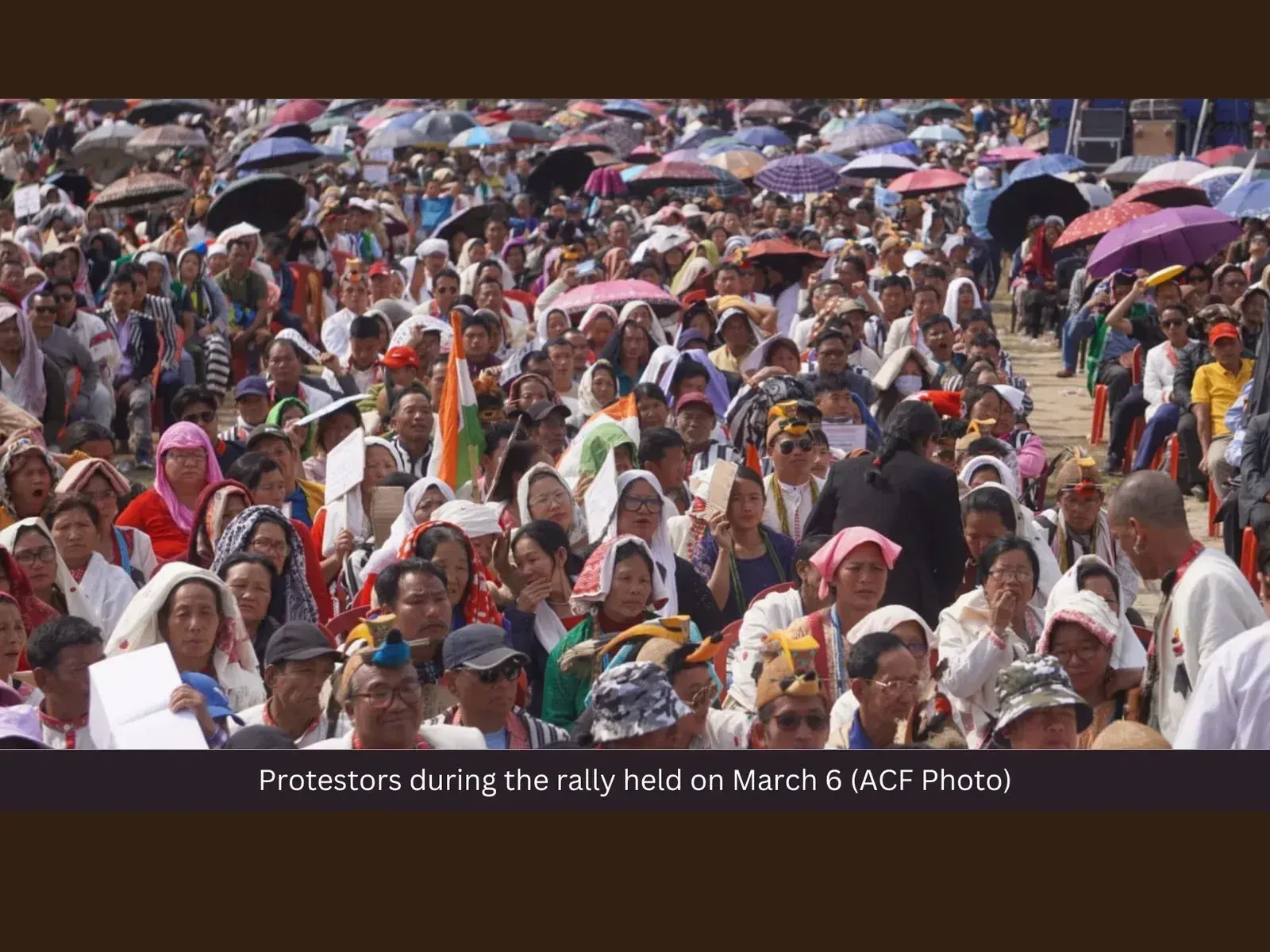
But the human cost of this singular focus is enormous. The Siang Indigenous Farmers’ Forum (SIFF) led sustained protests against the project. According to community estimates, the dam could displace over 1.5 lakh people and submerge 27 villages, most of them belonging to the Adi tribe, while also destroying agricultural land and cultural heritage sites.
Perhaps under the pressure of the Central government, his party, the BJP, and the security establishment, Chief Minister Pema Khandu changed his mind and began backing the project fully.
Cultural and Religious Pressure
Arunachal Pradesh has around 110 ethnic groups spread across one of the planet’s richest ecological zones. Most of these communities depend directly on forests and rivers for food, medicine, livelihood, and cultural identity. When the land changes, their way of life changes with it. This dependence is the reason why human rights debates here cannot be separated from questions of land, ecology, and identity.
A central human rights concern in Arunachal Pradesh is the absence of efforts to get genuine consent for governmental policies. Indigenous groups argue that pre-construction surveys and outreach activities are being pushed forward without the free, prior, and informed consent of affected communities.
Activists point out that the deployment of Central Armed Police Forces (CRPF) to facilitate surveys, recorded in a December 2024 state notification, turns a development project into a confrontation between the State and its own citizens.
The pattern of pressure has been stark. Reports describe offers of cash for consent, legal action against activists, and the suspension of village heads who opposed the project. The 2022 arrest of lawyer Ebo Mili for painting an anti-dam slogan became a symbol of how dissent is treated.
The Siang protests are not isolated. Arunachal Pradesh has a long record of anti-dam resistance, as seen in the Subansiri to the Dibang projects.
Protecting biodiversity in Arunachal Pradesh is not a separate issue from human rights. It is deeply linked to them. The State lies within the Eastern Himalayan biodiversity hotspot, one of the 200 most significant ecoregions globally, supporting rare species like the red panda, clouded leopard, and the critically endangered white-bellied heron.
For indigenous communities, this ecological wealth is inseparable from daily life. Tribes such as the Nyishi, Apatani, Monpa, and Mishmi rely on forests for food, medicine, and cultural tradition for generations. When a dam floods a valley or deforestation strips a hillside, the loss is simultaneously ecological and cultural.
Hundreds of villages along the India-China border live without basic amenities, an issue that drew the attention of the National Human Rights Commission. Acting on a petition by a human rights lawyer, the NHRC directed the state and central governments to ensure basic rights for around 600 border villages. The petition described villages cut off from all-weather roads, potable drinking water. When border villages remain underdeveloped, residents migrate away, leaving the frontier emptier at a time when China has been building villages in disputed areas. Here, ensuring human rights and securing the border become two sides of the same coin.
The Christian population in Arunachal Pradesh has grown significantly, from 0.79% in 1971 to more than 30% in 2011, making it the largest religious group. This demographic shift set alarm bells ringing in the Hindu nationalist BJP, the BJP-led government in New Delhi and the Rashtriya Swayamsevak Sangh (RSS), the ideological forebears of the BJP. In 1978, the government passed the Arunachal Pradesh Freedom of Religion Act (APFRA) with the explicit aim of “countering proselytisation by Christian missionaries”.
In 2018, Chief Minister Pema Khandu promised to repeal the law which had not been notified because of opposition from the people. The International Christian Concern (ICC) stated that the proposed revival of APFRA would “vitiate the erstwhile peaceful social harmony in a state known for peace and prosperity.”
However, in 2024, Khandu went back on his word and said that the law was meant to “preserve indigenous faiths and cultures”. The Arunachal state machinery was given powers to monitor conversions that “infringe upon liberty and privacy”.
Hinduisation of Tribal Beliefs
The State’s policy is being promoted by the Rashtriya Swayamsewak Sangh (RSS), the ideological arm of the BJP. The Hindu nationalist RSS has taken a leading role in reshaping tribal identities in the strategically sensitive Arunachal Pradesh on the Sino-Indian border.
The RSS has set up many schools in which Hinduism is promoted not directly but indirectly by incorporating tribal beliefs and rituals with Hindu beliefs and rituals, which are presented as parts of Sanatana Dharma (a universal and ever lasting religion or a system of values). The RSS propagates the view that tribal beliefs are also Hindu beliefs.
However, an attempt to transform tribal beliefs into Hindu beliefs is made by clothing them in the Hindu garb. Tribal deities are incorporated in the Hindu pantheon so that the two representations look the same.
The BJP government in Arunachal Pradesh established a Department of Indigenous Faiths and Cultural Affairs. Among other things, the department’s job was to codify these faiths and produce religious literature where the commonality with Hinduism is emphasised.
The RSS has introduced idol worship among the Rangfrah tribe, in which the image of Lord Shiva has a mongoloid face. But defenders of these changes say that they do not contradict the beliefs of the Rangfrah tribe. Sections of the tribals in Arunachal Pradesh point out that unlike the Christian missionaries, the RSS does not advocate a clean break from indigenous beliefs and rituals.
Anti-Christian movements and heroes of tribal resistance to Christian missionaries are celebrated. For example, in Nagaland, a tribal princess, Rani Gaidinliu, was promoted as a cult figure in 2014 by none other than Prime Minister Narendra Modi. The idea was to show that the BJP, RSS and Hindutva were not anti-tribal but pro-indigenous religions.
Catholics Protest
The All-India Catholic Union (AICU) wrote to Indian Prime Minister Narendra Modi last week, expressing its objection to the revival of the dormant 1978 anti-conversion law known as the Arunachal Pradesh Freedom of Religion Act (APFRA).
The AICU called the revival “a threat to the constitutional right to freedom of religion and personal liberty.” The Catholic Union appealed to the government to “immediately repeal the Act in the interest of peace, harmony, and religious coexistence” in the state.
END
RELATED NEWS
View all

Current Affairs
Sri Lankan Presidential pardons- the good and the bad
Sep 11, 2026

Current Affairs
The pros and cons of joining BRICS- the dilemma of Pakistan and Bangladesh
Sep 09, 2026
Current Affairs
Disaster in Nepal gets embroiled in geopolitics.
Sep 08, 2026
Current Affairs
Why Mecca Pact, and what does it imply for its members, Israel and India?
Aug 18, 2026