Current Affairs
Only an India-Sri Lanka deal on mining in the Afanasy Nikitin Seamount will end legal deadlock
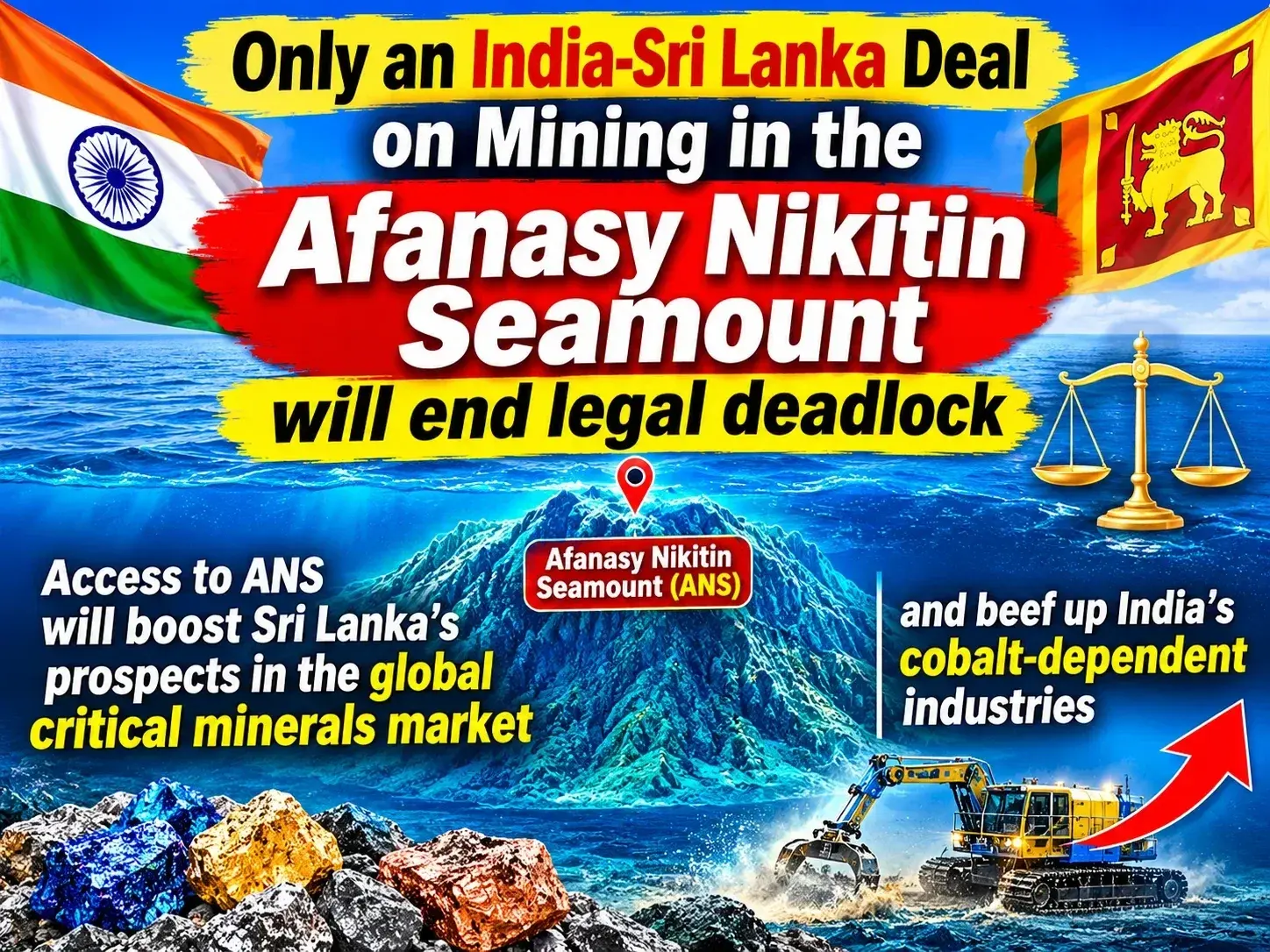
Access to ANS will boost Sri Lanka’s prospects in the global critical minerals market and beef up India’s cobalt-dependent industries
By P.K. Balachandran
Colombo, November 26 – Like every other country in the 21st. Century, Sri Lanka also wants to be a player in the global critical minerals marketplace. But its mineral industry is still small-scale and centred on a handful of products such as the premium vein graphite and mineral sands. Limited capital, technological gaps, and resistance from environmental activists have prevented the industry from expanding and seeking new heights.
But there are avenues which Sri Lanka could explore to become a significant player in the international market for critical minerals, an essential ingredient in modern technological development. In her paper “Sri Lanka’s Critical Minerals: Navigating a Contested Geopolitical Landscape,” published in www. factum.lk, Ms Hasarel Gallage of King’s College London examines the island nation’s prospects in the expanding global critical minerals sector and suggests ways to become a significant player.
Gallage says that Sri Lanka’s critical mineral sector will get a significant boost if it is able to exploit the rich resources present in the Afanasy Nikitin Seamount (ANS). Named after a historical Russian traveller, the ANS is located in the Central Indian Basin, 400 km in length and 150 km wide. It is rich in critical minerals such as cobalt, nickel, manganese, copper, platinum group elements, and gold.
ANS is 1,050 km southeast of Sri Lanka. But exploitation is blocked by a dispute with India, which claims the ANS is in international waters and not within Sri Lanka's exclusive jurisdiction.
Sri Lanka’s Case
To begin with Sri Lanka's case, Colombo claimed the extension of its Continental Shelf to include the ANS in 2009 under the UN Convention on the Law of the Sea (UNCLOS) of 1982. A Continental Shelf is the edge of a Continent lying beneath the ocean. This shelf extends from the coastline of a Continent to a drop-off point called the shelf break. The shelf break is where the underwater edge of a Continent Shelf begins to rapidly slope downwards towards the ocean floor.
Every coastal country has exclusive rights to the oil, gas, and other resources in the seabed up to 200 nautical miles from the shore or to the outer edge of the Continental Margin, whichever is the further, subject to an overall limit of 350 nautical miles (650 km).
Since the ANS was much further away from its shores, Sri Lanka used a special provision - the "Statement of Understanding for the southern Bay of Bengal “ negotiated by Sri Lankan Ambassador Shirley Amerasinghe in 1980. According to the Statement of Understanding (SOU), Sri Lanka can claim up to 500 nm using a different method - sediment thickness - because the Bengal Fan is thick, according to META.
India’s Claim
But Sri Lanka’s application has remained suspended because of India’s formal protest against it in 2022. India laid claim to the ANS thigh it lies 1350 km off the Indian coast.
In 2024, India applied to the International Seabed Authority (ISA) for an exploration licence in the ANS. But this has remained frozen because of Sri Lanka’s counterclaim made earlier.
As META explains, India’s argument is legal and not based on the distance from the ANS. The ANS is nearer Sri Lanka (1,050 km or 652 nm away ), while India is 1350 km (838 nm) away. India argues that ANS is far into the Indian Ocean and in “international waters.”
According to META, India objects to Sri Lanka’s use of the Special Bay of Bengal “Statement of Understanding” (SOU) to claim up to 500 nautical miles (926 nm) and include the ANS. India says that the ANS is a separate oceanic feature of the Central Indian Basin and not a natural prolongation of Sri Lankan Continental Shelf. The ANS lies in the international seabed, where India can seek exploration rights from the International Seabed Authority (ISA).
In a counter, Sri Lanka said that its 2009 claim was filed first, was accepted for consideration in 2016, and that India did not object till 2022 until Chinese research vessels started exploring the Indian Ocean and causing concern in New Delhi.
While the Chinese interest in the Indian Ocean seabed is worrisome for India and it made Sri Lanka impose a moratorium on Chinese research vessels operating in Sri Lankan waters, India’s claim to freedom of mining in the ANS is based on the contention that the ANS is in international waters.
Sri Lanka can legally challenge India’s claim at the International Tribunal on Law of the Sea (ITLOS). There are legal precedents for such instances, like the maritime dispute involving Bangladesh and Myanmar in 2012, Gallage and Moramudali point out. Myanmar blocked Bangladesh’s claim for an extended continental shelf using the tribunal route. Bangladesh later sued Myanmar at ITLOS, which ruled in Bangladesh’s favour, prompting CLCS to accept Bangladesh’s claim.
But under Article 298 of UNCLOS, when a state party ratifies UNCLOS, it is allowed to declare that it will not accept a ruling by an international court related to maritime boundaries, maritime military activities, or those related to disputes being debated in the UN Security Council. Since India has ratified UNCLOS, Sri Lanka cannot hold India legally bound by an international court ruling pertaining to the ANS.
Gallage and Moramudali say that Sri Lanka could compel India to participate in “compulsory conciliation” where an appointed commission evaluates the disputing claims. But they point out that the conciliation commission can only make recommendations that are not legally binding. This means that while Sri Lanka can bring India to a negotiation table, it can’t compel India to accept the outcome, the authors say.
Given these controversies, Gallage and Moramudali argue that an India-Sri Lanka deal on ANS is the only realistic path forward. Their argument runs thus: Sri Lanka possesses leverage for without its cooperation, India’s application cannot proceed further as the issue is under dispute. Sri Lanka could also use that leverage to seek a deal on capital and technology transfer from India for mining, they say – a win-win situation.
For India, cobalt is crucial for the development of its green energy transition. For foreign exchange-short Sri Lanka, the mineral resources in the ANS are important as a potential source of foreign currency earnings. Sri Lanka would require the support of
foreign companies to do any form of critical mineral exploration or mineral processing that requires substantial capital investment upfront. India could bring that. India and Sri Lanka could collaborate, one giving funds and technology and the other could providing facilities and infrastructure.
Sri Lanka is keen on foreign investment in minerals development, with foreign investment as President Anura Kumara Dissanayake and Industries Sunil Handunnetti have said.
END
Share this story
RELATED NEWS
View all
Current Affairs
Perceived tilt towards Israel in a statement in the US dents Rahul Gandhi’s image
Nov 25, 2026
Current Affairs
Sri Lanka counts the cost of two failed Chinese deals
Nov 23, 2026
Current Affairs
The motion that went nowhere
Nov 16, 2026
Current Affairs
Killers of journalists go untraced in 90% of cases, the UN says
Nov 03, 2026