Mirror Wall, Cover Story
Ranwala strikes again!
By kassapa
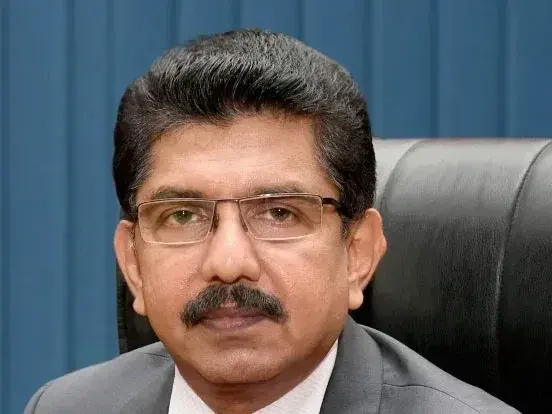
Just when the Jathika Jana Balavegaya (JJB) government appeared to have buried the fallout from the scandal regarding its first Speaker Asoka Ranwala exactly a year ago, he is back in the headlines and for all the wrong reasons too.
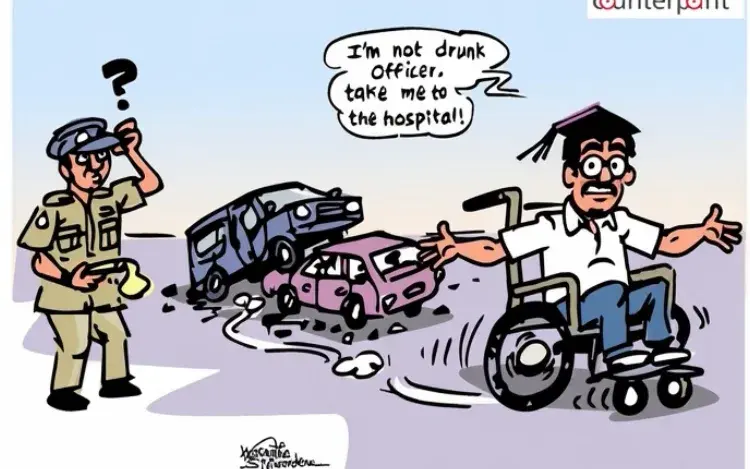
Ranwala was involved in a three-vehicle accident at Sapugaskanda last Thursday. That is not the issue at stake here as it could have happened to anyone. What was concerning was Ranwala’s conduct thereafter. He wasn’t tested for driving under the influence of alcohol. He took himself to the Kiribathgoda Hospital at first and then to the National Hospital, Colombo claiming that he was suffering from high blood pressure. As news got out and public pressure mounted, he was subsequently arrested and then released on bail.
Despite repeated inquiries from the media, there has been no satisfactory explanation on many matters. Why was Ranwala allowed to travel from hospital to hospital? Why weren’t his alcohol levels tested in a timely manner? Would the same courtesies be extended to any person involved in an accident? Did the Police fail to adopt usual procedures because they were under orders from some authority? Or, were they acting on their own, due to a misplaced sense of deference to a ruling party stalwart?
The ruling party’s defenders on social media have stuck to defending their man with a vengeance. Minister Ananda Wijepala attempted to justify the delay saying there weren’t enough testing kits to test for alcohol. Another colleague, Minister K.D. Lalkantha posted a cryptic message on his social media account: ‘Ranwala is a good man. Pity those who don’t know him’. Is Lalkantha suggesting that the law should be applied differently to ‘good’ men and ‘bad’ men?
The issue that is being debated is not whether Ranwala was at fault in the accident. It is not even whether he was intoxicated or not. It is about applying the rule of law irrespective of the status of a person. That was one of the key pledges of the JJB, particularly President Anura Kumara Dissanayake, during the two national election campaigns last year. The need to get rid of the culture of impunity that surrounded politicians was one of the major reasons why voters endorsed the JJB with a rousing two-thirds majority at the last general election.
Besides, Ranwala is no innocent first-time offender. We are only too familiar with the first scandal he was embroiled in. Just a few weeks after he was sworn in as Speaker, doubts were cast about his ‘doctorate’. Ranwala resisted for a while, claiming that he had indeed earned a PhD from a Japanese university. As days passed, he could provide no evidence. President Dissanayake was asked about this issue and he responded saying if there was a breach of ethics s or discipline by anyone, that person would be removed.
Shortly afterwards, Ranwala resigned as Speaker but offered a parting shot. He said he was resigning only to prevent further embarrassment to the government and that he would be producing evidence of his qualifications within a short period of time. Even Cabinet spokesman Nalinda Jayatissa, when asked about this issue said nonchalantly that evidence would be produced ‘shortly’ and that it was not a matter the government took notice of ‘above the knee level’.
That never happened. When Dissanayake visited Japan on an official visit, the government’s critics perked up again, asking whether he could bring back Ranwala’s degree certificate with him. There were those who insisted that Ranwala should also resign as a Member of Parliament as well, given his dishonesty. Still, with the passage of time, the fuss over the qualifications died a natural death because Ranwala had resigned as Speaker.
That is until now. The degree scandal has returned, magnified, to trouble him. The general consensus among the public is that Ranwala is a dishonest man. It was first proven in the degree scandal and now, his conduct following the accident appears to prove that yet again. Whether he was intoxicated or not, whether he was at fault in the accident or not, that is the majority public sentiment.
Cabinet spokesman Jayatissa was again asked about Ranwala last week. He was more cautious this time. If he has been found to have not kept to the party’s standards, disciplinary action would need to be taken against him by the party, he said. At the time of writing though, nothing drastic has happened, with Jayatissa and the government taking cover under the premise that ‘investigations are still ongoing’. With each passing day, the credibility of the government takes a hit, just as it did with the Phd scandal.
This cannot be dismissed as just another accident or a dink driving incident. It is a moment when the JJB’s commitment to the pledges it made is being called into question. It brings into focus the integrity and sincerity of the government. Ranwala maybe a senior in the hierarchy of the Janatha Vimukthi Peramuna (JVP) but does it mean that such people are untouchable by the long arm of the law? If so, how does it make this government any different from its predecessors when the Rajapaksas ruled with impunity and immunity?
The JVP and the JJB will do well to remember that, unlike its rival parties it does not have a large base vote. It relied on a massive dissent vote shifting in its favour in the wake of the economic debacle of 2022 and general discontent with the major political parties which had been brewing for decades. If the JVP and JJB renege on their key promises, that vote will as easily shift back to its rival parties at the next national elections and the present incumbents will be back to their single digit percentages.
This is why the ruling party needs to deal with Ranwala, decisively and promptly. It did so only half-heartedly last year and that too by not asking him to resign from Parliament. They are paying the price for that now. The longer they wait, the more they will suffer.