Point of View, Counterpoint Political Desk
UNP-SJB betrothal announced at JRJ’s birth anniversary commemoration
by Counterpoint Political Desk
President J. R. Jayewardene’ birth and death anniversaries come and go without much political consequence. But this time around there has been a difference. At Jayewardene’s 120th birth anniversary commemoration held on Thursday, UNP leader and former President Ranil Wickremesinghe and Opposition and SJB Leader Sajith Premadasa shared the platform and struck positive notes on efforts being made to bring them and their parties together.
What happened there has come to be viewed as a political betrothal. The coming together of Ranil and Sajith, or technically the UNP and the SJB, will pose a bigger political challenge to the JVP-led NPP government than thought.
Anura Kumara Dissanayake polled 5,634,915 votes (42.31%) at the 2024 presidential election to secure the presidency, and Sajith Premadasa, who came second obtained 4,363,035 votes (32.76%) whereas the then incumbent President Ranil Wickremesinghe had to settle for 2,299,767 votes (17.27%). Thus, what made Dissanayake’s victory possible was a split in the UNP vote between Ranil and Sajith; the duo polled between them 6,662,802 votes as opposed to Dissanayake’s 5,634,915 votes.
AKD’s mathematical approach
Speaking at a recent propaganda rally in Kalutara, President Dissanayake said he would never hold a referendum to postpone elections contrary to a claim being propagated by his political opponents. He said he was not so naïve to do so because he would divide the electorate into only two groups, one supporting the government and the other opposing it, in such an eventuality, but a presidential election will divide the Opposition into many factions, much to the advantage of the government. Thus, it is possible that the government is planning to hold the presidential election first, and it will keep on postponing the delayed Provincial Council elections.
Possible impact of UNP-SJB alliance
If the UNP and the SJB close ranks and field a common candidate, the NPP will have its work cut out, even if the SLPP goes it alone and eats into the anti-government vote. The government’s popularity is apparently on the wane to the extent of President Dissanayake himself having to traverse the country, drumming up support for his party. This shows that the government thinks the Opposition is recovering lose ground. It is also losing cooperative elections.
As we pointed out in a previous column, what signalled the end of the Mahinda Rajapaksa regime in 2015 was the SLFP-led UPFA’s ‘poor’ performance in the Sept. 2014 Uva Provincial Council election, where the then President Mahinda Rajapaksa himself led his party’s campaign.
The UPFA managed to secure the council but could retain only 19 out of 25 seats it had in the previous council, and the UNP obtained 13 seats (an increase of 6 seats), and the JVP 2 (an increase of one seat). The UPFA’s votes decreased from 418,906 (72%) in the 2009 Uva PC election to 349,906 (51%).
Shashindra Rajapaksa was the UPFA chief ministerial candidate. That setback for the Rajapaksa family stood the UNP in good stead in the presidential election that followed in January 2015. The UNP was able to ensure the election of the common presidential candidate of the Opposition, Maithripala Sirisena, who defeated the then incumbent President Mahinda Rajapaksa.
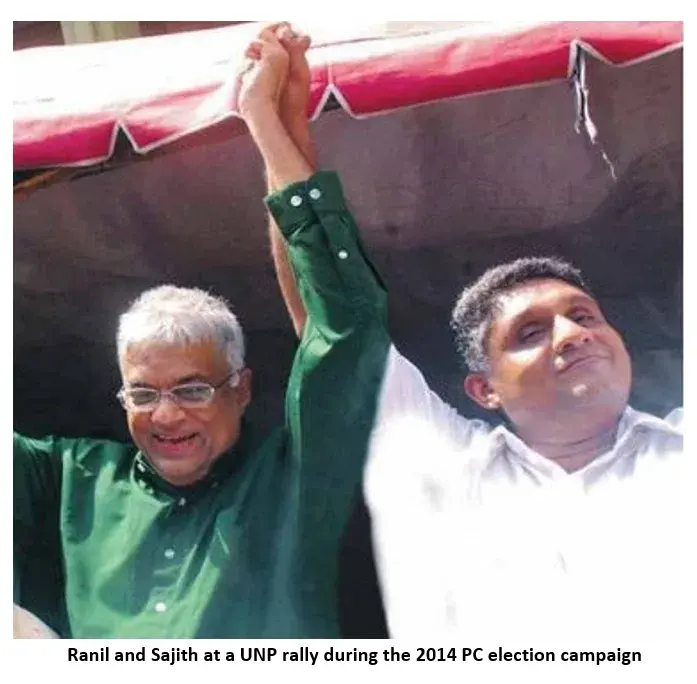
What helped the UNP better its performance in the Sept., 2014 Uva PC poll was a rapprochement between UNP leader Wickremesinghe and his deputy Premadasa in the run-up to the election. They appeared on the same platform holding hands together with other UNP seniors, boosting the morale of their supporters and offering the electorate an alternative to the Rajapaksa government. Maybe the seniors of the UNP and the SJB seniors are trying to do something similar again.
Misconceptions about mandates
Society often invokes the idea that truth and justice are their own form of power. Yet history shows how easily governments have suppressed both once they grew confident in their strength, and Sri Lanka's political past has no shortage of examples.
In 1975, Prime Minister Sirimavo Bandaranaike extended her government's term by two years without returning to the people for a fresh mandate. J. R. Jayewardene campaigned against that move,
and after winning power in 1977, took the unusual step of collecting undated resignation letters from every MP in his own party. He then went further extending the term of parliament with the help of a heavily-rigged referendum in 1982.
President Chandrika Bandaranaike Kumaratunga later stirred similar controversy when she took a second oath of office during her second term, asserting, according to contemporary reports, that a private investiture in 2000 meant her presidency could legitimately run until 2006. The claim did not pass muster with the Supreme Court, which held that he had to retire in 2005.
Mahinda Rajapaksa later amended the Constitution to pursue a third presidential term, only to be voted out in 2015. The 18th Amendment he introduced was later replaced by the 19th Amendment.
The lesson, repeated across decades, is that a temporary mandate mistaken for a permanent one tends to end the same way each time.
22A and unnecessary trouble
Until the government introduced the 22nd Amendment aimed at raising the retirement ages of the Superior Court judges, it had largely governed without major confrontation. But the amendment, put forward abruptly, without broad public consultation, has opened a new front of controversy.
Objections have come from the Bar Association of Sri Lanka, numerous civil society groups, Buddhist and other religious leaders, and international bodies including the United Nations, the Commonwealth Lawyers Association, LAWASIA, and the Judicial Service Association and the International Association of Judges. Despite this, the government and the President have signaled they intend to push the amendment through regardless of the opposition it has drawn. At recent rallies, the President reportedly indicated that further legislation would be introduced if necessary.
Attacks on legal community
As opposition mounted, some government figures turned on those voicing dissent. The President of the Bar Association became an early target, with one government MP alleging in Parliament without evidence cited that the BASL President's opposition had been motivated by ambitions for the SJB's nomination as Chief Minister of the Western Province.
A more pointed attack followed when the Minister of Justice told Parliament that the Commonwealth Lawyers Association was not an internationally recognised body, dismissing it as a fee-funded organisation. Former minister and law professor G. L. Peiris pushed back, noting the association represented members across 54 countries and should not be dismissed so casually.
Beyond the vote count
As of this writing, the Supreme Court has not yet ruled on 22A bill, though the government is reportedly preparing a strategy to ensure its passage regardless.
Unconfirmed rumors suggest more than ten government members privately oppose the amendment, with speculation swirling around the Prime Minister's silence on the matter. Minister Lal Kantha, speaking on her behalf, dismissed talk of a rift as the work of what he called "a group of mad people," insisting there was no internal crisis.
Separately, social media reports claim that if the government falls short of the votes needed, it
may seek support from opposition minority MPs, including backbenchers from the Tamil National Alliance, two major Muslim parties, and a National List MP from the SJB.
Namal's message from prison
Following what it considered a successful rally in Anuradhapura, the SLPP is now planning its next rally in either Kurunegala or in Matara. National organiser Namal Rajapaksa, writing from remand prison, sent instructions on what the party should emphasise.
Namal has urged the party to press the President on his promises, pointedly asking how 450 irrigation tanks could realistically be built in a year, which would require completing more than one a day, and questioning the feasibility of building 50 universities even with adequate funding. "Tell the people the leader they elected is still lying to them," he reportedly wrote, calling for the government's claims to be publicly challenged.
Namal has also noted that prison life is passing tolerably, that several opposition MPs visited him, and that he expects more party figures to be jailed soon.
Stones thrown at Sigiriya
A government in motion is like a procession, best understood by those watching from outside rather than those taking part in it. At the moment, the Opposition's strategy looks courtroom-bound, with its objections to the 222A largely funneled through legal challenges, amid the usual debate over whether courtroom argument alone can settle where the truth lies.
The Opposition fears the amendment is a vehicle for bringing the judiciary under executive influence. Former Chief Justice Sarath N. Silva offered his own verdict on some of the legal arguments being made: that they amount to throwing stones at Sigiriya, a remark that, like the ancient rock itself, carries more than one layer of meaning.
Share this story
RELATED NEWS
View all
Point of View
A Speaker in the crosshairs, an Opposition in search of relevance
Oct 07, 2026

Point of View
When an oil shock reaches Sri Lanka
Sep 22, 2026
Point of View
Week of constitutional fireworks expected in House
Sep 20, 2026
Point of View
Pathfinder Foundation considers proposals for maintenance of security in the Indian Ocean
Oct 09, 2025