Politics by Vishvanath, Cover Story
Demise of a political legend and future of Sri Lanka’s left movement – III

Rise, fall and rise of JVP and plateauing progress of traditional socialists
by Vishvanath
The defeat of the SLFP-led United Front (UF) coalition government in the 1977 general election, where the UNP secured a five-sixths majority, led to the release of all JVP prisoners including its founding leader Rohana Wijeweera. That marked a significant change in the JVP’s strategy. The JVP opted to operate as a democratic political force, and experiment with social democracy for all intents and purposes. It even contested the 1981 District Development Council elections, which the main Opposition parties boycotted. It refused to join forces with the trade unions affiliated to the traditional left parties and the SLFP, and pulled out of a general strike they launched in July 1980. The UNP government crushed that strike by sacking tens of thousands of strikers.
The traditional left opposed the government of President J. R. Jayewardene as much as it could, with key Opposition figures, like legendary leftist, Sarath Muththetuwegama, leading the charge in Parliament. The SLFP was active but was no match for the UNP; it had only eight seats in Parliament, and was faction ridden, with the members of the Bandaranaike family all out to destroy each other politically. Thus, there was some space left for the JVP to evolve as a democratic opposition party so much so that its leader Wijeweera contested the 1982 presidential election. The JVP began to vie with the so-called left for dominance in national politics.
Perhaps, the JVP held the most colorful presidential election campaign in 1982, with Wijeweera, given to melodrama, pretending that he was already the President, and making speeches to that effect at election rallies much to the glee of the Opposition activists. The SLFP accused the JVP of helping incumbent President Jayewardene in the presidential fray by creating a split in the anti-UNP vote. The JVP was in for a rude shock when the results of the presidential election was announced; Wijeweera could obtain only 273,428 votes. SLFP candidate Hector Kobbekaduwa came second with 25,48,438 votes. Wijeweera was not sighted in public for weeks. He could not stomach defeat. However, it was clear that the JVP was gaining ground on the political front. The LSSP candidate Dr. Colvin R. de Silva could obtain only 58,531 votes and the Nawa Sama Samaja Party candidate Vasudeva Nanayakkara only 17,000 votes. The JVP secured third place in the presidential race.
Proscription of JVP
After securing a second term, President Jayewardene was determined to retain the five-sixths majority he had obtained in Parliament under the first-past-the-post system. He knew that UNP was strong enough to win a general election under the Proportional Representation system, but would not be able to retain its steamroller majority in such an eventuality. So, in 1983, he held a referendum to consult the electorate on whether a general election should be held, and rigged it heavily to obtain the outcome he desired. The JVP challenged the results of the referendum in court, and speculation was rife that it would succeed in its endeavor. That was a worrisome proposition for the UNP government.
In July 1983, the LTTE killed a group of soldiers in the North, triggering a wave of racial violence against Tamils in the predominantly Sinhala area, especially in Colombo. President Jayewardene was accused of delaying the deployment of the armed forces to stop the pogrom, which the UNP was accused of having a hand in. When he incurred international opprobrium for the mass massacre of Tamil civilians and widespread destruction of their properties, President Jayewardene scapegoated the JVP, the Community Party and the Nava Sama Samaja Party and proscribed them, falsely accusing them of having instigated anti-Tamil violence. That marked the end of the JVP’s participation in democratic politics. The other two parties successfully challenged proscription, but the JVP did not; it went underground and opted for a military approach. The UNP government sought to kill two birds with one stone when it banned the JVP; it wanted to deflect the blame for ethnic violence and derail the case against the outcome of the referendum. Its move turned out to be a blunder.
The signing of the Indo-Lanka Peace Accord, which led to the introduction of the 13th Amendment to the Constitution, and the establishment of the Provincial Councils (PC) in 1987 provided the JVP with a fresh rallying point. Driven by political expediency, the JVP adopted a nationalistic agenda, opposing devolution, and unleashing violence to scuttle the PC elections. The traditional leftist parties supported devolution, and contested the PC elections—a move that enabled the JVP to lump them together with the UNP and brand them as traitors who deserved to be physically eliminated. The JVP managed to rally some popular support for its cause initially but alienated the public when it went to an extreme, killing people and destroying properties wantonly.
The CPSL and the LSSP managed to regain considerable representation in political institutions by securing seats in the newly established PCs, and play the role of defenders of democracy by standing up to JVP violence and encouraging the people to vote in defiance of poll boycotts. The JVP ordered people not to vote in the 1988 PC polls, the 1988 presidential election and the parliamentary polls in 1989. The traditional left defended the people's franchise and contested all those elections despite the violent deaths some of its members suffered at the hands of the JVP’s military wing, the DJV (Deshapremi Janatha Viyaparaya). JVP violence enabled the UNP to rig elections, placing the mainstream Opposition parties at a disadvantage.
It is doubtful whether the JVP had a clear idea about what to achieve politically by unleashing violence during its second uprising. In 1971, it was all out to capture state power. But in the late 1980s, its slogans were focused on liberating the country from the clutches of India, sabotaging the PC system and bringing down the UNP government. It did not have an active political wing at the time to take over the reins of power in case its military wing toppled the government of the day. It went on unleashing violence, causing the UNP to resort to equally barbaric counterterror. In 1989, President Ranasinghe Premadasa, who succeeded President Jayewardene even offered to negotiate with the JVP, but the latter had no political agenda as such and refused to talk. It just went on unleashing terror while the traditional leftist parties recovered lost ground to some extent through participation in democratic elections and having representation in Parliament, the PC and the local government institutions.
The JVP was defeated at its own game in 1989, when the Premadasa government decapitated it by wiping out its entire leadership save Somawansa Amarasinghe, who survived by fleeing the country. Mopping up operations conducted by the police and the military compelled most second level JVP leaders to remain underground for a couple of years, and the assassination of President Premadasa by the LTTE, the appointment of W. B. Wijetunga as interim President and the 1994 general election, which the SLFP-led People’s Alliance (PA) won, provided the JVP with an opportunity to come out of hiding and engage in democratic politics. In 1994, the JVP won its first-ever parliamentary seat; Nihal Galappaththi, who contested that election on the Sri Lanka Progressive Front ticket entered Parliament. Chandrika Kumaratunga, who became Prime Minister and President in quick succession, in 1994, facilitated the JVP’s re-entry into mainstream politics.
The traditional leftist parties continued to coalesce with the SLFP and have representation in Parliament, the PC and the local institutions while the JVP chose to be on its own and secured 10 seats in the 2000 parliamentary polls and 16 seats in the 2001 snap general election. It garnered favor with the public during the unstable PA government in 2000/2001, by successfully campaigning, together with other opposition parties, for reducing the executive presidential powers through the 17th Amendment.
The defeat of the PA government in the 2001 general election and the victory of the UNP-led UNF saw the JVP acting sensibly and recovering ground on the political front to the extent of being invited by President Kumaratunga to join the SLFP-led United People’s Freedom Alliance (UPFA) to contest the 2004 general election.
The JVP fielded about 55 candidates on the UPFA ticket in the 2004 general election and as many as 41 of them were returned. It gave away two National List slots to the SLFP and helped it resolve an internal dispute over seat allocation. Interestingly, the JVP found itself in the company of the traditional leftists from the CPSL and the LSSP in the UPFA government, where it held Cabinet posts. (Next: 2004-2024—A critical phase of the left movement, the JVP’s rise to power in 2024, and possible future scenarios.)
RELATED NEWS
View all
Politics by Vishvanath
Has 22A become the govt.'s Catch-22?
Aug 27, 2026
Politics by Vishvanath
22nd Amendment: A huge political gamble for govt.
Aug 21, 2026
Politics by Vishvanath
Move to raise retirement ages of judges: Options before govt.
Aug 05, 2026
Politics by Vishvanath
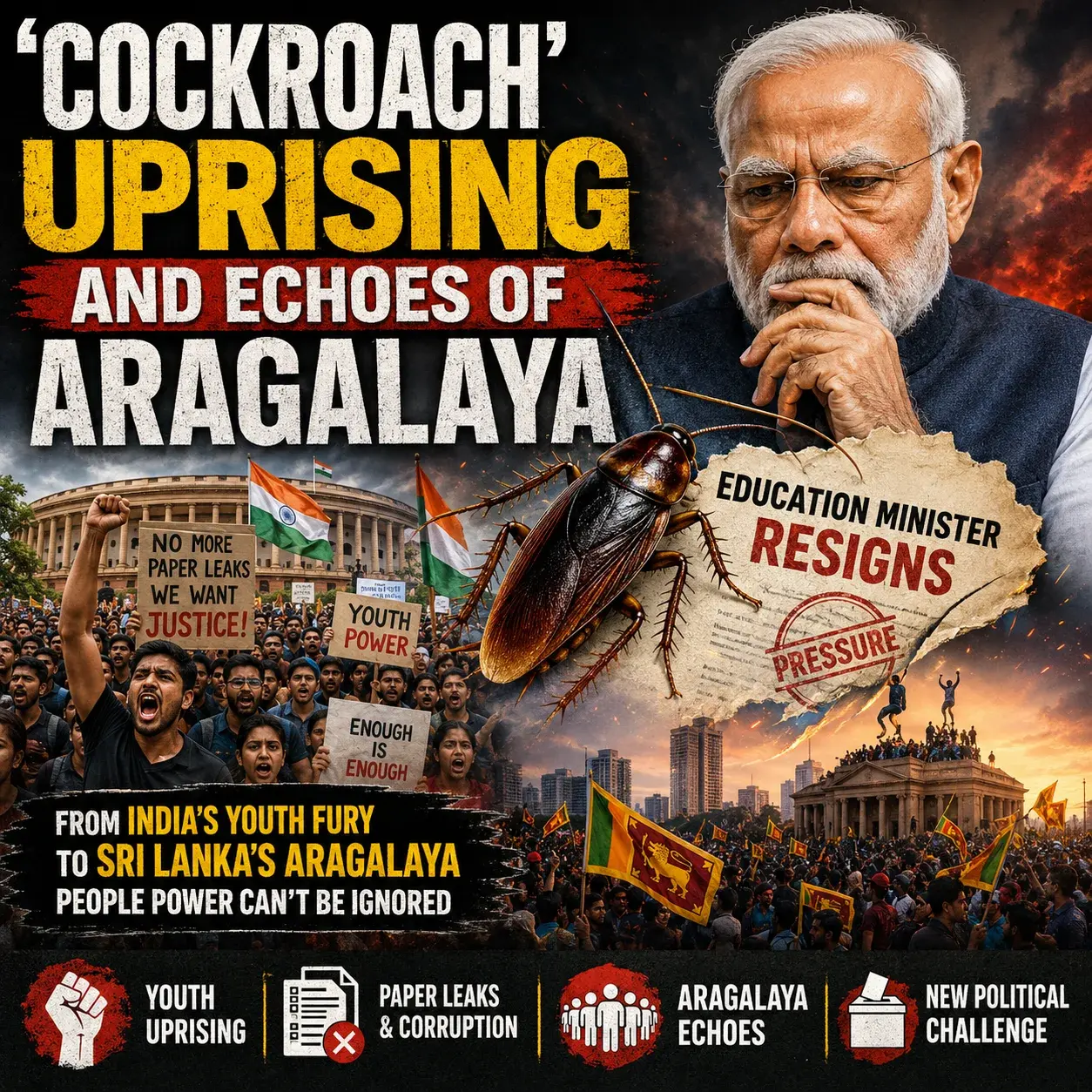
‘Cockroach’ uprising and echoes of Aragalaya
Jul 26, 2026