Politics by Vishvanath, Cover Story
Govt. shoots itself in the foot
By Vishvanath
Sri Lankan governments with mammoth majorities usually become so cocky that they labour under the misconception that it is plain sailing for them, and their weakened political rivals will never make a comeback. Worse, they take public opinion for granted and bulldoze their way through, throwing caution to the wind. This is why governments with two-thirds majorities are not re-elected in this country. In fact, those powerful governments have faced humiliating defeats, as we saw in 1977, 2015 and 2024. The UNP government elected in 1977 was an exception that proves the rule; after securing a five-sixth majority in 1977, the UNP won elections by resorting to large-scale rigging and political violence; it went to the extent of holding a heavily-rigged referendum to do away with the 1982 general election. The JVP-NPP government is also ruining things for itself. The manner in which it has mishandled the coal procurement scam is a case in point.
The JVP-NPP government is doing everything in its power to have the public believe that none of its members were involved in the coal procurement scam, which has caused huge losses to the state. Unlike the corrupt deals the previous governments were accused of, the coal scandal has affected the public directly, as the substandard coal imports have resulted in a massive drop in the electricity generation by the coal-fired power plant at Norochcholai, and the oil-fired power plants have to operate overtime to make up for the shortfall, and the additional cost of burning diesel is passed on to the public in the form or power tariff hikes and fuel price increases. The Ceylon Petroleum Corporation has admitted that it purchased as much as USD 286 per barrel of diesel, the highest-ever price in the world, according to HSBC CEO Georges Elhedery. Such is the desperation of the government to procure diesel for power generation. It has now become easy for the Opposition to turn public opinion against the government.
The government has provided the Opposition with a fresh rallying point, albeit unwittingly. Its political rivals have got hold of something to beat it with really hard and an otherwise pugnacious JVP/NPP is now on the defensive. This is a situation the government surely did not bargain for; having come to power, calling its opponents crooks and promising to throw them behind bars, the JVP/NPP leaders now find themselves in the dock.
All Opposition parties have said with one voice that they will have the coal scam probed as a top priority after the next regime change. Their battle plan is obvious. They are trying to use the government’s alleged involvement in procurement irregularities in coal imports to turn the tables on the JVP/NPP. Given Sri Lankans’ penchant for casting protest votes, the government, facing the allegation of a mega scam, has reason to worry.
One may recall that having voted the Rajapaksa government out of power in 2015 mostly due to serious allegations of corruption and abuse of power against its leaders, their families and cronies, the people voted overwhelmingly for the SLPP led by the Rajapaksa family in the 2018 local government elections, marking the beginning of the end of the UNP-led Yahapalana government. They voted the SLPP into office subsequently. So, the possibility of the Opposition being able to regain enough popular support to win elections by campaigning on an anti-corruption platform cannot be ruled out.
Ironically, those whom the JVP/NPP condemned as a bunch of corrupt politicians to win elections two years ago, are now accusing the JVP/NPP leaders of corruption. The asset declarations of some of the top JVP leaders have also stood the Opposition in good stead. The leaders of the JVP, the main constituent of the NPP, claimed before the 2024 elections that they were engaged in full-time party work and the party looked after all its needs, including food. Now, they have had to convince the public that they were politicians of some means before becoming JVP full-timers, but this claim runs counter to the JVP’s much-touted position that it is a party of the downtrodden.
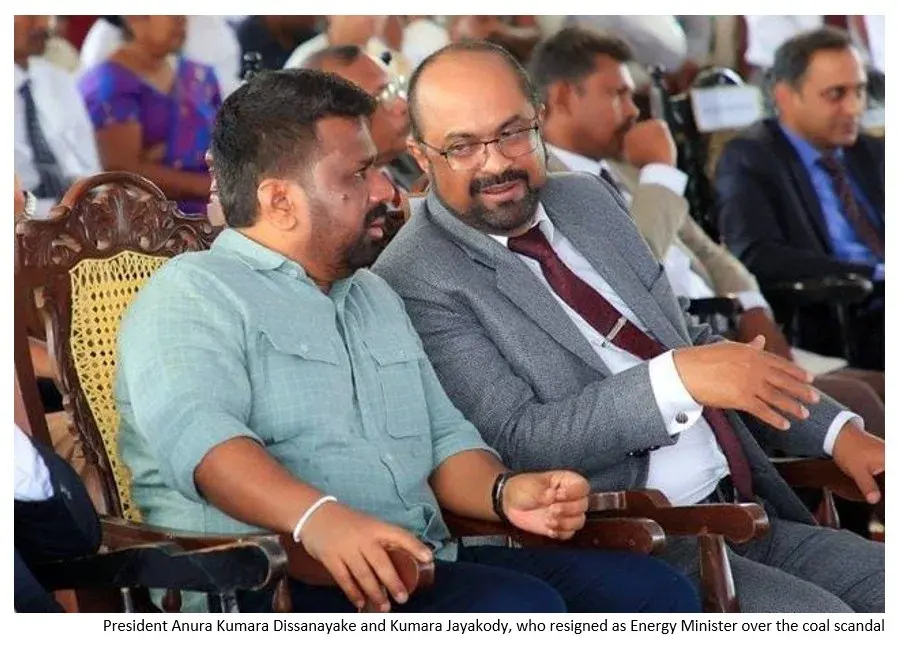
The JVP-led government is in the current predicament, with its political opponents trying to gain the moral upper hand by exposing its scandals, because it mishandled the coal scam. It should have asked Energy Minister Kumara Jayakody and Secretary to the Ministry of Energy Udayanga Hemapala when the irregularities in coal procurement came to light and ordered a high-level probe, without shielding anyone. Such a course of action would have enabled it to boost its image and score heavily on the political front, without allowing the Opposition to secure a rallying point. Instead, it defended Jayakody to the hilt in the parliament when a no-faith motion was moved against him, and President Anura Kumara Dissanayake appointed a presidential commission to probe coal procurement since 2009 in an obvious bid to muddy the water. The government has well and truly shot itself in the foot.
RELATED NEWS
View all
Politics by Vishvanath
Has 22A become the govt.'s Catch-22?
Aug 27, 2026
Politics by Vishvanath
22nd Amendment: A huge political gamble for govt.
Aug 21, 2026
Politics by Vishvanath
Move to raise retirement ages of judges: Options before govt.
Aug 05, 2026
Politics by Vishvanath
‘Cockroach’ uprising and echoes of Aragalaya
Jul 26, 2026