Politics by Vishvanath, Cover Story
AKD’s doosra
By Vishvanath
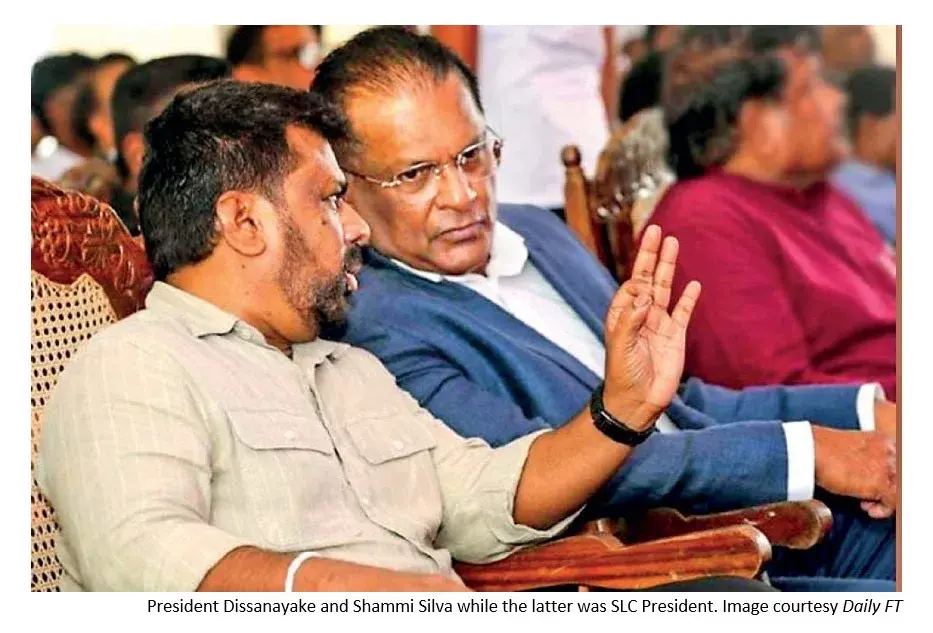
Cricket is much more than a sport in Sri Lanka. It has become a quasi-religion of sorts. It has been losing its popularityto some extent over the years owing to a sharp decline in the performance of the national team, but it remains the de factonational sport. It is widely considered a symbol of national unity, if not a force of national cohesion. Hence, the focus of successive governments has been on developing cricket and controlling Sri Lanka Cricket (SLC).
Not that cricket is without its fair share of critics, who argue that it has been utterly commercialized through betting and beentherefore reduced to a mere platform for gambling. To bolster their argument, they cite the numerous instances of spot fixing and other such irregularities and the involvement of betting tycoons in cricket administration. In fact, the general consensus is that Sri Lanka’s cricket has not been free from the clutches of the betting industry, which has been placed at USD 20 billion a year. This is only a ballpark figure.
Ironically, cricket, which is believed to unify nations, has caused disunity in Sri Lanka’s main Opposition party, the SJB,so to speak. The appointment of former SJB MP Eran Wickramaratne as the Chairman of the Sri Lanka Cricket Transformation Committee, following a radical administrative shake-up at Maitland Place, which saw the mass resignations of SLC President Shammi Silva and the entire SLC Executive Committee. The Ministry of Sports, which effected sweeping reform in the cricket administration, has appointed a nine-member committee consisting of former national cricketers and professionals to assist Wickramaratne in managing the affairs of the board. The committee includes cricketing greats, Roshan Mahanama and Kumar Sangakkara and Sidath Wettimuny. Other members of the committee are Thushira Radella, Avanti Colombage, Prakash Schaffter, and Upul Kumarapperuma.
Wickramaratne’s appointment as the cricket transformation committee chairman did not come as a surprise. Speculation had been rife in sports circles for weeks that he was the JVP-NPP government’s choice for the top post. Immediately after accepting the appointment, Wickramaratna announced his resignation from the Working Committee and the Management Committee of the SJB. However, the SJB has asked him to relinquish his party membership as well purportedly because it does not want the sports governing bodies to be politicized. SJB General Secretary Ranjith Madduma Bandara himself has said so while accepting Wickramaratna’s letter announcing his resignation from the SJB committees. However, it has been the SJB’s tit-for-tat reaction. The SJB leaders are obviously resentful that Wickramaratna has sided with the government, which, the Opposition alleges, is on a mission to debilitate the political party system and establish a one-party rule.
President Anura Kumara Dissanayake was very critical of Wickramaratne while out of power. The former went to the extent of lumping the latter together with the ‘failed’ politicians who served on high-powered committees in the UNP-led Yahapalana government. A video of Dissanayake bashing Wickramaratne and others, during election campaigns, has resurfaced in the digital realm. Interestingly, Dissanayake himself was a member of the Yahapalana government’s National Executive Council.
There were very serious allegations against the SLC during Shammi Silva’s tenure; the performance of players deteriorated, and the national team suffered strings of defeats to the extent of alienating some of its fans, and victories were few and far between for it. The SLC administration succumbed to arrogance of authority and became cocky. It faced allegations of corruption, and even stood up to the parliament, which unanimously resolved that its Chairman and Executive Committee resign in 2023. The International Cricket Council(ICC), dominated by India, made a decisive intervention on behalf of the beleaguered cricket administration, especially Silva, when the then Sports Minister Roshan Ranasinghe sacked them and appointed an interim committee headed by former Sri Lanka cricket captain Arjuna Ranatunga. It suspended Sri Lanka’s membership, citing political interference with cricket administration, causing the SLPP-UNP government to reverseMinister Ranasinghe’s decision. Subsequently, Ranasinghe lost his Cabinet post because he continued to clash with the then President Ranil Wickremesinghe’s top aide, Sagala Rathnayake, whom he accused of backing Silva and other SLC officials.
The JVP-NPP government was expected to dissolve the SLC administration immediately after coming to power in 2024,given scathing verbal attacks Dissanayake had carried out against Silva and others, but it was not in a hurry to do so. The resignations of Silva and others without resistance were no mean achievement for the government. The Board of Control for Cricket in India (BCCI) stands accused of being an appendage of the ruling BJP and keeping the ICC under its thumb. So, how did the JVP-NPP government manage to get rid of Silva and his team, backed by the BCCI and ICC officials? Did it leverage its close ties with Prime Minister Narendra Modi, who is well disposed towards its leaders to shake up the SLC?
Whatever the modus operandi of the JVP-NPP governmentwas, Sri Lanka’s cricket is now in the hands of a transformation committee. The JVP/NPP has killed two birds with one stone by appointing Wickramaratne as the committee chairman; it has prevented its critics from accusing it of packing all institutions with JVP/NPP cardres and sympathisers and, most of all, sown disunity among its political opponents.
RELATED NEWS
View all
Politics by Vishvanath
Has 22A become the govt.'s Catch-22?
Aug 27, 2026
Politics by Vishvanath
22nd Amendment: A huge political gamble for govt.
Aug 21, 2026
Politics by Vishvanath
Move to raise retirement ages of judges: Options before govt.
Aug 05, 2026
Politics by Vishvanath
‘Cockroach’ uprising and echoes of Aragalaya
Jul 26, 2026