Current Affairs
Historic events that Bogambara was witness to
By P.K.Balachandran
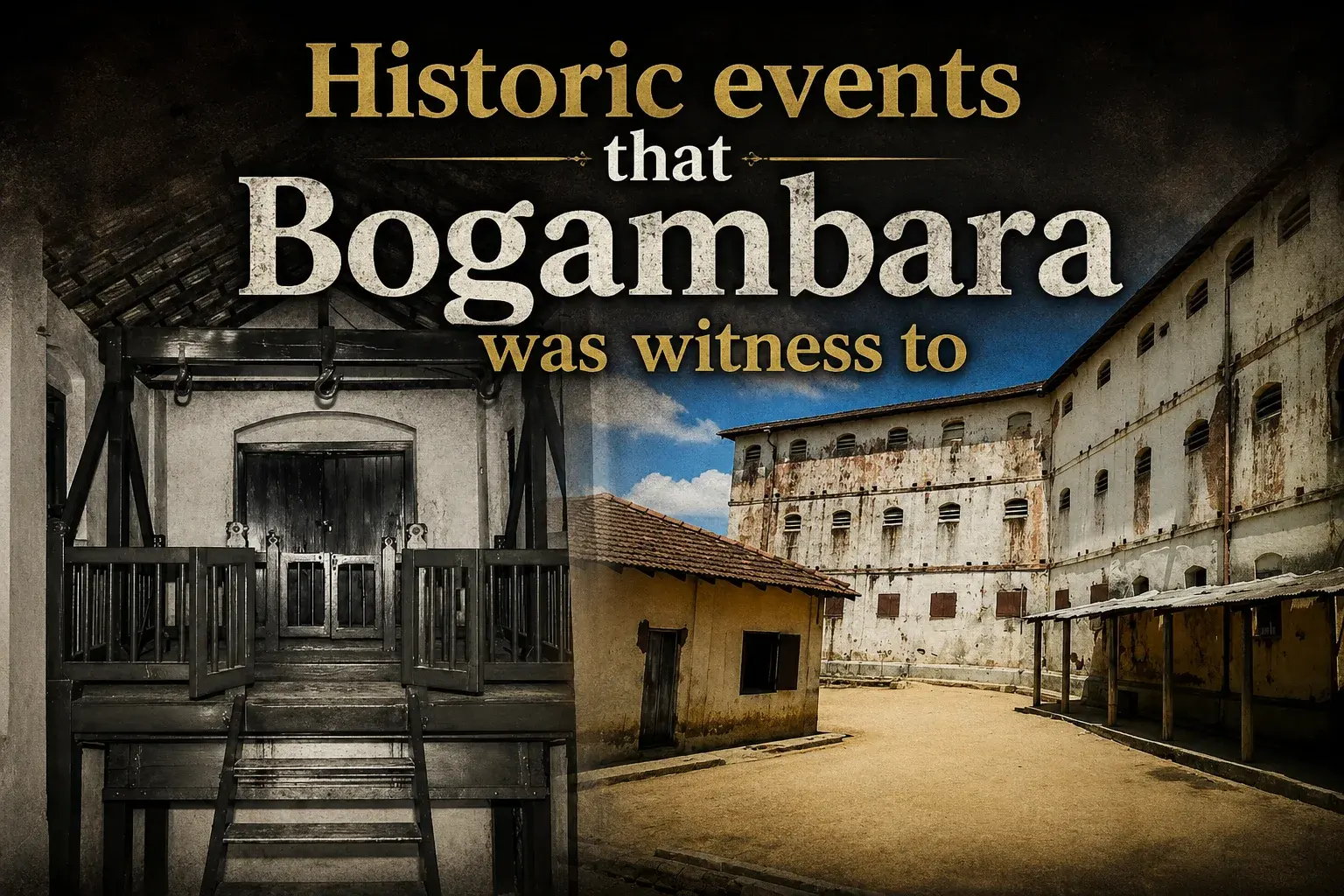
Colombo, July 10 – The Bogambara grounds, the lake and the prison have been witnesses to the unfolding of some key events in Sri Lanka’s history since 1814.
It was on the Bogambara grounds that the family of Kandyan rebel Ehelapola was executed in 1814. The anti-British rebel Keppetipola was beheaded in the grounds in 1818. It was in the Bogambara Lake that Ehelapola’s wife was drowned on the orders of the Kandyan King Wickrama Rajasinghe. It was in the nearby Hangman’s Hill that the Robin Hood-style outlaw, Saradiel, was hanged in 1864.
The Bogambara prison, which came up in 1867, had seen hundreds of hangings between 1867 and 1975 when hangings were stopped in Sri Lanka. It was emptied in 2013, and was renovated and made into a tourist attraction in 2014. Now, in 2026, the prison is going to be made a Correctional Centre for drug addicts to help reduce gross overcrowding in Sri Lanka’s jails and prevent the spread of addiction.
Even before the establishment of the Bogambara Prison, executions and hangings were taking place in the surrounding Bogambara grounds. The entire family of Ehelapola, a noble who had rebelled against King Sri Wickrama Rajasinghe, was executed in the grounds in 1814. First, the two sons were beheaded. Then their mother was made to pound their heads, and finally, the mother and her daughters were tied to stones and sunk in the Bogambara lake. People were outraged but could do little. However, Ehelapola himself escaped as he was under British protection in on the West coast.
In 1818, Chieftain Keppetipola, who had rebelled against the British in Uva, was beheaded on the Bogambara grounds. He wanted to be killed with one stroke, but the executioner failed. It was in the second attempt that the head was cut off. After his death, Keppetipola’s skull was taken to Britain and placed in the Phrenological Society of Edinburgh.
Following the British withdrawal from Sri Lanka in 1948, independent Sri Lanka declared Keppetipola a national hero. In 1954, his skull was brought to Sri Lanka and kept in the Keppetipola Memorial in Kandy.
After the British took over Kandy in 1815, they partially cleared the Bogambara Lake to build the Bogambara Prison. They shifted the gallows from the Hangman’s Hill to the newly-built prison. Prior to this, hangings and beheadings were done in open spaces for the public to witness and learn the lesson the rulers wanted them to learn. The present-day Kandy Central Market stands on the Hangman’s Hill.
It was on Hangman’s Hill that the Sri Lankan Robin Hood, Utuwankande Sura Saradiel, was publicly hanged in 1864.
The Bogambara prison, built in 1867, has changed its profile thrice in the last 159 years. From 1867 to 2013, it was the second-largest prison in Sri Lanka, spread over 14 acres. The prison had a dark reputation, having been one of two in Sri Lanka where hangings took place till capital punishment was stopped, de facto, in 1975. Between 1876 and 1975, 534 prisoners were hanged at Bogambara. The prison was known for a facility in which three persons could be hanged together.
Tourist Centre
In 2013, the Mahinda Rajapaksa government decided to abandon the iconic prison, as part of an larger plan to improve prison conditions by closing old and dilapidated ones located in the middle of towns and building modern ones outside the towns. The idea was also to put prime properties to good and productive use. The Bogambara prison was located on land that was prime property. It was under this scheme that the inmates of the Bogambara prison were shifted to new premises in Pallakele in 2013, and a project was initiated to renovate the facility at Bogambara and put it to revenue-yielding use.
But Rajapaksa government was voted out of office in January 2015. The new government headed by President Maithripala Sirisena and Prime Minister Ranil Wickremesinghe had difficulty in meeting the expected cost of US$ 7 to 10 million. In 2016, Minister Lakshman Kiriella suggested that the 382-cell Bogambara prison be converted into a luxury hotel.
But this was vehemently opposed by the Mahanayakes of the Malwatte and Asgirya chapters of the Maha Sangha located in Kandy. It is reported that in a letter to President Maithripala Sirisena and Prime Minister Ranil Wickremesinghe, the Prelates suggested construction of a Kandyan cultural centre instead.
Being short of funds, the government hoped to raise funds from overseas. The Board of Investment (BOI) tried to find foreign investors. But it was difficult to convert the prison cells into hotel rooms. The thick walls were difficult to break. The windows were tiny and right at the top. And most importantly, since it was a heritage site, the Archaeology Department, which was a participant in the renovation project, would not allow any tampering with the structure. The structures were built with brick, lime and wood, not concrete. Its floors were made of teak.
However, following a global trend in which prisons were being turned into tourist destinations if they were of historical value, the government pursued the project with vigour.
“Prisons, like other historical sites, provide a unique window into a country’s political history, views on crime and punishment, and laws governing freedom and human rights. Each year, millions of people trickle through the shadowy halls of decommissioned prisons around the world to learn their grim histories,” said Gulnaz Khan, a former editor at “National Geographic.”
For example, in the Texas Prison Museum in Huntsville, United States, the infamous American “electric chair” is displayed. In the Tuol Sleng prison cum torture chambers in the Cambodian capital city of Phnom Penh, one can see the tiny cells in which political prisoners were kept. The torture chambers and torture equipment are there for all to see. The walls of the Bogambara prison are said to look like the Bastille prison in Paris.
The first phase of the project was completed and inaugurated by Premier Wickremesinghe. It developed the prison’s external lands at a cost of approximately US$ 705, 930.
The second stage entailed the development of the buildings at an estimated cost of US$ 4.2 million. This envisaged the development of a cultural centre, an open-air theatre, studios for traditional arts and crafts, a tourist information centre, multi recreational areas and a shopping complex. Most importantly, there would be a museum displaying the prison’s history. Since Kandy is a UNESCO World Heritage City, the Department of Archaeology was also involved in the design of the project.
Given the pressing problem of overcrowding in Sri Lankan prisons and the issues thrown up by the rioting in the Negombo jail that led to 27 fatalities, the NPP government has decided to convert the former Bogambara prison into a correctional centre.
END
RELATED NEWS
View all

Current Affairs
Sri Lankan Presidential pardons- the good and the bad
Sep 11, 2026

Current Affairs
The pros and cons of joining BRICS- the dilemma of Pakistan and Bangladesh
Sep 09, 2026

Current Affairs
Disaster in Nepal gets embroiled in geopolitics.
Sep 08, 2026
Current Affairs
Why Mecca Pact, and what does it imply for its members, Israel and India?
Aug 18, 2026