Counterpoint Political Desk
Propaganda, accusations, conspiracy theories and internal problems
Political Desk
Group dynamics are difficult to manage in any organization and particularly tend to erode the unity of political parties and alliances. Competing ambitions that characterize politics do not promote reconciliation and consensus. Politicians out of power usually close ranks in a bid to bring down the government in power, but never do the hesitate to part their ways if that serves their purpose. Hence the disintegration of political alliances. So, it is only natural that the SJB prevented other Opposition parties from joining its protest against the 22nd Amendment near the parliament on 24 September while the debate on the controversial bill was on.
It was ironic that the Opposition alliance, which claimed that the 22nd Amendment had caused a rift between the JVP and the NPP in the government, itself suffered a split over the issue for all intents and purposes. However, this does not mean that there is no dissension within the JVP-led NPP coalition. Minister and Leader of the House Bimal Rathnayake himself admitted during the parliamentary debate on the 22nd Amendment that there had been some disagreement within the government ranks over the constitutional amendment, but the NPP MPs had ironed out their differences. This could be considered an understatement. Senior lawyer and member of the NPP Leadership Council himself openly opposed the 22nd Amendment and even moved the Supreme Court against it.
All NPP MPs voted for the 22nd amendment. However, there is no guarantee that their unity will last indefinitely, for the NPP is experiencing ideological differences—between two groups, one espousing Marxism and the other liberalism. They have managed to reconcile these two opposing ideologies to some extent, but the ruling coalition is dominated by the Marxist core of the JVP and whether the government will be able to prevent a clash of ideologies remains to be seen.
Conspiracy theories
The 24 September protest near the parliament was expected to bring all Opposition parties together although it was the SJB’s brainchild. In fact, several political parties, including the SLPP, were planning to join it, but on the eve of it, SJB MP S. M. Marikkar declared that only the UNP would be allowed to take part in it, prompting SLPP General Secretary Sagara Kariyawasam to react somewhat angrily, criticizing the SJB.
It was obvious that the SJB wanted the protest to be its own show of strength and did not want to share the credit for the success of the event with others. Another reason why the SJB did not
want to make the protest inclusive is that the government has launched a devastating propaganda offensive against the leaders of the SLPP, whose National Leader Namal Rajapaksa, MP, has already been arrested.
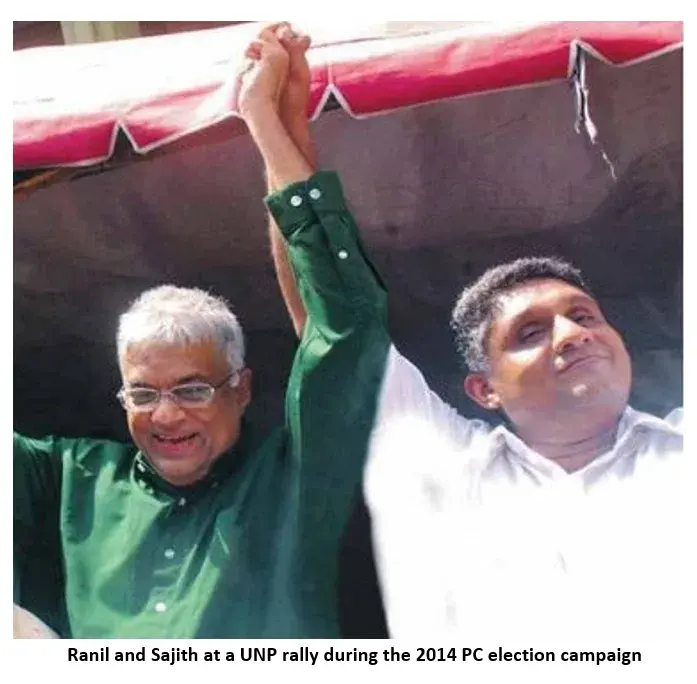
Moreover, there is a cold war between the SJB and the UNP over the question of who should lead the political alliance they are planning to form. The UNP is of the view that former President Ranil Wickremesinghe should be its leader while the SJB’s choice is Premadasa. So, it can be argued that 24 September protest was an instance of Premadasa putting on a show of strength himself. However, the reaction of the propagandists of the other Opposition parties has been to accuse the SJB of having struck a secret deal with the JVP. Such conspiracy theories are not uncommon in Sri Lankan politics.
Claim and counterclaims
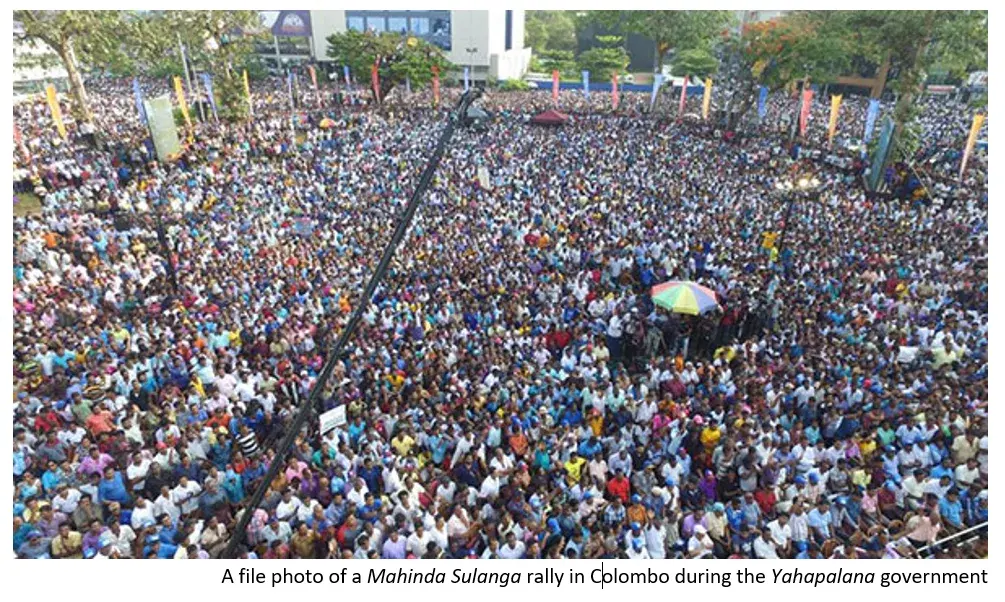
The JVP-led NPP government has been in power for two years, and it is laying out what he describes as its achievements. Its leader President Anura Kumara Dissanayake has launched a series of public rallies across the country to drum up support, claiming that the government has revived the economy and taken action to bring the former rulers and their associates for bribery, corruption and other transgressions.
President Dissanayake addresses rallies and meetings almost every week. With questions arising over whether the SJB is adequately performing as the main Opposition, he has used these platforms to explain what the government has done. He has also been revealing what amounts to budgetary information about cost-of-living measures planned for the next Budget.
But with last election's promises still unfulfilled, public confidence in new ones appears to have waned. Fuel priced at landed cost plus a small margin, a 33% cut in electricity tariffs, and tax-free schoolbooks and medicines have yet to materialise. The government also promised hundreds of crores of rupees in fuel subsidies, then raised fuel prices two or three days later, drawing criticism.
Meanwhile, Opposition Leader Sajith Premadasa is using statistics to paint a different picture, insisting that some of the figures cited in debate do not match official data. The Department of Census and Statistics places unemployment at 4.0% in the second quarter of 2026, while year-on-year NCPI inflation stood at 8.1% in August.
SLPP General Secretary Sagara Kariyawasam also uses figures to argue that a government claiming an exceptionally clean administration owes the public a better account of its economic performance: "During the Rajapaksa administration, which these people branded as a government of thieves, poverty, unemployment and inflation were at much lower levels. Economic growth also exceeded 7%. That is why we say this government has failed. This is a group trying to run the country through propaganda, words and revenge ..."
Ranil's analysis of Namal sleeping on a mat
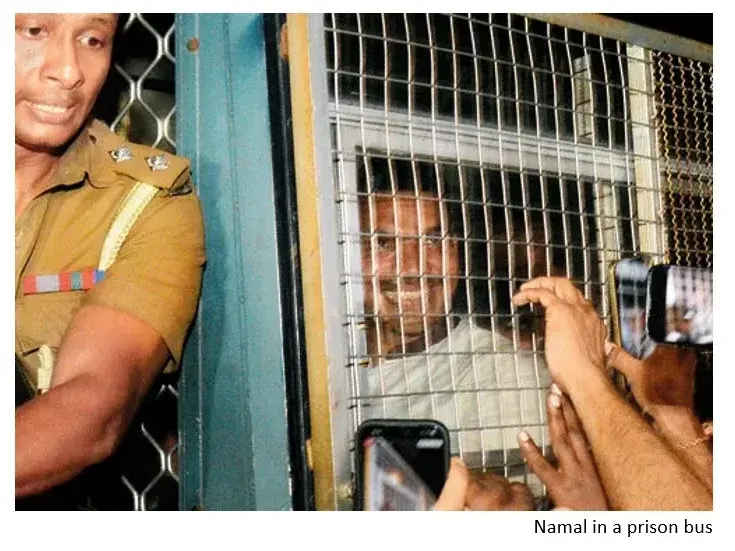
Namal Rajapaksa is still in remand prison. Those who have asked him about life behind bars say he told them he is receiving no special privileges. He has reportedly said that while some other political prisoners had themselves admitted to the prison hospital citing various illnesses, he has not sought that privilege. He has also reportedly told friends that he shares a cell with other prisoners, with only an ordinary mat and pillow.
Former President Ranil Wickremesinghe, at court in connection with a case, reportedly offered a succinct analysis to a former staff member: "This government has no brains. By arresting and imprisoning Namal, what they are doing is recreating the Rajapaksas."
Namal obtained bail in one case but remained in remand prison in connection with another. A
government politician has reportedly told another member of the Rajapaksa family that yet another relative would soon spend seven or eight years in Welikada Prison.
Cheers for the Metro bus
Among the government's recent projects, the Metro bus service in and around Colombo has won public appreciation. Transport Minister Bimal Rathnayake said at the launch that the service, which began with 122 buses on seven major roads, would soon be extended to Galle, Jaffna and Kandy. Apart from some private bus operators, the public appears to have welcomed it.
President Dissanayake appears to understand the difference between the state and the government. Whether many of his colleagues do is open to question. They say they have obtained governmental power but not yet state power, and several Cabinet ministers have publicly declared that state power must also be secured. These propagandists do not seem to realise that they are damaging the government's own image.
Almost all the major Opposition parties have criticised this approach. Their argument is that, in the name of state power, the government is using state institutions to suppress the Opposition. They allege that it intimidates opponents by dragging them into one case or another, and that the 22nd Amendment is also being used for this purpose. They further claim that most politicians now in prison are Opposition activists jailed for political reasons, and that the government shows little interest in even investigating complaints against powerful figures in its own ranks.
Mahatma Gandhi has said that refusing to oppose injustice makes one a party to it, and the leaders of a state should be mirrors of justice. He has pointed to India's first Prime Minister, Jawaharlal Nehru: "Mr Nehru is as pure as crystal. India is safe in his hands."
We should perhaps ask whether there are leaders in our own country we could describe in similar terms.
Share this story
RELATED NEWS
View all
Point of View
Protesting monks’ challenge: Govt. picks up the gauntlet
Oct 17, 2026
Point of View
Robe-sarong controversy eclipses all other issues
Oct 10, 2026
Counterpoint Political Desk
Row over a bill: When hope springs eternal amid uncertainty
Sep 26, 2026

Point of View
When an oil shock reaches Sri Lanka
Sep 22, 2026