Politics by Vishvanath, Cover Story
Delayed PC polls: Who will cut the Gordian Knot?
By Vishvanath
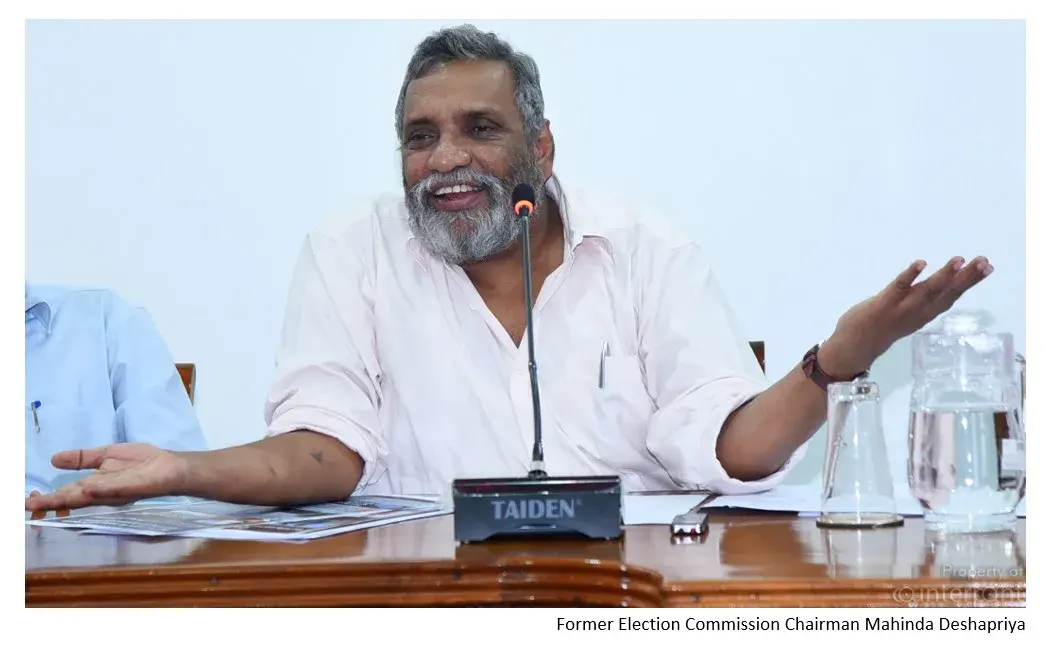
Former Chairman of the Election Commission (EC) Mahinda Deshapriya is known for his straight talk. He does not mince his words when he seeks to drive a point home. He has catapulted the long-delayed Provincial Council (PC) elections into the national spotlight again. Speaking at an event organized by the EC on Wednesday he pointed out that it was illegal for the PCs to be kept under Governors for a long time. He said the Supreme Court had given a ruling to that effect. He has brought a new perspective to the debate on the PC polls delay. Going by Deshapriya’s argument, it may be possible for someone to move the SC against the failure on the part of the current government to hold the PC elections
The PC polls have been delayed for eight long years. All political parties in the current parliament were responsible for the passage of a bill to amend the PC Elections Act in 2017; that bill was changed beyond recognition at the committee-stage to facilitate the postponement of the PC polls. Since the amendment of the PC Elections Act in the most deplorable manner, paving the way for the postponement of the PC polls indefinitely, there have been two Presidential elections (in 2019 and 2024), two parliamentary elections (in 2020 and 2024) and two local government elections (in 2018 and 2025). The country has also had four Presidents—Maithripala Sirisena, Gotabaya Rajapaksa, Ranil Wickremesinghe and Anura Kumara Dissanayake.
All nine PCs have been under the Provincial Governors appointed by the President for eight years. Thus, the Executive controls the PCs to all intents and purposes, making a mockery of the devolution of power guaranteed by the Constitution. Where the presidential control of the lower tiers of government is concerned, the situation was far worse before the conduct of the local government polls in May 2025; the LG institutions were also under the President for about three years.
Deshapirya spelt out what needed to be done to make it possible for the PC polls to be held expeditiously. Pointing out that it would take a long time to conduct the PC elections under the new electoral system, which requires the completion of the delimitation process, he said they could be held under the Proportional Representation system even early next year if the parliament so desired.
The EC has also said that it will take at least one year to complete a fresh delimitation process, which should therefore commence forthwith. EC Chairperson R. M. A. L. Rathnayake is reported to have said that a delimitation report submitted previously did not pass muster with the parliament, and therefore the delimitation process has to get underway afresh, or the PC polls will have to be held under the Proportional Representation (PR) system.
The parliament can easily legislate for the PC polls to be held under the PR system, as in the past, if it does not want the PCs to remain unelected any further. That is the best way to ensure that the PC polls can be held without further delay. But the NPP government has turned a blind eye to this option for political reasons.
The former EC Chairman highlighted the fact that the NPP government had promised to hold the PC polls soon. The NPP’s manifesto, A Thriving Nation: A Beautiful Life, presented to the public in the run-up to last year’s elections, says: “Provincial council and local government elections, which are currently postponed indefinitely, will be held within a year to provide an opportunity for the people to join the governance.” One year has elapsed since that solemn pledge was made, and the NPP is now humming a different tune. It has only held the LG polls. Foreign Minister Vijitha Herath, addressing the parliament last month, said the PC polls would be held only after the completion of the ongoing delimitation process, which is likely to drag on.
Deshapriya likened the task that the Parliament had to perform to prepare the ground for conducting the PC polls to the untangling of the Gordian Knot. According to legend, in 333 BC, it was believed that whoever untied that complex knot that fastened the yoke of an oxcart in Gordium in Phrygia would become the ruler of Asia. Alexander the Great, an emperor in a hurry, was no in mood for untangling it; he just drew his sword out and slashed the knot. The parliament of Sri Lanka has to do something similar to have the PC polls held without further delay. It has to resolve that the elections to the PCs be held under the PR system if it has any respect for the people’s franchise. That is what the NPP government was expected to do. In fact, it said last year that the PC polls would follow the LG elections. But it got cold feet as it could not obtain the result it expected in the mini polls. Its national vote share declined significantly in May, making it hesitant to face any other electoral contest soon. It has apparently embarked on a campaign to shore up its approval rating, weaken the Opposition, and fulfil some of its key promises to assuage public anger, if possible, before facing the PC polls. But pressure is mounting on it to hold the elections earlier. Some election monitoring outfits themselves have asked it to conduct the PC polls or do away with the PCs. It may be recalled that the JVP, which leads the NPP government, carried out a violent campaign to scuttle the PCs, in the late 1980s, when the 13th Amendment was introduced. Deshapriya also said something similar; he said now the NPP had a choice between abolishing the 13th Amendment and holding the PC polls.
Curiously, an otherwise vociferous Opposition has also chosen to remain silent on the PC polls. It claims to be confident of winning future elections, but it has baulked at pressuring the government to conduct the PC polls. What one gathers from the reluctance of both the government and the Opposition to face the PC polls is that both of them lack confidence to face an electoral contest any time soon despite their rhetoric.
RELATED NEWS
View all
Politics by Vishvanath
Has 22A become the govt.'s Catch-22?
Aug 27, 2026
Politics by Vishvanath
22nd Amendment: A huge political gamble for govt.
Aug 21, 2026
Politics by Vishvanath
Move to raise retirement ages of judges: Options before govt.
Aug 05, 2026

Politics by Vishvanath
‘Cockroach’ uprising and echoes of Aragalaya
Jul 26, 2026