Mirror Wall
Ranil’s resignation- fact or fiction?
By kassapa
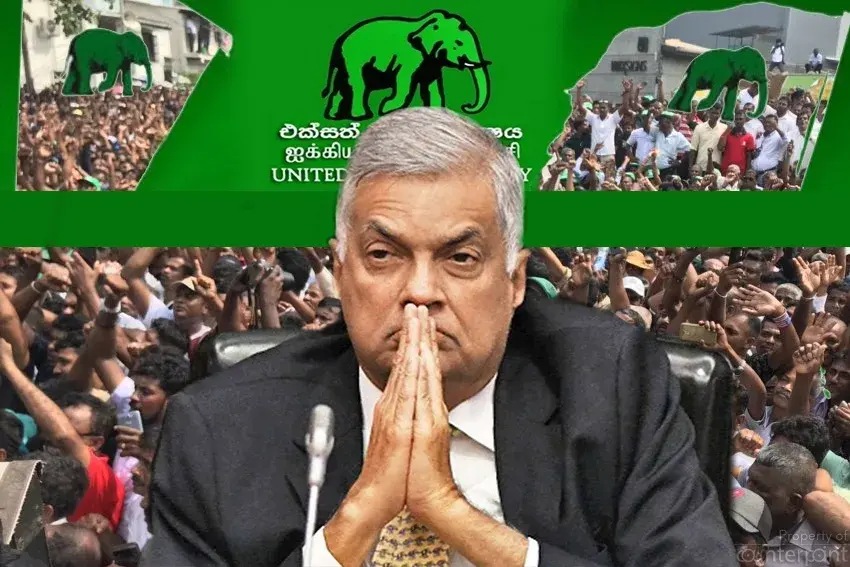
The domestic political world was all agog with a wave of speculation this week after United National Party (UNP) leader Ranil Wickremesinghe reportedly told party colleagues that he was ready to resign from the party leadership if it was felt that he was the obstacle to a reunification between the UNP and its breakaway faction, the Samagi Jana Balavegaya (SJB).
Many a UNPer- and even many a SJBer- was expressing high hopes because this was the first time, perhaps in thirty-one years, that Wickremesinghe had expressed such a sentiment. Others were not so sure. Had Sri Lanka’s ‘Accidental President’ finally had enough of the rough and tumble of politics? After all, he would be eighty years of age when the next national elections are held. Or, is the Old Fox, a title he has inherited from his uncle J. R. Jayewardene, up to yet another trick? If so, what was his underlying motive?
Wickremesinghe is not only an ‘accidental President’. He was also an accidental Prime Minister when he became Premier for the first time and he was an accidental UNP leader too. When Ranasinghe Premadasa was assassinated, he was Leader of the House because Lalith Athulathmudali and Gamini Dissanayake had left the UNP by then, with Athulathmudali being assassinated a week prior to Premadasa and that is how he came to become Prime Minister for the first time under D.B. Wijetunga.
By the time Wijetunga called for a presidential election, the UNP chose Dissanayake over Wickremesinghe to be its candidate. It turned out to be a poisoned chalice because he too was assassinated while campaigning. With Wijetunga retiring, Wickremesinghe, the only ‘leftover’ from the top tier of the UNP assumed leadership of the party. And he has stayed put since 1994 for thirty-one years, the longest tenure by far, the next being Dudley Senanayake who led the party for eighteen years and that too in two stints.
The uncertainty in Wickremesinghe’s announcement stems from his reputation as a political ‘game player’. Over successive elections (including three presidential bids), he has demonstrated that he is not charismatic enough to win the popular vote. Yet, he is very adept at backroom politicking and is a master behind closed door negotiations and ‘deals’.
The alacrity with which he accepted Gotabaya Rajapaksa’s invitation to become Prime Minister during the mid-2022 crisis, when Sajith Premadasa and Sarath Fonseka were also under consideration, is a clear example of this. Premadasa laid down conditions. Fonseka wanted guarantees. Wickremesinghe accepted the offer gleefully, no questions asked. The rest, as they say, is history.
In the current political landscape, among the major parties, the UNP remains marginally ahead of only the moribund Sri Lanka Freedom Party (SLFP) where internal disputes and court battles are the order of the day. Their respective breakaway factions, the SJB and the Sri Lanka Podujana Peramuna (SLPP) have run away with a majority of the traditional two-party vote base. That too was eroded at the 2024 elections with the more discerning voters opting to give the ruling National Peoples’ Power (NPP) a chance.
Therefore, in the reconciliation talks between the UNP and the SJB, the former is not negotiating from a position of strength. Premadasa has taken it upon himself to do the talking while the UNP is represented by Wickremesinghe’s cousin Ruwan Wijewardene, his staunch loyalist Sagala Ratnayaka and ex-SJBer Thalatha Atukorale. The problems they encounter are many.
With the formation of the SJB, the party has allocated electoral organisers who now compete with UNP organisers in their respective electorates. A reunification will mean that one will have to yield to the other, a sacrifice not many are willing to undertake.
The other issue, not spoken openly but in soft whispers, is that, just as much as Wickremesinghe being UNP leader is resented by Premadasa, most SJB stalwarts are not very happy with Premadasa’s leadership style too, which is quite similar to Wickremesinghe’s. He too has an inner circle of advisors and it is they who dictate how the party is run. Moreover, if there is an up-and-coming politician who is attracting a following, he or she is quickly marginalised if Premadasa perceives that person as a threat to him. Harsha de Silva and Hirunika Premachandra are examples.
Nevertheless, the overarching issue remains Wickremesinghe’s leadership. If he were to indeed call it a day and retire to 5th Lane, just as J.R. Jayewardene did to Ward Place when Ranasinghe Premadasa took over the UNP, reunification stands a reasonable chance. That would allow Sajith Premadasa to return to the UNP and rebuild the Grand Old Party according to what he perceives it should be, just like what his father did although Premadasa (Snr.) messed up that exercise in style, marginalising both Athulathmudali and Dissanayake instead of playing them against each other, leading to the impeachment against him.
However, if Wickremesinghe decides to linger on (with a title such as ‘Senior Advisor’), he will muddy the waters because he would still want to place his people (the Ratnayakas, the Abeywardenas and the Karunanayakes to mention a few), in key positions. If there is a reunification under Premadasa’s leadership, there is likely to be a purge of Wickremesinghe loyalists, just as much as there was a purge of Jayewardene loyalists, when Premadasa (Snr.) took charge. So, it is these very people in the UNP who will oppose a reunification which places their political careers in peril- and Wickremesinghe will feel obliged to protect his proteges who stood by him in his darkest hours.
For all these reasons, any talk of Wickremesinghe simply calling it quits and walking away from the UNP is fairytale material at this stage. Many issues need to be ironed out. It will not be an easy task with each and every politician wondering ‘what’s in it for me?’.
It will be in the country’s best interest though if someone can put the UNP together again. The nation needs a vibrant opposition, not only to keep the incumbent government on the straight and narrow but, in this instance, also to provide an alternative that is not the regressive, racist and family-based SLPP.