Mirror Wall
X-Press Pearl: Justice decided but can it be delivered?
By Kassapa
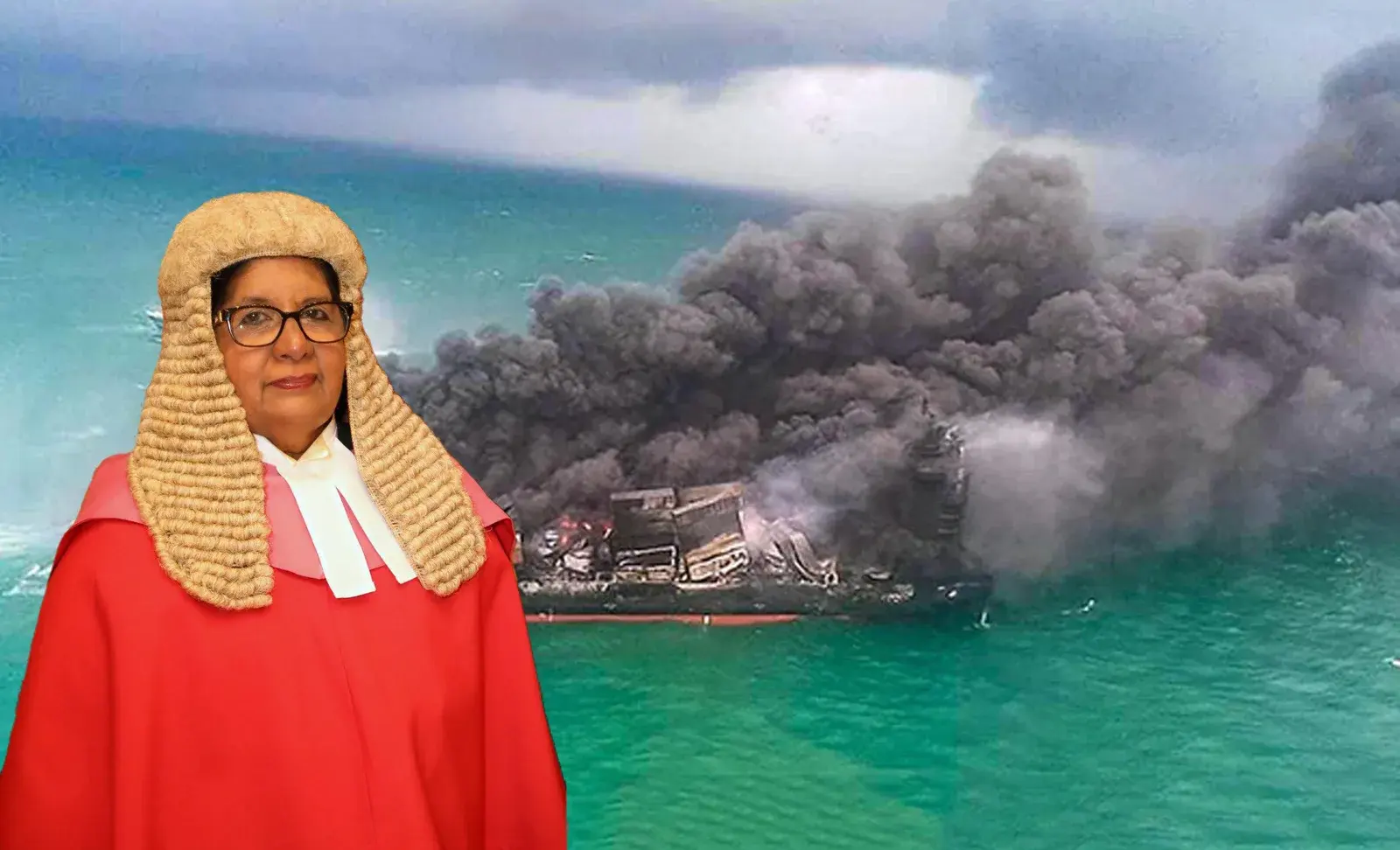
The verdict on the fundamental rights applications filed in relation to the X-Press marine disaster, where the container ship carrying chemicals caught fire and sank near Sri Lanka was outgoing Chief Justice Murudu Fernando’s last major judgment and a fitting farewell it was.
The Supreme Court decision from the five-judge bench headed by outgoing Chief Justice Fernando ordered the highest compensation decided by a Sri Lankan court, one billion dollars, to be paid by the ship’s owners, a Singapore based shipping company. It also made a series of stringent recommendations aimed at holding those responsible to account.
Most importantly, in analysed in forensic detail the circumstances surrounding the disaster and the bungling in the follow-up measures that were adopted by Sri Lankan authorities. It raised more questions, pertinently querying whether there were attempts to ‘hush-up’ the compensation claim.
The court’s findings specifically cast a shadow on two persons, the State Minister for Urban Development, Coast Conservation, Waste Disposal and Community Cleanliness Dr. Nalaka Godahewa and then Attorney General Sanjay Rajaratnam.
Godahewa’s culpability are mostly errors of omission: for his failure to constitute the Marine Environment Council of the Marine Environment Protection Authority (MEPA) and to supervise it.
Much more damning is the court’s observations on Rajaratnam. “The Attorney General has failed to perform his statutory function of indicting the Owner and the Operator(s) of MV X-Press Pearl,” the court noted, adding that “the decision taken by the Attorney General to institute civil legal action against the X-Press Pearl group of companies in a Singapore court, as opposed to instituting action in the High Court of the Republic of Sri Lanka exercising Admiralty jurisdiction, was an unreasonable, irrational and arbitrary decision, and was not in the best interests of Sri Lanka.” The question is whether this was an error of omission or commission?
The judgment makes no attempt to conceal the fact there may have been bribery involved with regard to decision making at high levels in respect of the disaster. That is why it has specifically directed the Commission to Investigate Allegations of Bribery or Corruption (CIABOC) to launch an investigation into the matter. The court even goes to the extent of recommending that CIABOC obtains “the assistance of the Financial Intelligence Unit of the Central Bank of Sri Lanka and the State Intelligence Service” for this purpose. Clearly, the court suspects that there is more to it than meets the eye.
This is why the Supreme Court has taken upon itself the task of setting up two entities, the MV X-Press Pearl Compensation Commission and the MV X-Press Pearl Marine and Coastal Environment Restoration and Protection Committee. Taking this a step further, it has also appointed retired Justice of the Supreme Court E.A.G.R. Amarasekera as the Chairman of the MV X-Press Pearl Compensation Commission.
The court has also ordered that both the Attorney General and the Director of the Criminal Investigations Department (CID) report back to the court within three months regarding the progress of the tasks entrusted to them. It has even fixed the next date when the case will be taken up for review of this progress, 25th September.
While the verdict is undoubtedly a victory for the environmentalists and others who lodged the fundamental rights applications for a variety of reasons, it also exposes the serious lack of checks and balances in governance that prevails in the country’s administrative structure that allows for this type of disaster to occur- both at sea and also in the aftermath in terms of pursuing compensation.
Speculation in the media has centred on the one billion dollar compensation award and whether the country will receive it. It is a large amount of money. To put this in context, it amounts to one third of the three billion dollars offered by the International Monetary Fund (IMF) under its Extended Fund Facility (EFF) over four years. The big question is, will the Singapore-based company pay up without a whimper and if they don’t, what more can be done? After all, the company cannot appeal this verdict because this is Sri Lanka’s highest court.
Even more daunting is the direction of the court regarding the conduct of the Attorney General who at the time was Sanjay Rajaratnam. Although not mentioned by name, the court finds the conduct of the Attorney General “unreasonable, irrational and arbitrary”. At the same time, it also instructs CIABOC to probe the entire issue, going so far as to say that CIABOC should obtain the assistance of the Central Bank Financial Intelligence Unit and the State Intelligence Service. It then directs the current Attorney General, along with the CID to report back to the court within three months.
Taken together, one could arrive at the conclusion that the court has deep suspicions about the conduct of high officials who made key decisions related to the disaster and its aftermath. Whether the institutions mandated by the Supreme Court to pursue this, the Attorney General’s Department and the CID, will be able to do so will be watched with great interest.
Indeed, the reputation of the CID has grown in recent months with several high-profile investigations and prosecutions underway. The elevation of Shani Abeysekara as Director, CID has given added muscle to the department and he may precisely be the kind of person who could spearhead such a task.
The Attorney General’s Department however does not enjoy the same degree of confidence among the public. Its conduct in the case related to journalist Lasantha Wickrematunge destroyed the department’s reputation to a great extent although some of it was regained in the cases involving Keheliya Rambukwella and Deshabandu Tennakoon through the work of Lakmini Girihagama and Dileepa Peiris respectively. How the Department will rise to the challenge of investigating a group of persons which could possibly include its previous head remains to be seen.
This is what makes the X-Press Pearl verdict unique. What happens next could be a major leap for the dispensation of justice in Sri Lanka- or another great disappointment.