Politics by Vishvanath
What’s the Field Marshal’s battle plan?
By Vishvanath
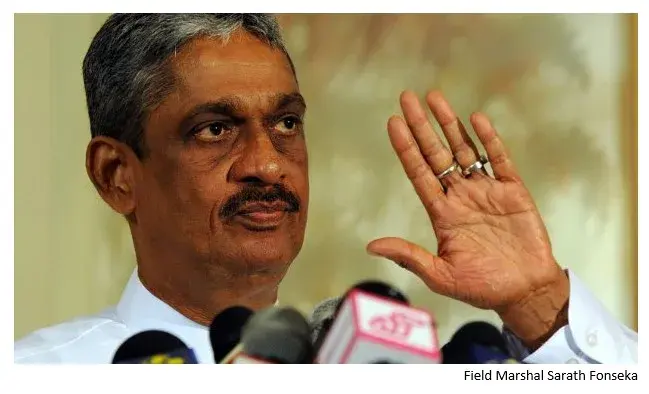
Field Marshal Sarath Fonseka is no stranger to controversy, which can be considered his middle name, in a manner of speaking. He is not known to exercise control over his tongue, which has caused him immense trouble both in the military and in civvy street, where he took to politics immediately after his retirement as the Army Commander in Nov. 2009 to contest the 2010 presidential election.
Fonseka is reported to have said he is all out to upend Sri Lanka’s corrupt political culture. He is planning to enlist the support of educated and honest citizens to cleanse Sri Lankan politics. Those who cherish good governance can join his political movement, he has said.
Fonseka became a prominent political figure thanks to the JVP, which was the prime mover behind a grand plan to defeat the then President Mahinda Rajapaksa in 2010. It is believed to have persuaded Fonseka to run for President. Rajapaksa’s popularity was at its zenith, in 2009, because of his political leadership for the war against the LTTE, and the Opposition was unable to choose a candidate to challenge him in the presidential race the following year. The JVP leveraged Fonseka’s military leadership for defeating the LTTE to mobilize popular support for him, and conducted an aggressive election campaign for him in the run-up to the 2010 presidential election.
Having played a pivotal role in Rajapaksa’s successful election campaign in 2005, the JVP may have been confident that it would be able to enable Fonseka to secure the coveted presidency in 2010. But its efforts failed. The Mahinda Rajapaksa government had Fonseka arrested on what its critics consider trumped up charges and incarcerated. He subsequently received a presidential pardon and re-entered Parliament as a National List MP of the UNP. He contested the 2024 presidential election as an independent candidate and came ninth with only 22,391 votes (0.17%).
What’s up Fonseka’s sleeve, now? He is apparently offering himself as an alternative to both the government and the SJB-led Opposition in a bid to make a comeback. Only the SJB and the SLPP can be thought to have the potential to defeat the JVP-led NPP in the future, and Fonseka has taken them on.
Having suffered crushing defeats in the last there elections, the SJB and SLPP are doing their level best to recover lost ground, and the NPP government has not been able to improve its approval rating which has shown signs of decline since its stunning win in last year’s general election, where it obtained a two-thirds majority. It was not able to sweep the May 06 local government polls, much less secure control of all the hung councils where it obtained pluralities. It has suffered humiliating losses in several cooperative society elections recently. Moreover, several key trade unions are on the warpath, and the JVP’s labor leaders have antagonized their erstwhile trade union comrades, who are now tearing into the government for having betrayed workers’ cause for political expediency. Among the protesters are the Ceylon Electricity Board employees, teachers, postal workers and university dons. Government doctors are also said to be contemplating trade union action over some unresolved issues.
Another electricity tariff hike is said to be on the cards, and fuel prices have not been reduced drastically. The cost of living remains very high. The Opposition is all out to make use of the JVP leaders’ assets, disclosed by the Commission to Investigate Allegations of Bribery and Corruption recently, to make the ordinary people envious. Unemployed graduates who campaigned hard for the NPP in the past three elections are up in arms, asking for jobs. The NPP was dependent on cross-ethnic votes, especially in the North and the East, to win elections, and now it is under pressure to fulfil its pledge of a new Constitution. Its stand on the UNHRC resolutions pertaining to Sri Lanka cannot be to liking of the Tamil hardliners who were instrumental in delivering a large number of votes to it in the North and the East. Most of the Sinhala hardliners also threw their weight behind the NPP, enabling it to win elections. It will an uphill task for the NPP to strike a balance between the aspirations and demands of the nationalistic groups among the Sinhalese and Tamils.
Fonseka entered politics at a time when the Opposition was weak to the extent of being unable to pick a presidential candidate. The current Opposition is also weak. Opposition and SJB leader Sajith Premadasa has lost two presidential elections and two parliamentary elections in a row. SLPP National Organizer Namal Rajapaksa has lost a presidential election and a parliamentary election. He did not contest the last general election for fear of losing it and entered Parliament as National List MP. The parties led by both Premadasa and Namal did not fare well in the last local government polls either, and they have not been able to function as an effective countervailing force against the powerful NPP government. Fonseka is apparently trying to be an alternative to the Opposition and the government, while eating into the NPP’s support base, which mostly consists of floating voters, who have backed different political parties overwhelmingly in elections since 2010. He is also trying to use a campaign against corruption, waste and the Rajapaksa family, to gain political traction. His thinking appears to be that he will be the choice of the voters who become disillusioned with the NPP government.
Interestingly, the JVP, which went all out to make Fonseka President in 2010, albeit in vain, and rode on his coattails to re-enter Parliament thereafter, did not consider him for even a National List slot in the last general election. However, Fonseka has refrained from taking on the NPP government. Instead, he has chosen to bash the Rajapaksa family, the SLPP and the SJB. His critics say he has been trying to curry favor with the NPP leaders.
Nothing is said to be so certain as the unexpected in politics, but at 75, with no strong political party to back him, Fonseka will have his work cut out to cobble together a political alliance, much less achieve his goal of ruling the country.
RELATED NEWS
View all
Politics by Vishvanath
Has 22A become the govt.'s Catch-22?
Aug 27, 2026
Politics by Vishvanath
22nd Amendment: A huge political gamble for govt.
Aug 21, 2026
Politics by Vishvanath
Move to raise retirement ages of judges: Options before govt.
Aug 05, 2026
Politics by Vishvanath
‘Cockroach’ uprising and echoes of Aragalaya
Jul 26, 2026