Current Affairs
197 Indian languages have been on the verge of death in the past 50 years, says UNESCO
By P.K.Balachandran
Colombo, February 23 – The annual observance of International Mother Language Day on February 21 has its origin in Bangladesh, where it marks the martyrdom of Bengali students who were agitating for the recognition of Bengali as an official language of Pakistan, alongside Urdu, in 1952.
The students’ demand was based on the fact that the language of the majority of the people of Pakistan (56%) was Bengali. However, in 2002, February 21 was dedicated by the UN General Assembly to the preservation of all mother tongues.
The reframing of the purpose of the International Mother Language Day was necessitated by the worldwide phenomenon of languages dying because they had been overshadowed by other languages due to political, social and economic reasons. These factors, which are the bases of political power, have, over the years, enabled some languages to prevail over and even smother other languages.
According to Dr. Aditi Ghosh of Calcutta University, 50 to 90% of the languages spoken across the world now, will be either dead or severely endangered in the next 100 years. And as per UNESCO data, 197 Indian languages have been on the verge of death for the past 50 years.
Dr. D.G. Rao of the Central Institute of Indian Languages has said that even those languages of India that are not officially on an endangered list, (such as the 22 languages in the Eighth Schedule of the Constitution) are facing serious difficulties. Linguistics professor, Dr. Mrinmoy Pramanick, has said that there are 75 officially-recognised “vulnerable tribal languages,” in India.
When senior members of a tribe or community speaking marginalised languages pass away, the languages they spoke would also pass away.
No concerted actions or measures are taken to preserve or record these rich languages which are but expressions of a culture. Therefore, the International Mother Language Day is of great relevance for scores of Indian languages.
1961 Census Stipulation
According to Dr.Pramanick, a reason why many languages have become extinct is that in 1961, the Indian Union government decided to ignore languages spoken by less than 10,000 people for the purpose of the national census. Lamenting this, Pramanick said, “When it comes to democracy, we hardly think of linguistic rights.”
The other reason is poverty-led migration to cities. Migrants discard their original languages and cultures and adopt the language and culture of the cities. The original language eventually dies of non-use.
According to Dr. Pramanick Bengali hegemony has led to the demise of tribal languages like Toto, Lodha, and Birhor in West Bengal. The loss is greater because, if a language dies, the culture of the community, its identity, its body of knowledge in medicine, literature, everything else, dies he says. All the lost knowledge had been accumulated over centuries.
Dr. Rao urges the increased translation of reading materials from foreign and developed languages to make them available to speakers of less developed languages. In India, it is difficult to teach even a common foreign language like English, given the severe shortage of competent English teachers in most parts of India. Translations will greatly help fill the knowledge gap.
Dr. Aditi Ghosh says that death approaches a language when another language has greater functional or social relevance. And since only a handful of languages hold such a dominant position, a large number of indigenous languages are in danger of falling into disuse.
Effect of India’s Official Language Policy
In India, the official languages of the Union and States have driven many other languages out of use. When a language is not used in prestigious domains, but only in informal and intimate domains, it loses prestige and ceases to be used for serious purposes. Eventually, it could go out of use. For example, Punjabi has been reduced to this status because of the higher social status accorded to Urdu.
In the emerging culture in South Asia, parents give up teaching in or even speaking to their children in the mother tongue because the mother tongue is of no use to the child in the wider society. Some linguists call this “linguistic suicide” as it is self-willed.
False Sense of Nationalism
Dr. Aditi Ghosh says that diversity is increasingly seen as an anti-national phenomenon. Multilingualism is seen as a problem by nationalistic governments. Multiculturalism or multilingualism is thought to be a source of disunity and as being detrimental to the concept of a united, cohesive and strong nation.
The modern concept of a nation is founded on the belief in a common origin, a common purpose and common characteristics. Because of this, nationalists go to the extent of inventing history to make people believe that, in the past, there was cohesion, a common purpose, and collective strength, which are being lost now because of the acceptance of diversity.
Linguistic Domination in India
In India, language has been an instrument of domination for a long time. It all began with Mahatma Gandhi in 1916. Seeing the need for a single language to unitedly fight the British rulers, Gandhi promoted the cause of Hindi as a replacement for English. English, he said, represented the colonial rulers and therefore it would be a ‘sin’ to use it. (Speech at the All-India Script and Common Language Conference in Lucknow in 1916).
In 1925, Gandhi asked some categories of non-Hindi speakers to sacrifice their languages for the sake of a widely spoken language he called “Hindustani”.
“All underdeveloped and unwritten dialects should be sacrificed and merged in the great Hindustani stream. It would be a sacrifice, not suicide,” he wrote in Young India, dated August 27, 1925.
Following Gandhi’s wish, India’s constitution, which came into force in 1950, ordained that Hindi and English would both be official languages of the Union Government for 15 years. But the Hindi that was fostered was a purified, highly Sanskritized Hindi, not spoken by the common man.
Formation of Linguistic States
But this stipulation ill-fitted developments in Southern and Western India in the mid-1950s. India’s major ethno-linguistic groups, which were not Hindi-speaking, demanded States or Provinces based on the language spoken. Maharashtrians wanted a Marathi-speaking State. Gujarati speakers wanted a Gujarati-speaking State. Tamil, Telugu, Kannada and Malayalam speakers in Madras State demanded States of their own.
The Union government was forced to appoint a States Reorganisation Commission, which recommended the formation of linguistic States. The formation of linguistic States did address the language issue to some extent. But it surfaced again in 1965, when the planned total switchover to Hindi from English as the official language of the Union government was to take place.
Anti-Hindi Agitation in Madras State
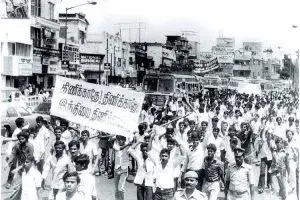
The Tamils of Madras State in South India rose in revolt in 1965, demanding the retention of English. They argued that if Hindi became the sole official language, native speakers of Hindi (living in North India) would dominate the Tamils and others who were not native speakers of Hindi. Tamils would be disadvantaged and pushed down the social, economic and political hierarchy.
Seeing the depth of resentment, the Congress government of the day promised the Tamils that English would remain an associate official language indefinitely. The assurance helped cool the political atmosphere.
However, Union governments, irrespective of the national party in power, did not cease to implement the original agenda of making Hindi the dominant, if not the sole, official language of India. National institutions, government programs and criminal and civil codes were given Hindi names. Special budgetary allocations were made for the promotion of Hindi and its use in official work.
Three Language Formula
The Indian Union government then devised the “Three Language Formula” in school education, according to which every Indian child should learn three languages – the mother tongue, Hindi and English. This was opposed in Tamil Nadu. But Tamils pointed out that under the formula, a Tamil child would be forced to learn three languages, while a child from a Hindi-speaking State will be required to learn only two, ie; Hindi (which is the mother tongue as well as the national language) and English. This is iniquitous, the Tamils said.
To force Tamil Nadu to accept the Three Language Formula, the Central government has been withholding several millions of rupees it is duty bound to give for school education in Tamil Nadu.
The campaign to impose Hindi continues unabated because the motto of the ruling Bharatiya Janata Party (BJP) is “Hindi-Hindu-Hindustan” (One country, one language, one religion).
Hence the critical importance of the International Mother Language Day for Indian languages which are being neglected or suppressed. But the annual observance of the day should not degenerate into an annual ritual. Concrete steps should be continuously taken to protect languages and facilitate their use because languages are repositories of culture, accumulated knowledge and the history of peoples.
END
RELATED NEWS
View all

Current Affairs
Sri Lankan Presidential pardons- the good and the bad
Sep 11, 2026
Current Affairs
The pros and cons of joining BRICS- the dilemma of Pakistan and Bangladesh
Sep 09, 2026
Current Affairs
Disaster in Nepal gets embroiled in geopolitics.
Sep 08, 2026
Current Affairs
Why Mecca Pact, and what does it imply for its members, Israel and India?
Aug 18, 2026