Politics by Vishvanath, Cover Story
A heavyweight champion in a minimumweight ring
By Vishvanath
The NPP government is drawing heavy fire for what its rivals describe as politicising the National Youth Services Council (NYSC). Opposition Leader Sajith Premadasa has gone on record as saying that the NPP has been ‘infiltrating’ all associations including funeral aid societies in villages, and at this rate it will not spare even the Buddhist temple committees.
The Opposition insists that the NYSC and its branches were free from politics under previous governments, but the NPP has stooped so low as to have its cadres elected as the office-bearers of those outfits. Denying this claim, the NPP has accused its rival of staging protests and disrupting the meetings of youth associations, unable to have their supporters elected as office-bearers.
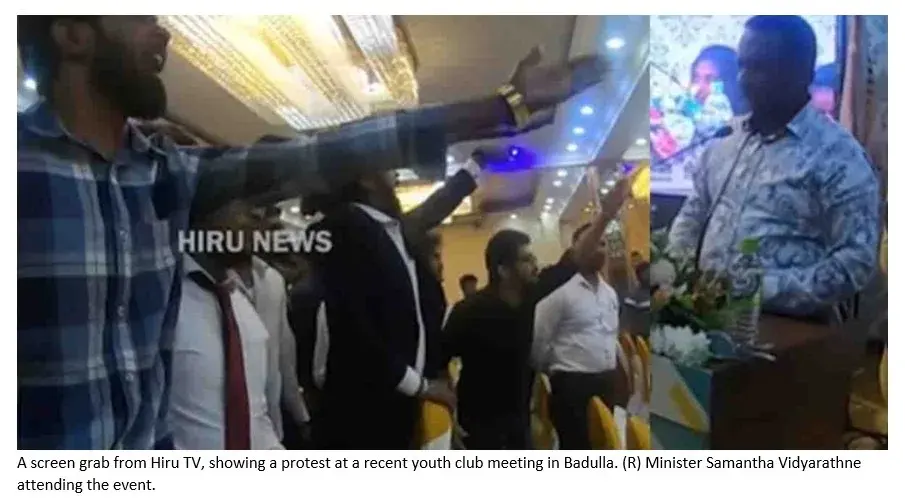
Several Ministers and Deputy Ministers who attended conferences of youth associations, where office-bearers were elected, had to face protests, and there were also a few instances of booing. One of the protesters was arrested in Kalutara, and the media was barred from covering some of the elections. Such measures are likely to prove counterproductive.
The Opposition has claimed that most of the new office-bearers of the youth associations are family members of NPP politicians, and the government is promoting nepotism at the expense of the unity among the members of those organizations. One of the main allegations the NPP leveled against previous governments to turn public opinion against them was that nepotism thrived under their watch, and a few political families had all the luck. If the Opposition’s claim at issue is true, the NPP will have a hard time explaining to the public why it is having the family members of its cadres in the top positions of the youth associations, which should be free from partisan politics.
Why is it that the NPP, which has secured the executive presidency, obtained a two-thirds majority in the parliament and won most of the local councils, does not consider it infra dig to pursue control of some youth associations which are of little political significance. The involvement of the ruling party in the youth associations is bound to create splits in them and alienate the members who hold different political views. If reduced to mere appendages of the government in power, such outfits will lose their appeal to the youth.
Every government is affected by a gnawing sense of insecurity, however powerful it may be. Hence the ruling party politicians do not leave anything to chance when they seek to retain their hold on power and prevent their opponents from making a comeback. In Sri Lanka, politicians apparently think everything is fair in love, war and the quest for power. There have been numerous instances where they even resorted to violent attacks on democratic dissent and even killings in a bid to perpetuate their hold on power. But all the regimes employed such uncivilized methods to suppress dissent eventually suffered humiliating defeats.
The NPP is apparently under the impression that it has to secure control of all grassroots level organizations to consolidate its power and shore up its chances of winning future elections. Neither the JVP or the NPP led by it has solid vote banks as such. The NPP victories in the last three elections were possible due to surges in floating votes, which can swing for any political party in future elections. In 2015, Maithripala Sirisena won the presidency and the UNP returned to power thanks to a wave of swing votes. Four years later, the floating votes paved the way for the SLPP’s meteoric rise to power. Last year, they propelled the NPP to power, and going by the May 06 local government polls results, there has been a decline in the NPP’s votes.
Perhaps, its defeat in a considerable number of cooperative society elections prior to the May 06 local government (LG) polls may have driven the NPP to adopt the current strategy of gaining control of all grassroots-level organizations. Usually, a political party that wins a presidential election and parliamentary polls in quick succession goes on to sweep other elections, LG or provincial council. But the NPP could not improve its electoral performance in the last LG polls. It vowed to secure control of all non-majority local councils where it had obtained pluralities, but could not achieve that goal; the Opposition won a significant number of them. The results of co-operative society elections helped the Opposition to regain confidence to some extent and boost the sagging morale of its rank and file considerably in time for the LG polls.
Most of all, there have been some developments unfavorable to the NPP on the political front. On June 24, the SJB succeeded in securing control of the Bentota PS, where the NPP obtained 10 seats in the May 06 LG polls. The SJB could win only 5 seats. Two independent groups and the SLPP won two seats each. The People’s Alliance and the UNP secured 1 seat each. The NPP’s loss in this particular PS is of immense political significance; the Bentota PS adjoins the Elpitiya PS, which the NPP won on Oct. 26, 2024 setting the trend for its spectacular win in the last general election that followed a few weeks later. It won 15 seats, the SJB 6, the SLPP 3, the People’s Alliance 2, an independent group 2, UPFA 01 and the National People’s Party 1, in the Elpitiya PS. It obtained only 50% of the seats, but it was able to secure the post of chairman in keeping with the LG election laws, which stipulate that a political party or an independent group that has obtained 50% of the seats or more in a local council is entitled to the post of Chairperson/Mayor. Less than eight months later, it lost the Bentota PS to the SJB, despite having a plurality in the council and the backing of the entire government, which went all out to prevent the Opposition from seizing control of that local government body.
Overall, the NPP has been able to outperform the SJB and other Opposition parties, but its popularity is on the wane. There has been a marginal improvement in the electoral performance of its rivals. The outcome of the May 06 LG polls seems to have had an unsettling effect on the NPP and driven it to consolidate its hold on all grassroots-level organizations and to build a vote bank. This may explain why the NPP is even chasing control of youth associations.
RELATED NEWS
View all
Politics by Vishvanath
Has 22A become the govt.'s Catch-22?
Aug 27, 2026
Politics by Vishvanath
22nd Amendment: A huge political gamble for govt.
Aug 21, 2026
Politics by Vishvanath
Move to raise retirement ages of judges: Options before govt.
Aug 05, 2026

Politics by Vishvanath
‘Cockroach’ uprising and echoes of Aragalaya
Jul 26, 2026