Current Affairs
Bangladesh still lacks a unified narrative on its independence movement
By P.K.Balachandran
Colombo, December 12 – It is 54 years since Bangladesh emerged as a sovereign country, and yet, there is no unified narrative on its independence movement, its nature and its reasons.
Factors contributing to the differences in the narratives on the independence movement are - changed relations with India; the fallout of Sheikh Hasina’s ouster; and a change in the attitude towards Pakistan, the country from which Bangladesh broke away in 1971 after an armed revolt.
Some analysts fear that the absence of a consensus on the nation’s journey to independence could weaken the idea of Bangladeshi nationhood and adversely affect Bangladesh’s ability to defend itself against challengers.
Differences over a country’s raison d'être and how the country’s nationality is forged are not uncommon. In India too there is an endless debate on what brought about its independence and what constitutes “India”.
Supporters of the Congress would say that it was the peaceful mass movement led by Mahatma Gandhi and Jawaharlal Nehru that led to the exit of the British in 1947 and that Indians had sunk their ethnic and religious differences to put up a joint front against the British. But the Hindu right-wing would attribute independence to the armed struggle led by Subhas Bose and assert that the Muslims were spoilers. Others say that the British quit India because Britain’s economy was in a shambles after World War II - no credit to the freedom movement. These clashing perspectives have weakened the “idea of India”.
Different Narratives
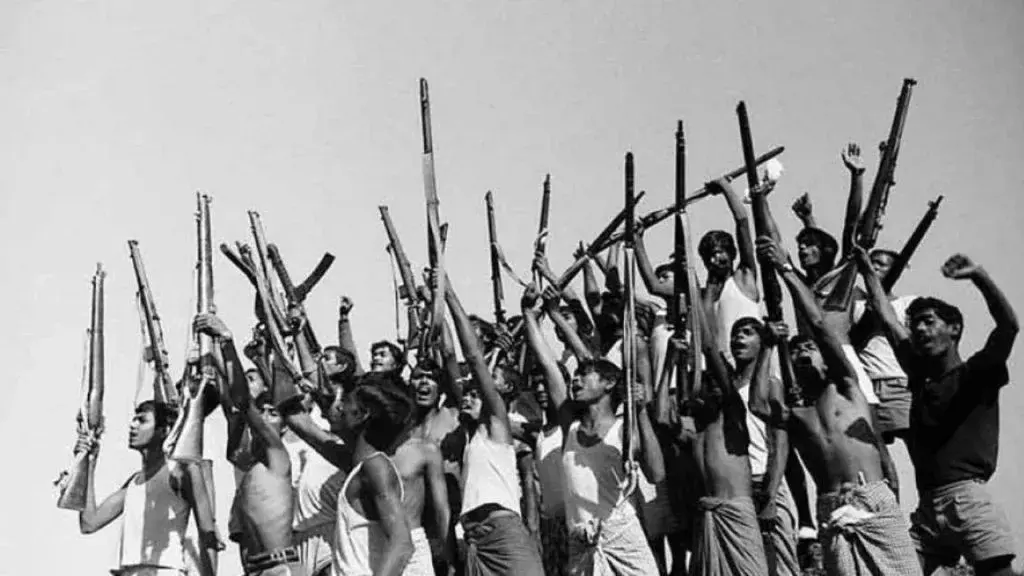
In Bangladesh, there are differences over the idea of Bangladesh. The vision and role of Sheikh Mujibur Rahman and his Awami League are disputed. So is the part played by the mutiny in the East Pakistan regiment led by Major Ziaur Rahman in 1971. The role of the Mukti Bahini guerillas and the part played by the Indian military in the final stages of the liberation movement are either highlighted or brushed under the carpet. The part played by the actions of the Pakistani military from March to December 1971 which led to the armed revolt is either given prominence or ignored.
The issue is further complicated by the clashing narratives emanating from India and Pakistan. The official Indian view is that Bangladesh got its independence due to the Indian military’s intervention to stop the Pakistan army’s brutal attacks on civilians in East Pakistan. The Indian strategic perspective is that India’s intervention was a geopolitical masterstroke to cut traditional rival Pakistan into two. The Pakistani view is that the entire freedom movement in East Pakistan was a conspiracy by India conjured up with the assistance of the Awami League and that the “genocide” allegedly committee by the Pakistani army was a gross exaggeration.
Bangladeshis have shown a manifest tendency not to openly acknowledge the role of the Indian military. Instead, they give credit to the mass uprising against discrimination by West Pakistan and the brutal attacks on East Pakistani civilians by the Pakistan army. Indigenous freedom fighters, including the Mukti Bahini guerillas, are portrayed as the vanguard of a peoples’ struggle.
Those sympathetic to the Awami League attribute the attainment of independence to their party and its leader, Sheikh Mujibur Rahman and also a long line of Awami Leaguers like H.S.Suhrawardy. As per the sixth schedule of the Constitution of Bangladesh, the text of Mujib's telegram by Major Ziaur Rahman on March 26, 1971 stated the following – “ This may be my last message, from today Bangladesh is independent. I call upon the people of Bangladesh wherever you might be and with whatever you have, to resist the army of occupation to the last. Your fight must go on until the last soldier of the Pakistan occupation army is expelled from the soil of Bangladesh and final victory is achieved.”
But supporters of the Bangladesh Nationalist Party (BNP) point out that it was the BNP’s founder-leader, Ziaur Rahman, who actually led a mutiny in the East Pakistan regiment after reading out Mujib’s March 26 telegram over Chittagong radio station.
“This is Swadhin Bangla Betar Kendra. I, Major Ziaur Rahman, on behalf of Bangabandhu Sheikh Mujibur Rahman, hereby declare that the independent People's Republic of Bangladesh has been established. I call upon all Bengalis to rise against the attack by the West Pakistani Army. We shall fight to the last to free our motherland. By the grace of Allah, victory is ours,” Ziaur Rahman said.
Different Visions
The difference between the Awami League and the BNP was seen in their respective visions of a free Bangladesh. The Awami League envisaged a secular Bangladesh based on “Bengali nationalism” over-riding the Hindu-Muslim divide. It also sought close friendship with neighbouring India. But the BNP believed in “Bangladeshi nationalism” based on its Islamic character in contrast to Indian Bengal. To the BNP, Bangladesh could not be unhinged from Islam. Ziaur Rahman’s notion of Bangladesh also meant ideological and political autonomy from India.
The Bangladeshi religious right wing represented by the Jamaat-i-Islami, Hafazet-i-Islam and other Islamic groups see the separation of East Pakistan from West Pakistan as a betrayal of the concept of Islamic unity. These parties valued the religious bond with Pakistan and saw the liberation movement as a sell out to “Hindu” India. An independent Bangladesh was anathema to them.
Of course, the Islamic parties now accept Bangladesh but as a fait accompli. They now justify their existence in the national space by propagating the idea that Bangladesh can be a strong, independent and just society only if it is run in accordance with Islamic principles. The Islamic parties believe that resistance to the “all absorbing Hindu India” will be possible only if the government in Bangladesh is truly Islamic.
In the context of the anti-India feelings that came to the fore in Bangladesh following the 2024 mass movement against the pro-India Sheikh Hasina’s government, the Islamic parties’ campaign for a clear anti-India stand is gaining acceptance. A recent opinion survey conducted by the Bengali daily “Prothom Alo” found that 65% of the respondents held a favourable view of the Jamaat-i-Islami, the vanguard of the Islamists. The Jamaat-i-Islami does not celebrate Bangladesh’s independence day though of late, it has made some attempts to deny that it is anti-liberation.
Every political group is agreed that December 16 ( the day in 1971 on which the Pakistani army surrendered to the Indian army) cannot be deemed “independence day” because it would take away the credit from indigenous freedom fighters like the Mukti Bahini guerillas. But December 16 is commemorated as Victory Day (Bijoy Dibosh).
It is March 26, that is deemed to be Bangladesh’s independence Day because it was on this day in 1971 that Sheikh Mujibur Rahman gave a clarion call for the fight for independence.
December 6 is observed in India as “Maitri Diwas” to mark the day in 1971 when India officially recognised Bangladesh as an independent country and became the first country do so. Maitri is a Sanskrit word for empathy and trust. But Maitri Diwas is purely an Indian event.
However, throughout December, various places in Bangladesh observe “Bijoy Dibosh” separately depending upon when the local freedom fighters drove the Pakistani army units out. Public meetings and processions are held with the participation of political parties and even local government officials.
Josim Ahmed, acting editor of the “Daily Times of Bangladesh” had recently written a piece highlighting the possible consequences of the absence of a unified national narrative about the country’s nationhood. He points out that the issue is complicated by the clashing narratives propagated by the armies of two foreign countries- India and Pakistan.
For the Indian army, Bangladesh’s independence signals an Indian military victory against Pakistan. And the Pakistani army portrays its soldiers implicated in 1971 atrocities as “heroes” who had fallen while doing the right thing to smash separatism.
However, Bangladesh’s own political forces, including the Yunus government, are largely silent on the issue. Ahmed attributed this to two factors - tactical caution and indifference to the country’s own national narrative. He says that the lack of a public political response is due to “geopolitical considerations” outweighing “memory politics”.
Bangladesh’s evolving engagements with Pakistan — spanning economic exchanges and nascent security dialogue — may be at the bottom of the caution, Ahmed says. Simultaneously, commenting on India’s military involvement may have its own geopolitical and domestic costs. A positive comment on India’s role in 1971 might please India but alienate the emerging anti-Indian sentiment at home, he explains.
Because of the limited investment in independent research on the freedom movement, a common narrative has not emerged and in its absence, the masses are confused and political actors find it more convenient to remain silent, Ahmed says. He fears that future generations of Bangladeshis may inherit an understanding of 1971 shaped less by Bangladeshis themselves than by competing regional powers. The absence of a unified narrative on the independence movement could weaken Bangladeshis’ ability to face challenges mounted by local and external forces, he warns.
END
RELATED NEWS
View all

Current Affairs
Sri Lankan Presidential pardons- the good and the bad
Sep 11, 2026
Current Affairs
The pros and cons of joining BRICS- the dilemma of Pakistan and Bangladesh
Sep 09, 2026
Current Affairs
Disaster in Nepal gets embroiled in geopolitics.
Sep 08, 2026
Current Affairs
Why Mecca Pact, and what does it imply for its members, Israel and India?
Aug 18, 2026