Politics by Vishvanath, Cover Story
Conflicting signals fuel speculation about dissent in govt. ranks
By Vishvanath
The government’s decision to shelve its education reforms partly has not yielded the desired results. It was aimed at ending protests by other key stakeholders, particularly teachers and principals. The protesters are demanding that the education reforms be ditched, lock, stock and barrel urgently. Claiming that they are not against education reform per se, they have said they are opposing the government’s reform agenda due to serious flaws in it and the haphazard manner in which it is being implemented. They have highlighted various deficiencies in the newly crafted learning modules in addition to an adult website link in the Grade 06 textbook.
The education reform dispute took a dramatic turn on Monday, with Deputy Director General of the National Institute of Education (NIE), Darshana Samaraweera, being sent on compulsory leave over the Grade 06 module issue. Two other NIE officials have been suspended. Earlier Director General of the NIE Prof. Manjula Vithanapathirana stepped down temporarily pending an internal investigation and a probe by the CID.
The Ministry of Education has announced the suspension of the distribution of the module at issue. The Opposition is demanding that the cost of printing the module, amounting to about 60 million, be recovered from those responsible for the textbook fiasco.
The government has been sending conflicting signals about its decision to put on hold Grade 06 reforms. Some of its parliamentary group members, especially ministers, are not speaking about the Cabinet decision, with one voice. They are expressing different views, with some of them demanding that the education reforms be implemented no matter what. Their stance runs counter to the principle of collective Cabinet responsibility. The government has officially announced that its decision to postpone the Grade 06 reform was made by the Cabinet headed by President Anura Kumara Dissanayake.
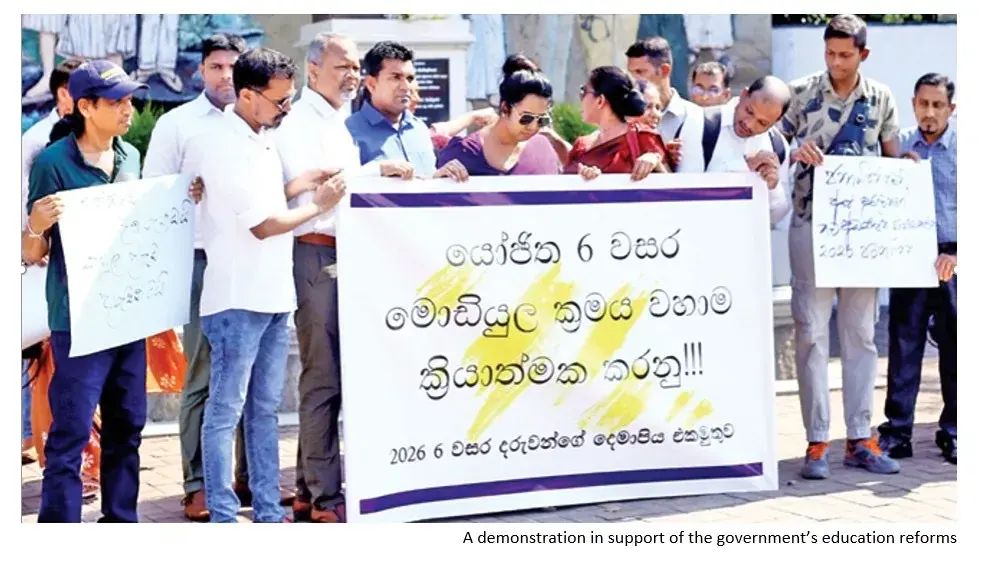
Meanwhile, protests have sprung up in different parts of the country against the partial deferral of the education reforms. Groups of protesters, claiming to be concerned parents with no political affiliations, are demanding that the Grade 6 reforms be carried out urgently. They have taken exception to the government decision to postpone them. The Opposition has pooh-poohed these protests as events scripted by the government. Some Opposition members have even claimed that the pro-reform demonstrations indicate a rift between the NPP and the JVP, with the supporters of Prime Minister Harini Amarasuriya defending education reforms and protesting against the decision of the JVP-dominated Cabinet to shelve them partly. The narrative about a rift in the government may be taken with a pinch of salt, but the pro-reform demonstrations smack of a government propaganda move. One group of demonstrators has given up their protests after handing over a petition to the President’s Office.
Why should the government organize protests against its decision to postpone part of its education reforms? There are three possibilities. The government is trying to mobilize public support for implementing the education reforms; it is on a campaign to turn public opinion against its trade union rivals and the Opposition. It is also possible that a section of the ruling coalition, unable to stomach the government’s about-turn, is all out to have the education reforms carried out and deny victory to the Opposition and other stakeholders.
It defies comprehension why the government undertook to reform the education sector, which is in a big mess, at a time when its focus should remain on the economic front, where it has numerous issues to contend with. Foreign currency reserves have to be shored up, and the difficult economic targets set by the IMF met while adequate funds are allocated to cover ever increasing recurrent expenditure. The post-Ditwah rebuilding and relief programs have made the situation far worse. They are expected to cost the country USD 3-5 billion.
Reforming the education system is a long process and requires the participation of all key stakeholders for it to reach fruition. The government in its wisdom made haste and sought to accomplish the task on its own. The Opposition has claimed the government is under pressure from the international lending institutions to introduce education reforms. There has been foreign funding for the education reforms, but the claim that the government undertook to reform the education system as part of the current bailout program has yet to be substantiated. If there had been no external pressure, the government should not have prioritized education reforms over other tasks; it could have introduced them in a systematic manner with the concurrence of other stakeholders, who are currently on the warpath.
The government would not have been in this predicament if it put its education reform program on hold at the first sign of trouble and invited all stakeholders to talks and taken their views on board. By rushing to reform the education system it has provided its political rivals with a fresh rallying point, albeit unwittingly.
RELATED NEWS
View all
Politics by Vishvanath
Has 22A become the govt.'s Catch-22?
Aug 27, 2026
Politics by Vishvanath
22nd Amendment: A huge political gamble for govt.
Aug 21, 2026
Politics by Vishvanath
Move to raise retirement ages of judges: Options before govt.
Aug 05, 2026

Politics by Vishvanath
‘Cockroach’ uprising and echoes of Aragalaya
Jul 26, 2026